Меню
Соціальні мережі
Розділи
April 6, 2026, 6:50 p.m.
The Guru of World Populism: A Political Portrait of Viktor Orban
This article also available in English1

PHOTOS: 1tv.com.ua
He started out as a young democrat who wanted to free his country from Soviet influence as soon as possible. When he won the election for the first time, he welcomed Hungary's accession to the EU and NATO. But today, everyone knows him as an autocrat, an enemy of free media and fair elections. He is Putin's most important partner, and his minister calls Lavrov after closed-door meetings of EU foreign ministers.
Viktor Orban has been prime minister of Hungary since 2010. And he is perhaps one of the few politicians who has radically changed his views and rhetoric over these 16 years. He is one of those who, in the words of former New York Times CEO Mark Thompson, "sells politics like laundry detergent." Orban has shown that specific ideas do not matter. What matters is that they incite the crowd. That is why he can be called the guru of global populism. Of course, he is not the only one, but his example is being studied by extreme right-wing politicians in the United States and the EU. And they use his recipes to come to power. Orban led his country before Trump did, who in 2010 was just inventing his modern aggressive political style. And such epoch-making events as the 2016 US elections, Brexit, and the storming of the Capitol in 2020 were communicated according to a model that was developed much earlier for Orban. Post-truth, alternative facts, polarization, irritation, populism... All of these contemporary phenomena have, so to speak, a Hungarian trace.
Viktor Orban may evoke different emotions in us, but he is still a prominent and exemplary figure in contemporary politics. Yes, his methods are often unethical, but they are also effective in the modern digital environment and an unstable world. Let's create a political portrait of the Hungarian prime minister to understand why people choose such politicians and how these politicians change our societies and communication.
Orban, Fukuyama, and the "politics of irritation"
After the collapse of the Soviet Union, most philosophers agreed that we should expect a surge in democracy. However, in 2005, one of the most famous human rights organizations, Freedom House, began to record a decline in the level of freedom, a trend that continues to this day. In 2008-2009, due to the global financial crisis and then the debt crisis in Greece, a large number of people in Europe lost their jobs, money, confidence in themselves and in the future. The Russian-Georgian war of 2008 showed that the West is not always able to protect its allies. The situation continued to deteriorate. The Arab Spring (a series of revolutions in the Middle East and North Africa in 2010-2011), although in some cases contributing to the change of authoritarian regimes, also caused the spread of instability, civil wars and large-scale migration. In addition, the American fight against terrorism in Afghanistan and Iraq has led nowhere, only further fueling extremist sentiment.
In this world full of injustice and anxiety, people began to wonder why things had suddenly become so bad in my life, when yesterday nothing had predicted trouble and experts had promised prosperity. We needed someone who could integrate people into the new social and economic realities, or someone who would point out to disillusioned people who was responsible for their misery. Viktor Orban, like many other populists and autocrats around the world, felt these sentiments well and chose the second option: to offer society an insidious enemy and a story of a lost paradise.
Orban, Trump, and Putin are basically telling their voters the same story: we had a great country, everyone respected us, but migrants/democrats/banderites came and took our country, trampled on our dignity, and want to destroy us and our identity. This explanation worked. Believing in the fictitious threat and feeling irritated and dissatisfied, people rallied around the leader. This is how the country is led by people who are ready to do anything for power.
What if democracy is not for sale?
Viktor Orban has been in Hungarian politics since the country broke free from Soviet control. In 1989, he delivered a speech at the reburial of Imre Nagy, the prime minister of the 1956 Hungarian uprising. At the time, the young Orban advocated the introduction of free elections, loyalty to the ideas of the 1956 revolution, and the immediate withdrawal of Soviet troops.
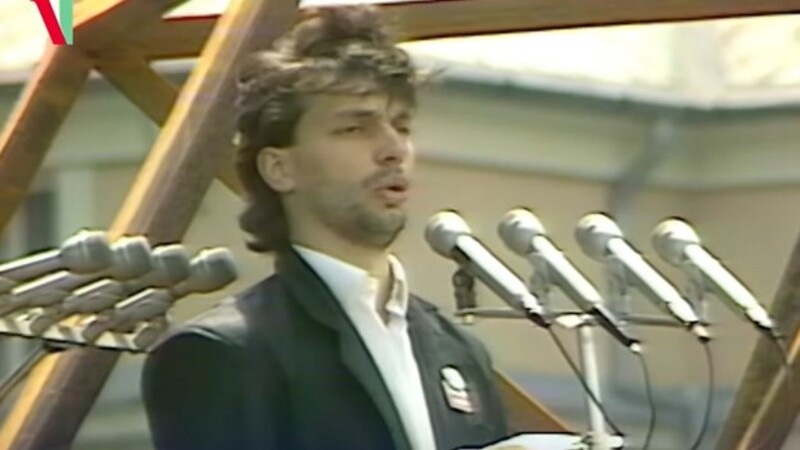
Viktor Orban on Heroes' Square in 1989 demanding the withdrawal of Soviet troops. PHOTO: tvpworld.com
At that time, the Fidesz party, or the Alliance of Young Democrats, was already in existence, which Orbán founded with his friends. In 1990, they participated in the elections and even won 22 seats in the parliament. But this was not enough for the political ambitions of the young democrat, and he began to look for ways to win the hearts of voters.
First, he abandoned his style: "No" to long hair, beard, jeans. After the party failed to win a significant number of votes in the 1994 elections, Orban began to move towards conservatism: national traditions, devotion to the homeland, family, middle-class values, and religion. After 11 years of marriage, Orban and his wife were married in a church.
And in 1998, the Fidesz party received the largest number of votes (almost 30%) and already had 148 seats. However, this was due not only to Orban's conservative stance, but also to a corruption scandal and unpopular reforms of his predecessors. The politician became the youngest prime minister, and in 1999 Hungary became a NATO member under his rule. The following year, the EU agreed to Hungary's accession, and in 2004 it became a member of the Union. However, Fidesz failed to win the 2002 and 2006 elections. It was only in 2010 that the party became a triumphant winner, gaining a majority (52.73%) amid another corruption scandal and financial crisis. At that time, Orban's political rhetoric was quite moderate. The slogan of the campaign was "Itt az ido!" - "This time has come!"
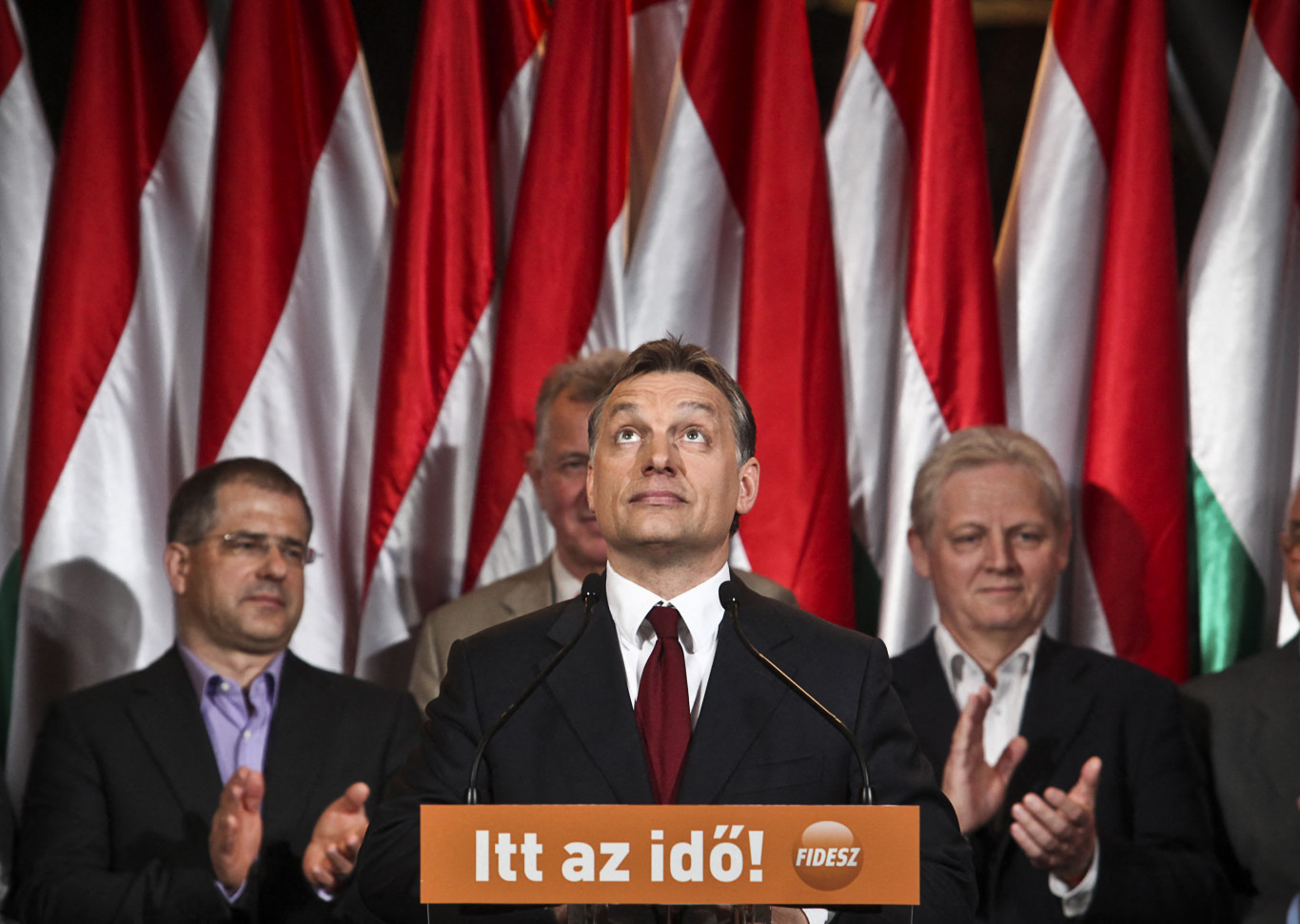
Viktor Orban's speech in 2010. PHOTO: ici.radio-canada.ca
"Today, Hungary has reaffirmed its commitment to democracy and its place in Europe and the European Union," he said in April 2010, on the eve of the second round of elections. However, it turned out that Orban was only paying lip service to democracy. Having gained a majority in the parliament, he was able to change the laws in such a way as to remain in power for as long as possible. He could change the constitution, suppress the media, control universities and bureaucrats. However, laws alone were not enough. A fundamentally different rhetoric was needed to ensure a majority in the next election. This is what Orban's turn to the far right is associated with.
At the same time, right-wingers around the world are making a similar choice. It is becoming increasingly difficult for conservatives to attract the attention of voters amid general liberalization. In addition, more and more people simply do not go to the polls and are not interested in politics. So the question arises: how exactly to motivate them?
Trump, with his aggressive attacks, global warming denial, misogyny, and racism, has suddenly become a lifeline for Republicans. In the world of social media, his offensive posts go viral. The echo chambers of social media amplify the effect, polarizing and radicalizing supporters of one point of view or another.
When Orbán won the election, the Movement for a Better Hungary (Jobbik) party also took part in the election. It was this party that professed nationalism, anti-Semitism, and spread conspiracy theories. The party called for the creation of Hungarian autonomy in the Transcarpathian region, opposed the elites of the "corrupt" European Union, and tried to incite hostility between the Hungarian and Roma populations. Politicians of this party called Israel a "Nazi system based on racial hatred" and acted as "observers" from the so-called DNR/LNR and in Crimea. Over time, Orban adopted the main tactics of the far right: to look for enemies, to divide, to incite... He also adopted some messages. "Jobbik, on the other hand, began to gravitate more towards centrism, lost popularity, and many of its representatives withdrew their candidacies in favor of Tisza in the 2026 elections.
Orban and social media
What was Orbán's rhetoric on the eve of the election? Let's take a look at his Twitter account / X. Here is a politician in a simple quilted jacket speaking in the rain to the public. "As long as I'm here, no one will hurt you," the caption reads. The implication is that if I'm not here, you will be left defenseless in this scary world where everyone wants to take advantage of you.
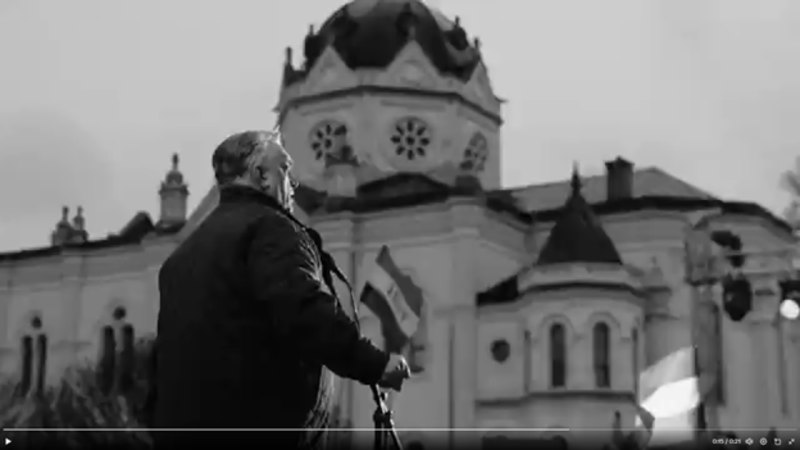
SCREENSHOT: video from Viktor Orban's personal page on the X network.
For example, Brussels is raising oil prices, but Orban will do everything to ensure that "Hungarian families, businesses and farmers" are protected. And here is Zelenskyy, who is blackmailing Hungary. He wants to sow chaos and influence the elections. It was through Hungary that he transferred millions to pay Europeans and Americans to support the war. It was he who made the country a testing ground for his own special services, and his agents infiltrated the opposition party Tisa. The Hungarian money will be transferred to Ukrainians if a pro-Ukrainian government is suddenly formed. Only Orban will be able to deal with Brussels and Zelensky.
"Two forces are pitted against each other: those who are for war and those who are for peace. One side puts Ukraine first, the other puts its own people first. We will not give up. We will not be dragged into a war that is not ours," Orban writes in X. Creating vivid images is a classic of the populist genre. Let these images be so horrifying that frightened people do not demand proof, but want only one thing - a wise defender who will avert the threat.
Let's now look at the word cloud generated from Viktor Orban's tweets over the past five months (349 posts in total). The top three words: Hungary, war, and Ukraine. The top twenty also includes a couple of Orban's enemies: Brussels and migration. Much attention is paid to the topics of energy and oil, as it is Brussels and Ukraine that "prevent" Hungarians from taking advantage of cheap Russian resources.
Word cloud based on Viktor Orban's tweets on the X network
Renowned authoritarianism researcher Anne Applebaum drew attention to another popular social network, TikTok, where the Hungarian authorities are creating a "post-realist campaign." "An AI-generated version of Volodymyr Zelenskyy, the Ukrainian president, sits on a golden toilet, counting money, snorting cocaine, and giving orders to a Hungarian soldier. You can also find an AI-generated Peter Magyar, the leader of the Hungarian opposition, saying that he is perfectly happy to hand over Hungarian factories to foreigners. The main thing is that he leads the country," the researcher writes. It seems that the election campaign has never been so far from reality.
"If I'm hit once, I'll hit back twice as hard"
In his book Orban - Europe's New Strong Leader, Austrian journalist and political commentator Paul Landwei analyzes the politician's biography. Viktor Orban comes from a very poor family. As a child, he worked in the fields. He said that he had constant problems with discipline, his father beat him. "Throughout his youth, his short compulsory military service, and his university years, his principle remained unchanged: if I was hit once, I would hit back twice as hard," the author of the book writes.
It is probably this principle that led the young democrat, a supporter of the withdrawal of Soviet troops from Hungary, to where he is now - to fictional golden toilets, spy scandals, attacks on the opposition, and friendship with Russia.
But how will his story end? Authoritarian leaders from Putin to Trump and the European far right are expressing support for him. For them, Orban's defeat will be very painful.
If Orban wins, his campaign can be used as a model. "This could be the future of electoral politics: multiple politicians from different countries bombarding their electorate with propaganda to induce terror about an enemy that doesn't really exist," writes Anne Applebaum. Posters and videos generated by AI will compete with each other. And the politician who tells the most vivid story will win.
However, the defeat of Orban and the determination of Hungarian society to change the leader and course of their country may open the way for changes in the EU, particularly in Central Europe. Of course, it is naive to expect that populist politicians will change themselves. Perhaps voters will begin to change, realizing that the inability of citizens to recognize simple political manipulations and the desire to take out their anger and frustration on fictional enemies can cost them and their country very dearly. After all, preparations for a fake war with Ukraine are unlikely to help adequately defend against the real enemy of a free Europe - Russia and Vladimir Putin.
Наталія Стеблина