Меню
Соціальні мережі
Розділи
March 9, 2026, 6:53 p.m.
Communities in exile: how local budgets work in the temporarily occupied territories
This article also available in English6

IMAGE: probudget.org.ua
When a community is fully or partially under occupation, a logical question arises: why does it need a budget and administration if it does not control its territory? This is the question that is often asked today about communities in Luhansk, Donetsk, Zaporizhzhia, and Kherson oblasts. The expert team ofthe Budget in Exile 3.0 project has prepared an explanation of this issue.
Why communities without territory continue to receive funding
After the full-scale invasion, thousands of people left their hometowns and villages, businesses relocated, and local taxes virtually disappeared. While tax revenues were the main source of community income before the war, most of the budgets of the temporarily occupied communities are now formed mainly by state transfers.
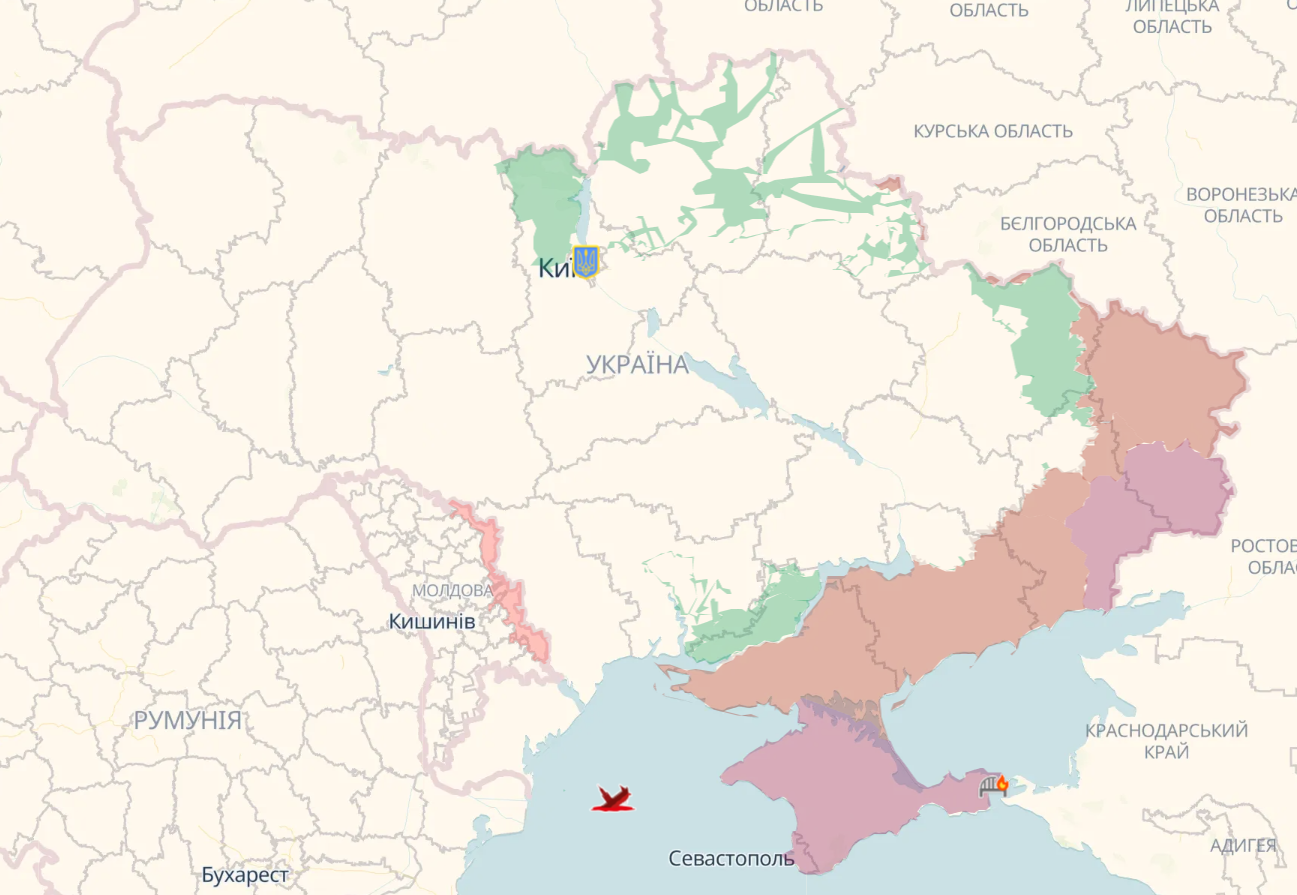
Map of the temporarily occupied territories. IMAGE: Deep State
Because of this, society is increasingly asking whether communities in exile are turning into formal structures that require budgetary funds to maintain, while these resources, according to critics, could be used to support the defense forces or help internally displaced people.
However, for the communities themselves, the issue looks different. Budget and administration are a way to preserve the community as an institution even when its territory is temporarily lost. In 2014, such a mechanism did not actually exist, and some of the communities that were under occupation at the time were left without governing bodies outside their territories. This experience became one of the arguments for preserving communities in exile after 2022.
"If there is no budget, there is no community as a subject. We have to keep the management structure, data on people, property, and losses, so that we can start rebuilding in the future," explains the head of the financial department of one of the temporarily occupied communities.
The "survival budget" regime: what the funds are actually spent on
Today, the budgets of communities whose territories are under temporary occupation are actually operating in the "survival budget" mode. The main expenditures are directed to basic management functions, salaries for education and social workers, and maintaining communication with community members who now live in different cities of Ukraine and abroad.
At the same time, communities in exile perform other important functions. They maintain population registers, document destruction and damage, collect data on the needs of residents, and keep in touch with people who remain part of these communities even when they are away from home. This work is also important for future recovery, as it is communities that accumulate data on the loss of property, infrastructure and housing, which can later become the basis for reconstruction and compensation programs.
"A community is not just a territory. It is people. And even when a city or village is occupied, the community must remain organized and work for its residents," says one of the heads of military administrations.
Experts emphasize that preserving communities in exile does not mean preserving pre-war administrative structures. The reality has changed, and the governance system needs to be adapted.
Time for change: a new model of governance in exile
For example, if a community establishes humanitarian or administrative hubs for its residents in different cities of Ukraine, such centers should be integrated into the official structure of the military administration. If relocated hospitals or educational institutions continue to operate, the respective departments should remain and ensure their activities.
However, in areas where actual operations are currently not possible, such as capital construction, road repairs, landscaping, or infrastructure maintenance, structures should be reviewed and reorganized in accordance with the actual functions of the community.
"Communities in exile need a new model of governance: more compact, more flexible, and focused primarily on working with people. Preserving pre-war structures without adapting to new conditions does not meet the real needs of communities," note the experts of the Civil Partnership "For Transparent Local Budgets!".
Therefore, the main question today is not whether communities in exile are needed. It is important to understand what their role and structure should be under the conditions of prolonged occupation.
First of all, it is important that the administrations actually work for people: keep in touch with community residents, help where possible, and preserve the community as a community even when its territory remains under occupation.