Меню
Соціальні мережі
Розділи
Oct. 20, 2025, 10:14 p.m.
Small hromadas of Odesa Oblast: councils approach the 5th anniversary of their powers with what composition
This article also available in English250

Photo: https://euromaidanpress.com/
On October 26, 2025, regular local elections were supposed to be held in Ukraine, but due to the full-scale invasion and the legal regime of martial law, it is impossible to hold them. With this in mind, on October 8, the Verkhovna Rada adopted a resolution confirming the continuity of the work of local councils and community heads.
Until sustainable peace is established, local councils should be fully operational and meet the needs of citizens. The most vulnerable in terms of functionality are small communities - those with up to 10,000 voters (as of 2020) and elected deputies by the majority system. In such communities, deputies who resign early can only be replaced through midterm elections, but this procedure is blocked in the context of war.
At the same time, ensuring the sustainable functioning of local self-government and the full-fledged work of local councils are among the priorities of the Roadmap for the Functioning of Democratic Institutions, the implementation of which is necessary for Ukraine's accession to the EU.
Read about the current composition of local councils in Odesa region and how the war affected the early termination of deputies' powers in the material of the Civil Network OPORA. The full study is available here.
Powers of councils: the realities of today
In Odesa Oblast, there are 50 communities whose deputies were elected by the majority system. OPORA collected data by sending requests for access to public information as of September 5, 2025. It is worth noting that responses from Zakharivka and Shyriayivka village councils have not yet been received, and Plakhtiyivka village council provided incomplete information. Thus, we have analyzed the activities of 47 communities' self-government bodies.
Local councils of small communities usually consist of 22 deputies. Reducing the number of members below half (less than 11 deputies) is considered a critical level, as in this case the council cannot make decisions.
As of the end of the fifth year of the term, we have not recorded any mass resignations. The number of councils is currently sufficient to make decisions, and all of them held meetings in August-September 2025.
About 77% of the analyzed councils (37 communities) continue to function in almost full strength - 20 or more deputies. Almost 17% of the councils (8 communities) are composed of 17-19 deputies.
Only two communities - Lymanska and Novoborysivska rural communities - have 16 active deputies, and in Velykobuyalytska village council their number has decreased to 15.
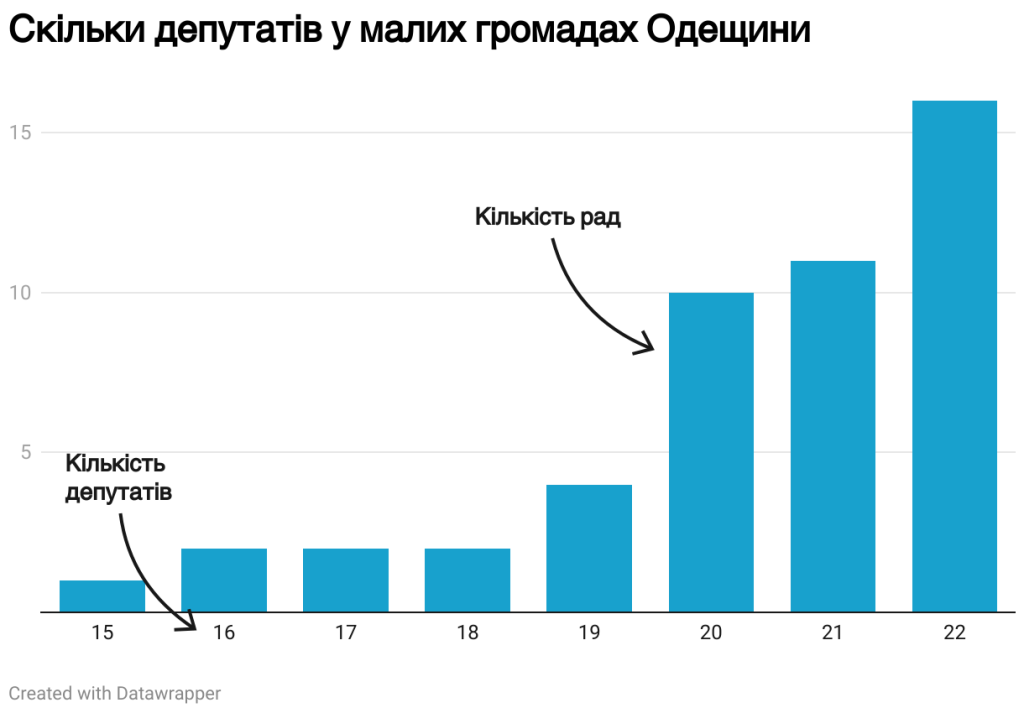
Number of deputies in small communities of Odesa Oblast. Infographic - OPORA
Although formally the composition of many local councils remains full, the actual participation of deputies in plenary sessions indicates a deterioration in the functionality of representative bodies. In some communities, the average attendance of sessions is significantly lower than the official composition of the council.
For example, in the Teplodar city community, OPORA was informed that no deputy has officially resigned. At the same time, one deputy is serving in the Armed Forces of Ukraine, one is missing, and four others are abroad. According to the minutes of the council meetings, in 2025, 6 deputies did not attend a single meeting, and the average attendance was only 14 out of 22 deputies.
The situation is similar in the Ivanivska settlement community, where only one deputy officially resigned his mandate. However, the average attendance at the sessions was 17 deputies. Two elected representatives did not attend a single meeting in 2025.
As we can see, the legal preservation of the full composition of the councils does not mean their real capacity. Some deputies miss meetings for objective reasons, such as service in the Armed Forces, illness, or traveling abroad, but subjective factors also have an impact: low motivation or political irresponsibility. Taken together, this creates risks for the proper functioning of the councils and may make it difficult to ensure a quorum in the future.
How the war is changing councils
In total, 6.8% of deputies in small communities in Odesa Oblast - 70 deputies out of 1029 elected in 2020 - have terminated their powers. However, not only the number is important, but also the reasons and chronological trends of these cases.
In particular, since 2023, the rate of termination of MPs' powers has increased significantly. While before this year, almost 13% of the total number of those who resigned their mandate terminated their powers, since 2023, it has already been 87%. The largest number of resignations occurred in 2024 - 35% (25 cases).
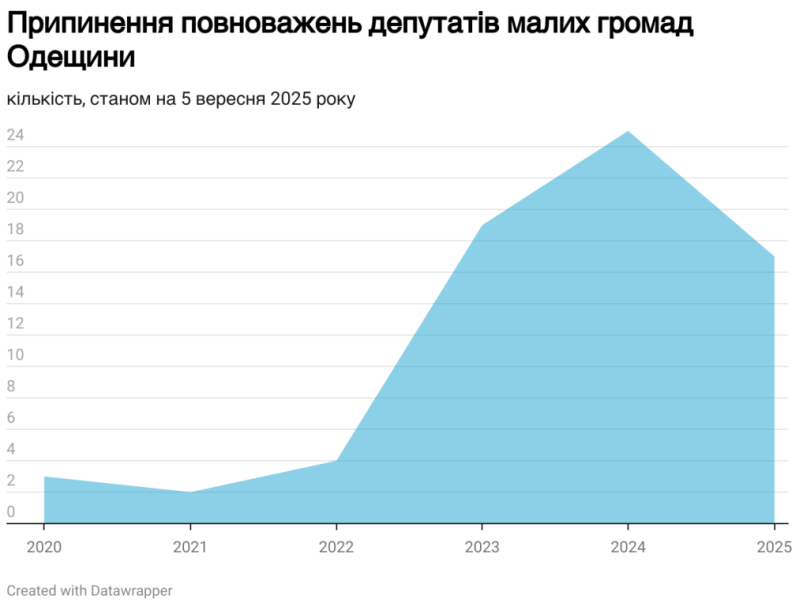
The number of MPs who terminated their mandate. Infographic - OPORA
Such dynamics may be explained, in particular, by the fact that in 2023 the Cabinet of Ministers of Ukraine changed the Rules for Crossing the State Border, limiting the departure of local council members (including women) to official business trips. This decision may have further encouraged some local councilors to resign, especially given that their work is unpaid. In the pre-war years, the main reasons for resignation were usually appointments to incompatible positions, such as starostas.
In 2025, women MPs, except for those who are local government officials, were allowed to travel abroad. This decision may have a positive impact on women's desire to stay in politics. At the same time, male MPs remain restricted in this right, including those who are generally allowed to cross the border - those with many children, over 60 years of age, people with disabilities, etc.
In terms of gender, men predominate among those who have resigned - 60% (42 MPs) against 40% (28 women). This is due, in particular, to the higher mortality rate among men, including at the front. Since the beginning of the term, 22 deputies from small communities in Odesa Oblast - 18 men and 4 women - have resigned due to death.
The most common reason for termination of deputy powers was a personal statement - 66% of the deputies (46 people) who resigned their mandates used it, with equal numbers of men and women. Two more terminated their powers due to traveling abroad.
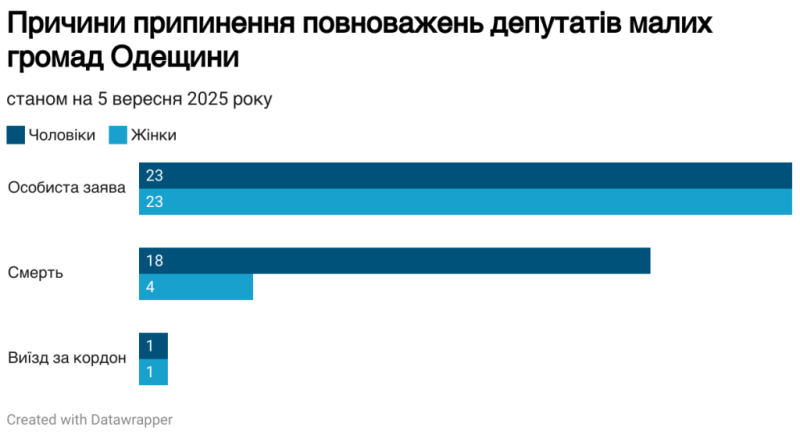
Reasons for the termination of MPs' powers. Infographic - OPORA
However, in many cases, it is extremely difficult to determine the true motives for resignation, as various reasons may be hidden behind a personal statement. In unofficial communications, community representatives noted that some MPs submitted such applications due to mobilization or intention to go abroad. Other common reasons for resigning were family circumstances, health conditions, or retirement.
*****
Despite all the challenges, the local councils of Odesa region continue to work with the authorized composition, retaining the ability to make decisions. However, recent trends point to the need to ensure a legal mechanism for the continuity of local self-government that will guarantee the stability of communities in times of crisis.
The number of local councils will gradually decrease both due to natural causes and the impact of the war. The five-year term limit has become just a kind of rubicon, and local councils can serve for a long time.
In times of crisis, military administrations can take over some of the administrative powers. However, such restrictions must be justified and take into account the public interest.
Дмитро Баштовий
Костянтин Донченко








