15 June 2026, 18:42
Volodymyr Yeskiliev: “We shouldn’t turn Ukraine into a mini-empire”
Ця стаття також доступна українською
Are there any exclusive clubs in Ukraine that actually influence the architecture of the future? Why has modern politics turned into a theater where the roles of playwrights and actors are clearly defined? Writer Volodymyr Yeskiliev is convinced: attempts to turn Ukraine into a copy of the Soviet or imperial model are doomed to fail, because our strength lies in poetry, fatalism, and healthy anarchy.
In an exclusive interview, we discuss: the meanings of a new sincerity, intellectual trends, and ideas that won’t let us rest; why the space opera "Farenho" was ahead of its time and whether AI is capable of sovereign creativity; what is the main threat posed by the combination of the will to power with cyber technologies; the danger of political theater and the urgent need to preserve platforms for public dialogue.
You identified the main traits of Ukrainian identity as poeticism, fatalism, and anarchism. Which of these traits saves us today, and which, on the contrary, hinders us?
I think there are even more traits to list. I focused on these three traits, probably because there wasn’t time to discuss more of them. Undoubtedly, Ukrainian identity is based on a much larger number of different markers. As for what is generally helping us survive, I think that the poeticism and fatalism, as well as a bit of the anarchism, that we possess are helping us right now.
I travel around Ukraine, through the eastern and southern regions, and I see how people perceive the war, these barbaric Russian shellings of peaceful cities. A city that suffers daily from strikes, drones, and missiles, yet a city that lives on, a city that smiles and creates culture—this is, without a doubt, a city of people who are both poets and fatalists, and who have a bit of that anarchic spirit in their heads. And that’s really cool, because that’s life. Ukrainian identity is incredibly vital, life-affirming. It is the identity of people who live on the frontier, on the border, for whom life is here and now, because tomorrow the horde may attack again.
And this sense of the present is very much in tune with the discourse of metamodernism, because it involves this new sincerity, when people say: “Don’t tell me fairy tales, just tell me what you’re going through and what hurts you.” And, in fact, we have a lot to say about what we’re going through and what hurts us, which is why this discourse is very much our own. There will be a lot of Ukraine and Ukrainian culture in the future, because this is where the meanings of this new sincerity are born.
Fantasy is often criticized for escapism. And now, during the war, your space opera “Farenho” is being reissued. Does this indicate a need for that very escape, or a new scale for comprehending reality?
"Farenho" is not fantasy; "Farenho" is science fiction. More precisely, it is space fiction, a space opera. And space fiction differs from fantasy in that cosmic worlds are open. While fantasy worlds tend toward autarky, toward closedness, toward self-sufficiency, the sci-fi world is open. Reptilians or intelligent worms could always arrive from some other planet and turn everything upside down. But in the fantasy world, elves, gnomes, and humans are constantly hanging out on the same land and can’t seem to divide it up. In the end, humans win because they’re more technically advanced, and that’s already techno-fantasy.
But my novel also borrowed a bit from fantasy. I always feel a bit envious when I present myself as a science fiction writer (since I sometimes write detective stories, art house fiction, and much more) that fantasy authors develop their worlds in such detail. These worlds are so meticulously crafted, with all those maps, all those animals, the climate, and the tiniest details of everyday life. But science fiction writers, after all, only started catching up to this during the era of Cameron’s *Avatar*. Before that, sci-fi just sketched out the canvas with a few strokes. Sci-fi writers were more interested in scientific paradoxes or in exploring and outlining some futuristic idea or some form of social engineering, and so on. These worlds weren’t fleshed out in such detail; they weren’t developed deeply. And so I decided that science fiction is worth the effort of fleshing out these worlds. And “Farenho” is a world fleshed out in detail. It is elaborated in detail, much as fantasy authors generally do, rather than science fiction writers.
And that’s why this is a special kind of science fiction; it’s the science fiction of a new era. And, again, it’s postmodern science fiction, because I don’t wrap the future in some rosy wrapping paper of progress and universal happiness. It’s a difficult future, a terrifying future, a cruel future, a dark future—but hope still lives within it all. And this isn’t a story about how we’re all going to die. It’s science fiction about the fact that we will live amid contradictions.
As a member of the jury for many competitions, have you learned to distinguish between texts generated by ChatGPT or Gemini? And have you recognized fragments of your own worlds in the works of young authors?
Look, I’d like to brag and say that yes, I can tell the difference between text generated by ChatGPT and text generated by Gemini or Claude. But in reality, these systems are developing so quickly that, in the end, they’ll probably be the ones laughing, not me. And they’ll be the ones showing off, not me.
I think I could probably tell those early AI models apart, because I’ve read the works and I already know how they’re generated by these systems. But they change and improve every year, and honestly, I can’t say for sure today. Perhaps there are already AI systems that generate something I, as an expert, can’t distinguish.
What is your stance on AI in writing? Is it a path to formulaic writing, or an adequate technical consultant for world-building?
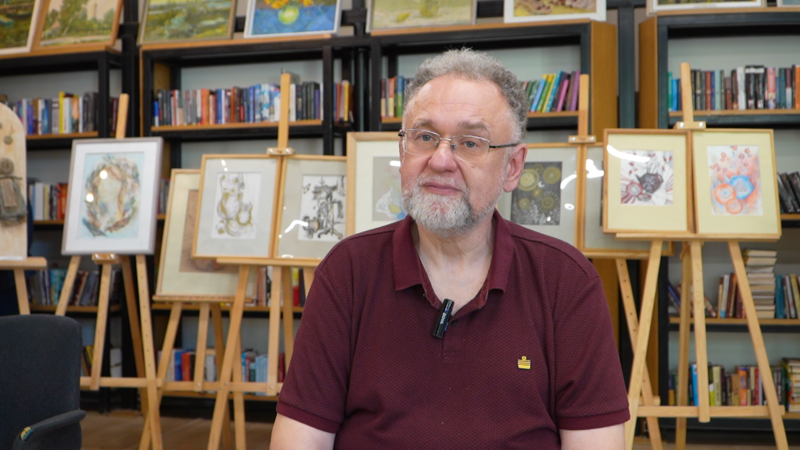
I still have a negative view of this. Why? Because AI is not a sovereign creator. It is a system that generates some kind of synthesized text. The basis for this synthesis is works that have already been written. It is a complex system of indirect plagiarism, so I cannot view this system positively; it is a detriment to literature.
SCREENSHOT: Intenta’s YouTube
As for AI helping someone generate worlds, well, I don’t know. I, for example, generate my own worlds without the help of AI; somehow I manage to do it. But in the future, if writers start using AI in their work, it’s very hard to say what the future will hold. Perhaps there were once writers who said that novels could only be written by hand, that using, say, a typewriter was already a desecration of literary work. They turned out to be wrong. That’s why I’m afraid that when I paint a picture of the future and speak of AI only negatively, I’m afraid of ending up in the role of those writers and repeating the same mistakes. Who knows what the future holds. AI is something that’s constantly evolving. I wouldn’t dare to draw any definitive conclusions on these matters.
You are quite skeptical of the theater’s pursuit of mass appeal, calling it an elitist spectacle for the select few. What is this new “chosen” youth in theater halls like today, if the elites, it seems to me, have dissolved into blogging and financial success?
Throughout history, there have been high-quality reference groups that understood art and supported it—high-quality art of the kind that theater represents. And there were the masses, who were more drawn to high-quality mass spectacles. And even now, more people still go to a rock concert than to the theater. Even if this theater wants to be mass-oriented, even if it produces high-quality mass spectacles, using technology to create some kind of laser show and so on, fewer people will still come there than the hundreds of thousands who attend rock concerts.
I think theaters shouldn’t chase after mass appeal. The point is that if a theater were to take this path of carnival-style spectacle, some genius in this field might manage to gather half a million people for a theatrical performance. But the question arises: what for? Why take away the bread and butter from variety shows, from stadiums, from their shows, when the theater has a different mission?
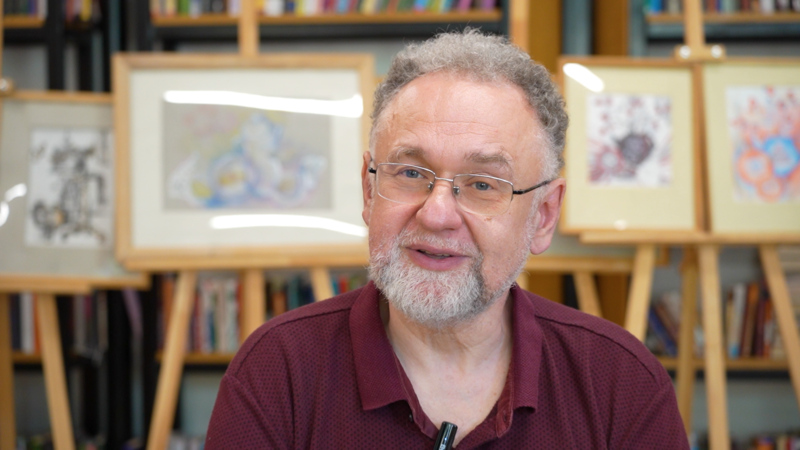
The theater’s task is to bring deep things, deep feelings, to the surface. And in this depth, the theater is now becoming immersive, that is, it breaks down that fourth wall between itself and the audience. It is becoming closer to people not through mass appeal, but through its speed of response to the questions people ask of it. When the theater responds not twenty years later, summing up the era, but when the theater says: “Oh, this phenomenon arose yesterday, and today we’re talking to you about it through the language of theater and trying to understand what lies at the foundation of this phenomenon.” It is theaters like these that fulfill their mission.
SCREENSHOT: YouTube Intenta
And when theater turns into a show… Well, okay, maybe there’s a place for that kind of theater too. But it seems to me that this is just as much a death of theater and its function as, say, the transformation of theater into a museum, when it consciously sets out to preserve certain particularly successful productions of the past and says: “We’ll show you the perfect Hamlet of all time and all peoples, as performed, say, by Laurence Olivier. Or we’ll show you the ideal Rostand, as performed in the era of Sarah Bernhardt.” Well, okay, a theater-museum probably has its place too, but that’s no longer the kind of theater where life is present.
You’ve been researching the topic of Freemasonry and esoteric orders for many years. In your opinion, are there any such closed intellectual or political clubs in Ukraine today that actually influence the architecture of our future, or is all of our modern politics pure, transparent populism?
Well, look, such clubs undoubtedly exist and always will. And in general, all of modern politics has come to resemble a theater, where there are politician-playwrights, politician-directors, but also politician-actors. If back in the nineteenth century someone like Disraeli could be simultaneously a playwright, a director, and an actor in his own political theater, today the roles are divided because the current political landscape has become much more complex. It is very difficult for one person to simultaneously captivate the masses with their charisma, write scripts for the future and party platforms, and manage organizational offices, and so on. In other words, the roles are divided. But those who win are the ones with the most talented actor and the most sophisticated direction.
Do you believe that rampant standardization and unification are signs of the approach of totalitarianism? Do you notice this unification now?
We have attempts at unification, so that everyone has to write only in a certain way, or standardize all urban spaces according to a single template, or stick some monuments and pantheons everywhere for no apparent reason.
Although there are other, more organic ways to honor people’s memory. If this is done, for example, within a single community, people have much more humane opportunities and tools for honoring memory, rather than necessarily building yet another hundred-meter-tall stele or some clunky sculpture and thus mimicking the Soviet era.
I think we don’t need this kind of standardization. We shouldn’t turn Ukraine into a small empire. That’s a dead-end path; our mentality isn’t like that.
Referring to Sartre, you emphasize the need to rediscover humanism. What specifically needs to be done in Ukraine to achieve this rediscovery during the war?
First, we must remain open to all voices and pluralism, resolving issues not by suppressing dissent but through debate, in which the winner is the one who charts the path to the future—the wisest, and the one who speaks for the nation, not for an archaic group trying to preserve the Soviet era or something like that.
We now need to decide many things collectively, because we must reach a consensus. And this is very difficult during a war, because war, by its very nature, requires a commanding voice, requires a unified command, requires unified decisions, for example, regarding armaments or military logistics. But this should be characteristic of an environment where it is useful. And it should not be transferred to an environment where pluralism and diversity are the foundation of that environment’s life. In other words, these things need to be distinguished. It’s complicated.
There are many temptations to apply certain templates to spheres where these templates do not belong. There is a temptation to oversimplify the tools of governance. And that is understandable too, because during a war, people want to avoid having any extraneous issues getting in the way, since the priority is to solve core problems and defeat the enemy. And then certain people appear with their own opinions. This temptation is powerful and understandable, and sometimes I even side with them when the cacophony of voices begins to closely resemble enemy propaganda.
But still, at our core, we must preserve platforms for discussing our problems. Journalism, for example, and public commentary—these are some of those platforms. Thanks to this, we expose corruption. Because where a single opinion reigns and a single command center rules, those in that command center are always beyond criticism. And that shouldn’t be the case.
Is there a book you reread every few years and discover anew each time?
Yes, it’s the short story collections by Jorge Luis Borges.
And finally: what idea has been troubling you lately?
It’s probably the idea of how relevant caste systems are in a technocratic society. Will we experience a new era of caste systems, but this time based on technocratic approaches, technocratic tools, and technocratic social engineering? This idea is troubling me right now, and perhaps it will find its way into my writing.