05 September 2026, 06:52
Iryna Biryukova: "What will happen when the power goes out and there's no internet?"
Ця стаття також доступна українською

Iryna Biryukova. PHOTO: Odessa National Scientific Library
Attacks on printing houses and the destruction of publishers’ warehouses have forced the Ukrainian book market to face a harsh reality. How to replenish collections during a crisis in book publishing, why digitize 19th-century rarities, whether artificial intelligence poses a threat to libraries, and why it is physically impossible to gather and evacuate the 5.5 million volumes of the Odesa National Scientific Library—we discuss these topics with the library’s director general, Iryna Biryukova.
What should a library offer today to remain attractive to people who have round-the-clock access to the internet?
We’ve long since stopped talking about “readers” and started talking about users and visitors. They come for books, lectures, meetings with philosophers, or poetry evenings by lantern light in our courtyard. A library should be a vibrant, multifunctional space without barriers—neither physical nor psychological. Anyone can come with a good idea and bring it to life here. In the digital age, the main challenge for librarians is ensuring the reliability of information. We must serve as a tool that helps people find the truth: this involves media literacy, the ability to spot fake news, and media hygiene. Of course, a librarian cannot know everything—from the depths of Shevchenko’s creativity to the latest applications of artificial intelligence. But we are a hub where connections and knowledge converge. We find subject-matter experts and engage them so that our community receives verified, reliable knowledge.
Should a modern library compete with the internet and artificial intelligence?
The internet is just a tool. It’s as if 50 years ago we were competing with newspapers. The real challenge for us is distorted information behavior. Nowadays, it’s considered easier to ask artificial intelligence a question and get a ready-made answer. But we caution: data sources can be compromised. People must be able to search for information themselves, interpret it, and analyze it. They shouldn’t just take a ready-made answer generated by AI; they need to engage their own logic.
I’m not afraid that libraries will disappear if everyone starts using “chat.” What scares me is something else: what will happen when the power goes out and there’s no internet? Won’t people lose the ability to acquire knowledge on their own, verify it, and communicate in general? When you see hundreds of generated, cloned texts online that are supposed to be from real people, it’s frightening. It’s a new trend that, I hope, will pass once society realizes: there’s no value in this if a person hasn’t contributed their own intellect to the result.
Every day you hear the claim: “The book is dying; young people don’t read anymore.” Who is your main readership today?
When it comes to working with our collections, it’s researchers. Our collection has been growing continuously for nearly 200 years, since our founding in 1829, and it didn’t stop even during World War II—nor has it stopped today. Since the ONNB is designated to receive a mandatory copy of all publications released in Ukraine, its collections are the most comprehensive across all fields of knowledge and are preserved for life. In practice, this means, for example, that a researcher might not find the desired work in the library of a specialized university if the research involves a complex interdisciplinary study or requires a significant chronological depth of the sources being examined, but we are very likely to have it.
As for events—the audience here is significantly younger. These are professionals with higher education and students. Every year, we hold over 200 events. Of course, it’s impossible for the library team alone to organize such a large number of events: partners and volunteers help out.
A prime example of this is the “Great Odesa Book Night” project, which we organize in collaboration with Odesa’s libraries, theaters, museums, and other institutions. Thanks to this collaboration, a vibrant, rich program is created that attracts young people.
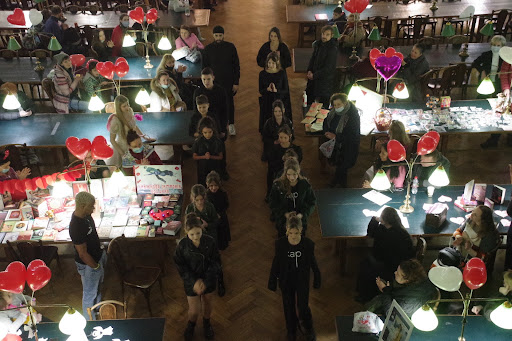
The “Great Odessa Biblionic” event at the Odessa National Scientific Library. PHOTO: ONNB
To capture the attention of the youngest visitors, we create special events. For example, in December we’re launching family tours featuring the Snow Queen. Children are guided through the historic halls, introduced to rare books, and then they work together to create a giant 10-meter-long coloring page. We often involve older family members in organizing such events, because a love of reading is fostered within the family—not through coercion, but through genuine enthusiasm.
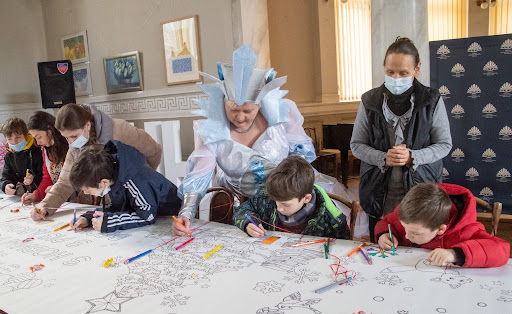
The “From St. Nicholas to Christmas” Project. PHOTO: ONNB
Has the demand for literature among visitors changed since the start of the full-scale invasion?
Demand for literature on Ukrainian history and culture among adult visitors has increased significantly. Society is searching for answers: Who are we? Where do our roots lie? Why is this happening? After years of being fed a Soviet or Russian version of history, people now have a natural desire to learn the truth. To rediscover the figure of Mazepa, to understand the significance of the Battle of Poltava, to learn the history of place names or the people in whose honor streets are now being renamed.
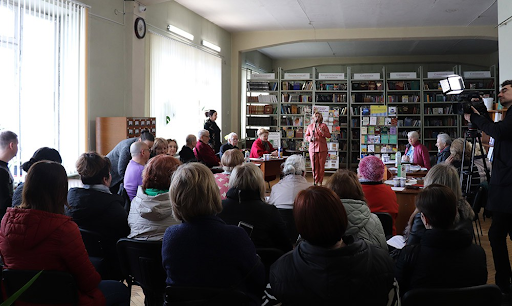
“Dyvoslovo” Language and Literature Salon. PHOTO: ONNB
In this process, the library becomes a safe and reliable space for learning and discussion. You have to admit, such discussions can be much more productive, because not all discussions can take place on the street or on a trolleybus—a culture of dialogue is necessary for meaningful conversation. We provide books and various documents for study, create a space for calm, thoughtful discussions, and involve professional historians in them.
Under what conditions would you consider physically relocating your most valuable collections? After all, moving 5.5 million items is a daunting task.
Relocating such a vast number of documents and ensuring proper storage conditions for them is practically impossible. And the issue isn’t even the complex logistics, but the lack of a secure final destination. Books require specific temperature and humidity conditions, proper ventilation, and compliance with sanitary standards. Our library building was constructed in 1907 by architect Fedir Nesturkh. At the time, it was the most modern library building, and today it remains a functional space for the proper storage of documents of various types and formats. Everything in it is designed so that the collections can “breathe” under controlled sanitary and hygienic conditions. Creating a new underground storage facility of the appropriate scale with the necessary conditions is a colossal challenge—not to mention that during the rocket attacks, it became clear: there are no absolutely safe places during wartime.
That is why our main focus has been on large-scale digitization. In early 2022, when we were unable to physically welcome readers, our scanners operated around the clock in multiple shifts. Moreover, our technical infrastructure has significantly improved over the years: thanks to the Ministry of Culture of Ukraine and partners from the Consulate General of Greece in Odesa, UNESCO, the Hanseatic city of Bremen, the Museum for Change Foundation, the ALIPH Foundation, the Wave 91 Charitable Foundation, and other benefactors, librarians now have access to new scanners, a professional digital camera, computers, laptops, and charging stations. Our biggest challenge has been a grant project, through which, with the support of the British Library and the University of Oslo, we will digitize and make available over 92,000 pages of rare 19th-century periodicals, including those in A1 format. Everything we digitize and make available in the “Treasures of Ukraine” digital library will eventually become part of the global project of the National Electronic Library of Ukraine, which is currently being developed under the auspices of the Ministry of Culture and UNESCO.
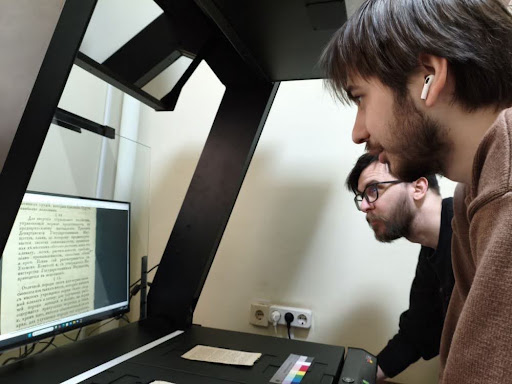
The digitization process at the Odesa National Scientific Library. PHOTO: ONSB
Civil society and international donors have made a tremendous contribution. As you can see, each of these gestures of support strengthens the collective result and gives us the strength to continue our work.
Is there a risk that you’ll digitize only what interests a broad audience, while scholarly collections are overlooked?
No, that’s out of the question. We have a long-term digitization plan that we update every year. The library’s departments are staffed by specialists—historians, philologists, and archivists—who maintain a strategic focus and understand what the state and academia will need not only today but also years from now.
A separate priority is the protection of historical truth. You must agree that in the digital world, any paper document can be digitized and altered in Photoshop: the name of a plot of land or a border line can be changed, or a place name can be distorted. Once a document is digitized and recorded by our institution, we act as a kind of notary: we guarantee its authenticity and the accuracy of its content.
In addition, digitization allows us not only to ensure the preservation of information but also to make rare items accessible. For example, when presenting an exhibition on the culture of borscht preparation (listed as UNESCO Intangible Cultural Heritage), we couldn’t have transported the original antique recipe book to the festival. However, we digitized it, created postcards with a QR code, and distributed them to visitors. People can scan the code and comfortably read the original source at home. Or, thanks to our collaboration with the Consulate General of Greece, we digitized a unique collection of Greek-language books published in Odesa in the 19th and 20th centuries. This collection is currently being expanded and is available in our digital library.
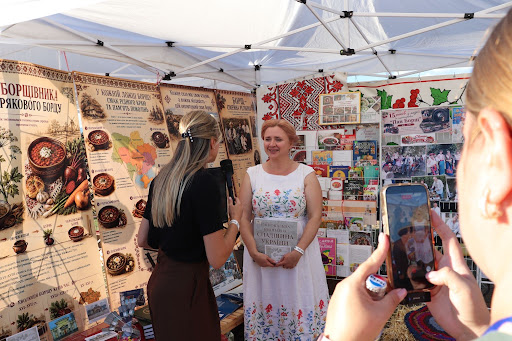
An exhibition on the culture of borscht preparation. PHOTO: ONNB
The past few months have been very difficult for the Ukrainian publishing industry due to Russian attacks on printing houses and warehouses. How is this affecting the expansion of your collection?
According to analytics from the Ukrainian Publishers Association, Ukraine’s entire book market has an annual turnover of approximately 7–8 billion hryvnias, which is comparable to the budget of a single large supermarket. Indeed, the book business in Ukraine isn’t about superprofits—it’s about values. The loss of print runs and the rising cost of paper will inevitably lead to price increases, and publishers simply won’t be able to take risks by publishing niche projects or works by young authors, investing in innovation, and so on. And this isn’t just a business problem—it’s a blow to our information security.
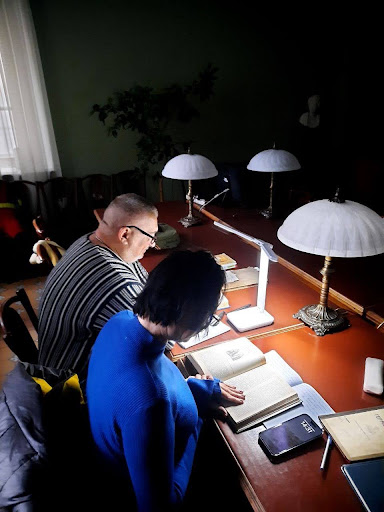
The library remains open during lockdowns. PHOTO: ONNB
How can we help the book ecosystem survive? First, by funding the purchase of books for libraries to implement a kind of distributed storage system: instead of keeping millions of copies in warehouses in cities near the front lines, send them to the library network as quickly as possible. There are nearly 12,000 public libraries in Ukraine, and they can serve as a reliable repository. Second, there are initiatives by citizens themselves: buying a book to support a publisher and donating it to the nearest library, or bringing a newly purchased book to the school library on September 1 instead of flowers.
A book in a library is the community’s best investment. It doesn’t gather dust on someone’s private shelf after being read just once; it’s constantly circulating. And it’s extremely important that new books reach libraries as quickly as possible, because when someone is eager to read a bestseller, it’s like being hungry. And just like a hungry person, you can’t ask them to “come back in a month”—they need food right now! If you don’t provide a quality book in time, people will lose their enthusiasm and fill that time with toxic content on social media, which prevents them from lifting their heads and seeing the stars.
Do libraries have mechanisms or government support that allow them to purchase new literature under these conditions?
We receive books through the legal deposit program, but publishers, to minimize logistics costs, often send them in bulk at the end of the year. We’d like to have them right away, when a book is in the spotlight. For example, when a list of the “35 Most Iconic Books of Independence” is published, or an author receives the Shevchenko Prize, the Nobel Prize, or another prestigious award, readers want that book right away—not at the end of the year, when it finally makes its way to the library. We’d like to see library procurement processes work much more efficiently—everyone would benefit from that.
Which partnership and grant projects from recent years do you consider the most successful for the library?
During the full-scale invasion, we secured over 20 million hryvnias in aid. The lion’s share of this consisted of technical assistance, equipment, and supplies. We will always remember those who were the first to lend a helping hand in 2022: the NGO Museum for Change, with funding from the ALIPH Foundation, helped us purchase packing materials to preserve our collections, fire safety equipment, and more, and continued to provide this support thereafter.
We received significant support from our Czech partners. With the assistance of the Komarek Family Charitable Foundation, the Ukrainian Library Association, and the Yaroslav Mudryi National Library of Ukraine, the National Library of the Czech Republic provided a mobile station for the rescue and restoration of collections — a special metal container equipped with a range of materials and equipment for the restoration and conservation of damaged documents. Using this equipment, and with the support of the ALIPH Foundation, professional training sessions were held for librarian-restorers.
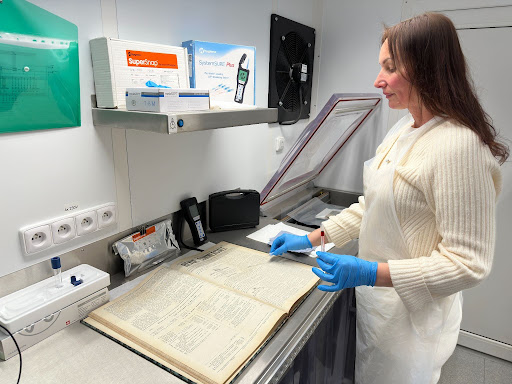
Mobile station for the rescue and restoration of collections. PHOTO: ONNB
What are you reading for pleasure right now, not for work?
I recently read *1,000 Autumns of Jacob de Zoet* and thoroughly enjoyed David Mitchell’s signature elegant style. Among female authors, I’m particularly impressed by the Canadian Margaret Atwood, an incredibly wise person with a deep insight into the processes of societal development. By the way, I suggest paying attention not only to the widely known *The Handmaid’s Tale*, but also to *The Penelopiad*, which is particularly relevant today given the box-office success of the film *Ulysses*, the novella *The Penelopiad*, in which the story of the hero’s heroic journeys is told through a female perspective. As for Ukrainian writers, I really love the works of Myroslav Dochynets. I’m convinced he’s a Nobel Prize-caliber author, and I follow his creative progress closely.
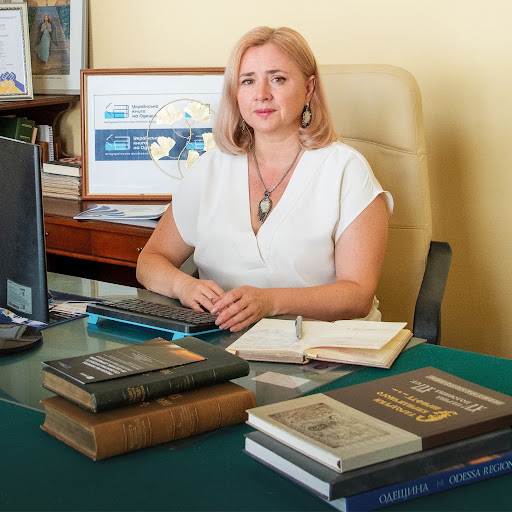
Iryna Biryukova. PHOTO: ONNB
What decision has been the hardest for you since the start of the full-scale war?
I didn’t face a situation where I had to make the hardest choice. Probably because none of the options I chose required me to compromise my conscience or give up my sense of where and who I am meant to be. Even with the most difficult choice for any family—“to leave or to stay”—I didn’t face any problems. I knew I was in the right place, and my family supported me in that.
The hardest part isn’t making personal decisions, but taking responsibility for people or for a situation whose consequences could be irreversible. I remember how, on June 6 of this year, a huge crowd gathered in our main hall for the opening of the “Ukrainian Books in Odesa Region” book forum. And right at that moment, the alarm sounded—there was a threat of a missile strike. You’re faced with a choice; you understand the relentless timing of the entire three-day sequence of events, and you know that no one but you will say, “Let’s begin” or “Let’s take cover.” At a moment like that, you alone are responsible for the safety of every person in the hall. That feeling—having to make a decision right here and now under the threat of shelling—is probably the hardest part of all.