Меню
Соціальні мережі
Розділи
March 5, 2026, 6:49 p.m.
"I don't want to live away from home," Serhiy Mus Guleykov
This article also available in English41

PHOTO: Intent / Natalia Dovbysh
What feelings make us stay in Ukraine? For Serhiy Huleikov, it is the feeling of home that fills him, even though he cannot visit his home. We talked about childhood, memory, and the sincerity of Ukraine and Ukrainians at Burning Man. Watch the interview about memories, family, and perception of the outbreak of war on YouTube and read the text version on Intent.
How did you react to the outbreak of hostilities in the East in 2014? I would not have liked it to be so, but the country woke up in 2022. The public, social perception that has caused people to rethink, to give up habits, to give up some content. They are looking at it more globally. But we understand that people who have a childhood connection with the East may have experienced 2014 differently.
I didn't realize the danger and probably hoped that it would somehow be resolved. I was in Donetsk in 2014, before it started, because I was offered a job in Kazakhstan, and I went to see my parents before I left. I spent 2014-2015 in Kazakhstan because I got a good contract and went to work. That was the last time I saw my father, because he died in 2015, and I couldn't even bury him, because back then you had to wait at least a week for a permit to enter Donetsk. The morgues there were so full that they buried him the next day. So the body could not wait. And I'm in Kazakhstan. I had to submit documents to the SBU just to get permission to enter, and I had to wait for a week on the demarcation line for all the checks. Then things got a little better. Or rather, they gave me a pass for a year, but I only got it once.
In 2014, I went there and I saw how it all started, because I saw young men on the bus, drunk or in a changed state, shouting"Khokhly," something so aggressive, the working masses were wound up with Russian propaganda. And I, as a person who grew up there, understood why it was so, that is, the principle of divide and conquer worked there. So I understood all of this, but I guess that's how the brain works... But somehow I didn't perceive it as a direct threat at the time.
When I came back from Kazakhstan and started shooting more in Ukraine: commercials, some entertainment shows, and more like this - it's still entertainment, but it's informational and entertainment. So I started to get more interested in all this, in some social civic movements and trends, and I started to understand more about it. And this led to the fact that we switched to Ukrainian and abandoned Russian. Back in 2019, we made this decision for ourselves. And in 2020, we publicly announced it, i.e. we launched the UkrYutubProject.
I realized that the occupation must have killed my father because, as I say, he felt like a Ukrainian. He was born here, he worked here, and despite the fact that he spoke Russian all his life, he never had any sentiment for Russia. And the inability to do anything about it, I think, shortened his life. I mean, he lived in the occupation for a year, and his heart gave out, I think it was tormenting him, not letting him live. And me, too, over time, yes. I mean, I didn't have any sharp reaction, but having been there several times, because I went to visit my mother, of course, I mean, I was there three or four times during the occupation, I was there.
I saw how Donetsk was changing, what kind of people were there. But over time, I realized that as a public figure, I had to do something to talk about it and prevent it. Or at least inform about what is happening.
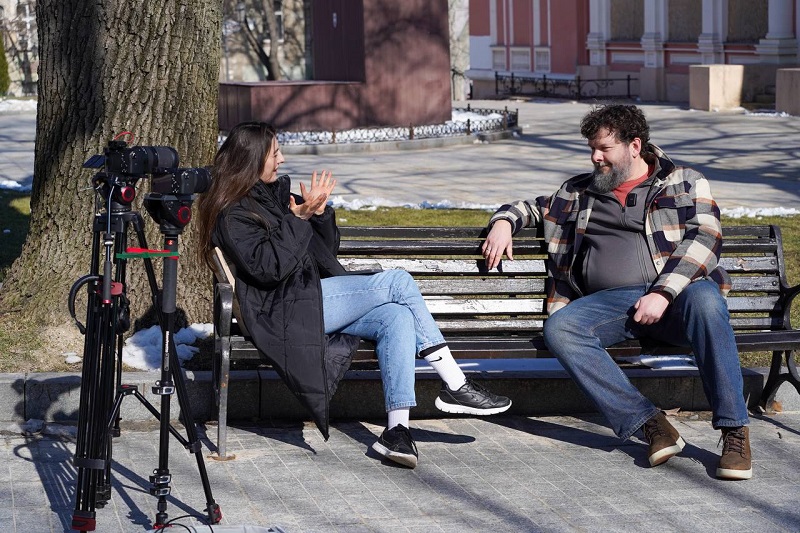
PHOTO: Intent / Natalia Dovbysh
You have experience of traveling around Ukraine in a certain way. How would you describe Ukraine, for example, to a foreigner who has never been here, but not in the context of the war. What kind of country is it?
Wow, that's a tough one!
We always say that Ukraine is a big country, and despite being connected, it has clear differences.
And this is not a bad thing. It can't all be the same. It would be strange if people who live a thousand kilometers away from each other were the same. That's what the scoop tried to do, resettling everyone and smearing them, to create homosavvety. How can I describe Ukraine in one word: sincere. And the deeper you go into a village, the more sincere the people are. It's a kind of hospitality, not even in the sense of feeding, but I think it's an interest in people and a desire to make people feel good. I like this in Ukrainians and it is something that unites everyone. Anywhere, in Zakarpattia, in Donbas, anywhere. In general, this is my impression.
We're in Odesa, we're talking about the South, and that's why we always talk about Odesa, asking for different contexts, so that we can understand who we are and see certain differences between who we were and, for example, who we are becoming, how we react to events. Here is an image of modern Odesa in 2026. What kind of city is it and who are these people? Is it still the Black Sea Pearl, the center of this country's tourist universe?
I think Odesa is a marker of Ukrainianization, perhaps. If Odesa is being Ukrainized, then everyone is being Ukrainized. And I'm pleased to hear more Ukrainian every time I come to Odesa, because it seems to me that it's fundamentally more difficult for Odesa. I hope that this civilizational shift will deprive Odesa of that little bit of arrogance that resort cities always have.
I would like to live in Odesa, I was curious. I come here and I am pleased to see the changes. That's all I can say. There are changes, it's great. Because there is a critical mass of people who are driving this story, and others are already watching and catching up. And it's important that there is a critical mass. It's cool.
I came to the sea with my son in the fall: We spent 5 days on the Fontan, swimming, and the weather was fine. It was great. Access to the sea has been restored, because we came here in 2023. Then it was even sadder. Now, however, this side of Odesa is open, which is great. But it's also nice that Odesa has become a center of a social movement - I have many friends, I follow and read it. I like that Odesa expresses its Ukrainian position. This is important.
We stay in certain places because of our feelings and sensations towards that place. Given the full-scale war, we stopped communicating with certain people. It's a big story about how even families fall apart because of feelings. What feelings are holding you together today in 2026? Is there a sense of fear, messiahship, responsibility?
A sense of home. I have been producing content for a long time since I started my media career, but I started coming up with my own content not so long ago, in 2019. When I felt such an understanding of Ukraine and this Ukrainianness grew in me, I did not realize it as a child, teenager, young man. And as an adult, I realized what it means to be Ukrainian. I can't articulate it, but this Ukrainianness is in me, I feel it and realize that if I leave now, I will betray it. And I will betray everything I did before, all this popularization of Ukraine. I filmed 50 hours of travel videos about Ukraine, and then I left and threw it all away? And where is my contribution, what did I bring to it? Well, I had the opportunity to leave Ukraine many times and I thought about it once and decided not to do it. And I decided to do it now out of fear: if I leave, who will stay? I don't want to leave, I'm happy here. There is a little bit of a mercantile side to me, but I'm 46 years old, I've spent my whole life building a reputation, a career, something else. Now I'm going to give it all up and go somewhere else? Who would need me there? I'll be a nobody again, I'll be working on something. And I'm still a media person, if I were an IT guy, I could go somewhere with my laptop. I don't want to... It's scary, but I don't want my son to grow up there as some kind of Canadian with Ukrainian roots. I feel good here. I want to be here. I believe, I guess, because I repaired the house, I didn't build it, but I invested, that is, I spent my financial cushion on the house. I was a little bit stupid, but it survived the winter. This is such an investment... I don't know. I told you: I could have left when I was 20, when I was 30.... I lived abroad for a while: I don't like it everywhere, I don't want to live away from home.
I'm sincerely glad that Russia couldn't take away your sense of home in Ukraine.