Меню
Соціальні мережі
Розділи
Dec. 26, 2025, 6:53 p.m.
Taras Shamaida: there is more Russian language than in 2022
This article also available in English63

Taras Shamayda. PHOTO: Intent / Natalia Dovbysh
Taras Shamaida is a public figure and one of the key voices of language policy in Ukraine. We talked about the real state of the Ukrainian language and resistance to de-Russification on the ground. Watch the long interview about language, memory, and overcoming the colonial legacy on our YouTube channel, and read the shortened version on the Intent website.
There are organizations that monitor the language situation. One of them is Freedom Space, of which you are a co-organizer. What monitoring situations are you pleased with?
Currently, Freedom Space is not directly engaged in monitoring, but we have been doing it for 10 years: from 2011 to 2020. We monitored and tried to change the legislation, but since we took a very active part in drafting the law on the state language, we wrote into the law itself a provision stating that these responsibilities are assigned to the Commissioner for the Protection of the State Language. Therefore, after 2020, the state will prepare an annual report on the situation of the Ukrainian language and the Commissioner's recommendations. Because we did this on a voluntary basis, we did not involve any money, state or grant money, but simply dozens of people across the country joined forces. We really collected the available information statistically, sociologically, and did our own monitoring.
Of course, if we go back 20 or even 10 years, the language situation is much better now. It's not even comparable. But I would say right away that if we go back two years, the situation is worse now. And this is shown by sociology and various objective data. That is, the presence of the Russian language in Ukraine today is much less than, for example, 5-10-20 years ago, but more than in 2022-2023. That is, there is a certain rollback, not to the level of 2021, of course, but it is happening. This is a very disturbing trend, and something needs to be done about it.
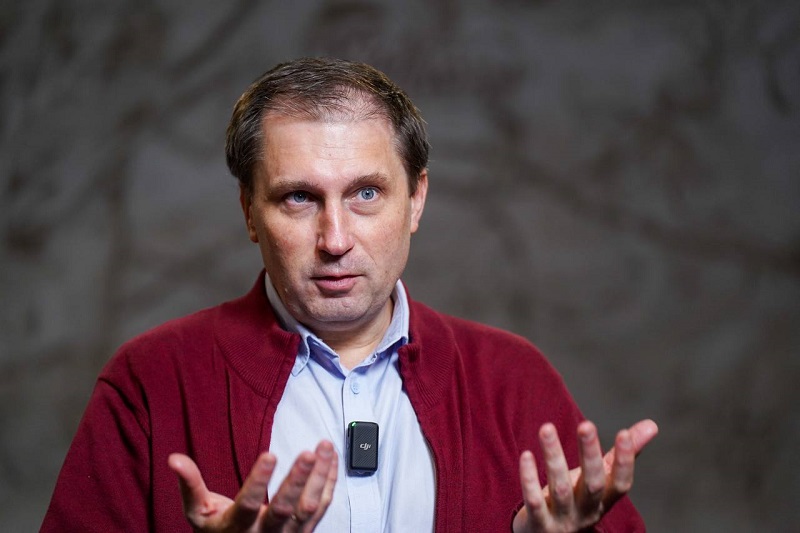
Taras Shamaida. PHOTO: Intent / Natalia Dovbysh
In general, we can say that there have been several such waves. Ukrainization, although I don't like this word because we are in Ukraine. The first big wave began in the last years of the Soviet Union. And this wave continued in the first years of independence. It gave way to a certain rollback in the days of Kuchma. At first, there were powerful Ukrainian music festivals and Territory A, Ukrainian songs on the radio, Ukrainian books. But since the late 90s, there has been a rollback, because the policy of the Ukrainian government has been quite pro-Russian. And, of course, after 1991, Russia began to take over our information space.
The second wave was associated with the Orange Revolution, with the fashion for Ukrainian, and then with certain government policies. For example, the introduction of Ukrainian dubbing in movie theaters is connected with this wave. To today's youth, this may seem like something wild and unrealistic, but until 2006-2007, absolutely all films in all cinemas were shown in Russian. That is, they were either Russian-made films or American Western films dubbed into Russian. It was only during the time of Viktor Yushchenko that Ukrainian dubbing began. And in 2014, after the ban on Russian contemporary films, the Ukrainian language finally dominates in our film distribution. And this is very important because, among other things, Ukrainian dubbing is a separate art form. It is usually done with money from American film companies, which realize that high-quality Ukrainian dubbing will bring in more attendance and revenue. Entire generations, especially in Russified cities like Odesa, have been brought up on this dubbing, on these Ukrainian-language quotes from Hollywood movie characters.
But of course, there was Yanukovych's government, the Kivalov-Kolesnichenko law, and Tabachnyk's actions that further russified the process.
In Odesa, by the way, these processes are very noticeable, when they tried to roll back the gradual process of spreading the Ukrainian language in schools, for example, during Yanukovych's time. And just when we were conducting these monitoring sessions, we saw, including from statistical data and surveys, that the number of Russian speakers in Odesa schools increased. And in general, Russia has always paid attention to the South, and to Odesa region in particular. This attention remains very strong at the moment. And we need the state to pay much more attention to this region, to its inclusion in the Ukrainian space.
The next wave began in 2014, after the Revolution of Dignity and Russian aggression. First, as a reaction to the Russian aggression itself, many people began to switch to Ukrainian, many businesses. For example, in book publishing, in fact, some of the publishing houses and bookstore chains that were connected, affiliated with Russian structures, broke away. In fact, the number of books published and sold in Ukrainian has increased significantly. Similar processes took place in other industries. Plus, of course, due to the fact that the government was finally post-Maidan, that is, the presidents, parliaments, and governments that came after 2014 were not in the orbit of Russian politics. That's why laws were passed on radio quotas. Imagine that, for example, before the introduction of quotas - it's 2016 already (we monitored key radio stations) - 3-4 percent of the time was taken up by Ukrainian songs in prime time. More than 60% were in Russian. The rest was in all other languages. The introduction of the quotas, despite the fierce propaganda and resistance from Russian and various pro-Russian radio station owners, showed that the quotas were not only being met, but exceeded. The law immediately set a quota of 30-35%. That is, every third song should be in Ukrainian. But in reality, almost all radio stations had an average of 51-52% before the full-scale invasion. Because in addition to popular music, it turned out that there were a lot of young performers. The quotas themselves stimulated the demand for a variety of different genres of music.
Is there any impact of the law on the state language?
The law on the state language has also given a great impetus. In fact, we can say that since 2014, the share of people who speak Ukrainian has been steadily increasing-slowly but steadily. 2019 saw the adoption of the law on language, and 2021 is the transition, according to this law. This is very important, because the essence of the language law is that everyone has the right to be guaranteed information and services in the Ukrainian language in their Ukrainian state. This, contrary to various myths, is not a compulsion to speak to anyone or to pray in any language. On the contrary, the law explicitly states that the sphere of private communication and religious rituals is a sphere of human freedom. That is, yes, the state may consider Russification harmful, and we as people may believe that it is normal for parents who retain their Russian identity there, who are also in Ukraine. They are raising their young children in 2025 in Russian, and we may not like it.
I sometimes compare it to the fight against smoking: we may not like the fact that people smoke because smoking kills. We can put warnings on the packs, but it's up to the people. If they don't poison anyone and smoke somewhere else, it's their business. We can say at the human level and even at the level of certain social advertising and state propaganda that smoking kills. And we can say the same about the Russian language, because it is true. It is an instrument of enslavement and occupation of Ukraine. We see, for example, in Belarus, how language can be used as a tool to seize an entire country even without weapons. Certainly, the Russians have such intentions towards Ukraine. Beyond such calls, explanations of why this is harmful, we cannot interfere in the private atmosphere. However, when a person, as a consumer, as a citizen, comes to an authority, to a school, to a kindergarten, to a store, to a trolleybus, they have a guaranteed right to be served in Ukrainian. And in 2021, these norms were approximated, and, of course, this gave very big impetus. Of course, these norms are still not 100% fulfilled. We are a big country, we have hundreds of thousands of service providers, and just like traffic rules, the norms are not always followed. Some people run red lights, some drivers speed, but we do not deny that without traffic rules it would be much worse. That is why people have a guaranteed right to be served in Ukrainian. If people believe that their right is being violated, they can appeal. This is certainly the case in cities like Odesa. For example, I certainly encounter violations in coffee shops or stores in Odesa, but in most cases the service is in Ukrainian, and this is very important.
There are people who either didn't get it in 1991, some didn't get it in 2014, or people were just young and their parents didn't get it. In 2022, they finally got it. Not to everyone, but to many. According to sociologists, at least 4 or up to 5 million people who retained their Russian language in 2022 switched to Ukrainian. This is a huge number of people, including, for example, in Kyiv. Kyiv, for the first time in 150-200 years, has become a city where the Ukrainian language is more spoken than Russian. So this is a positive thing: both government policy and people's aspirations are moving in the same direction. Although, of course, there are large cities, such as Odesa, Kharkiv, to some extent Dnipro, Zaporizhzhia, Kryvyi Rih, where the Russian language still dominates, and I think the dominance of the Russian language among children and teenagers is particularly dangerous, and it is this category that Russia is targeting. Not only through direct propaganda, of course, but also because Russian music, entertainment products, games, social networks, and so on are aimed at this category.