Меню
Соціальні мережі
Розділи
Nov. 26, 2025, 6:56 p.m.
"Public outrage is greater than Bankova Street realizes" - Volodymyr Viatrovych
This article also available in English80

Volodymyr Viatrovych. PHOTO: Intent / Natalia Dovbysh
The secret bill that restores the Russian language, the Mindich case - how can society stay united in such circumstances? We talked about this with historian, politician, and public figure Volodymyr Viatrovych. Watch the full version and read the shortened version of the interview about ratings, the only marathon, Odesa's multiculturalism, and General Cook on the Intranet.
Could you tell us about the secret bill, what is its essence, and how is it supposed to return the Russian language to the space?
Actually, we are now witnessing several strange, to say the least, legislative initiatives concerning the Ukrainian language, and all of them, unfortunately, threaten to reduce the Ukrainian language in one way or another. I mean what we learned from the news from the statement of the Vice Prime Minister for European Integration, Mr. Taras Kachka. We learned that he is coordinating a certain text of a bill with the Hungarian government, which concerns education. It was very strange to hear this, because none of the Ukrainian experts or MPs had heard or known about this project. I took the opportunity, when Mr. Kachka was speaking in the Verkhovna Rada, to approach him and say that it was a little strange to hear about it. I reminded him that the Ukrainian parliament is not in Budapest, but in Kyiv. He reacted quite aggressively, saying that he was not obliged to say anything, that when there is a bill, it will appear in the parliament at the right time. I think that if it again contains some kind of reduction in the functioning of the Ukrainian language, it is obvious that this will cause outrage. I think it will not pass. And it seems to me that Mr. Kachka simply underestimates the sensitivity of this topic for Ukrainian society, and the importance of at least a few dozen MPs who will be ready to defend these issues.
Another bill. It is about something that has long been prepared and Ukraine had to adopt amendments to the law on the ratification of the Charter for Minority Languages. Let me remind you that such a charter was ratified in Ukraine in the early 2000s with an incorrect translation organized by Dmytro Tabachnyk, a person who is known to have worked and continues to work for Russia. Minority languages, i.e. languages that are under threat, were turned into national minority languages due to incorrect translation. And, obviously, this is how this charter began to apply to the Russian language. Although Russian is definitely not a language under threat in Ukraine, but rather a language that poses a threat to many languages, including Ukrainian and languages of national minorities. So, for many years, it has been said that another law should be adopted that will introduce the correct translation of this map into the Ukrainian legal field. This was even mentioned in the decision of the Constitutional Court in 2021. In the end, it was done, the government did it, and our committee considered this issue. The bills were included in the agenda and suddenly, on the initiative of the Deputy Prime Minister for European Integration, allegedly at the insistence of some experts from the Council of Europe, this bill was removed from the agenda.
The third initiative became known quite recently. It was the State Service for Ethnic Policy of Freedom of Conscience that submitted its draft law for approval by other ministries in the Cabinet of Ministers, which again, under the guise of European integration, significantly reduces the use of the Ukrainian language. It is about using the languages of national minorities, including in some scientific events, scientific publications, sports events, and partly in the service sector. The point is that members of local councils or officials of these councils should be proficient in these languages in administrative-territorial units where there is a majority of representatives of national minorities. The fact is that Ukrainian legislation still provides for such a concept as settlements with a majority of representatives of national minorities and, obviously, there are special conditions for the use of a national minority language. Instead, the term administrative-territorial units is being introduced, which provides for the possibility that it will no longer be in specific settlements, but, for example, in entire districts, where it is not necessary that the entire district is inhabited by a majority of representatives.
Importantly, we have been working in this way with legislation related to national minorities so far, in agreement with our European colleagues, so as not to violate the rights of national minorities to their cultural and linguistic rights, on the one hand, and, on the other hand, so that it does not turn into a window for some kind of re-Russification of Ukraine. That is why they used their own wording that it should be about the languages used in the EU, thus excluding Russian. Now, at the initiative of the State Service for Ethnic Policy and Freedom of Conscience, this wording about the EU language is disappearing and, accordingly, it simply refers to the languages of national machines, including Russian. Therefore, all of these provisions I mentioned, the use of Russian in scientific activities, in publications, in sports, in speeches, even at the level of self-government organizations, will apply to Russian. Again, there was no expert discussion on this very sensitive issue for Ukrainian society. Again, an attempt to do it quietly in order to force the issue: "Well, we have to, because Europe demands it." This has happened more than once, and each time there is such a discussion, we eventually come to the conclusion that there are no such requirements from Europe. These are just things, the desire of some part of the Ukrainian government or officials to dismiss this issue of language as unimportant, as something that can be exchanged for something really important.
Unfortunately, the Ukrainian government itself is turning the language issue into a bargaining chip in some kind of bargaining. And, thank God, thanks to the sensitivity of Ukrainian society, there is a rejection of any conditions on the part of Russia regarding the Russian language. Instead, under pressure from the Hungarian government, we were ready to make some concessions, which are undoubtedly being accepted, including by Russia, which will undoubtedly take advantage of this. That's why we are sounding the alarm, because we are well aware that only public attention to such issues guarantees that the bill will not pass. All previous attempts to take advantage of European integration and "return Ukraine to Russification" have been stopped. Therefore, I think we will stop it this time as well, but this does not mean that it happens automatically, it always requires effort, some attention from the media, the public, and pressure on the Ukrainian authorities to make them understand that this issue is important to Ukrainians.
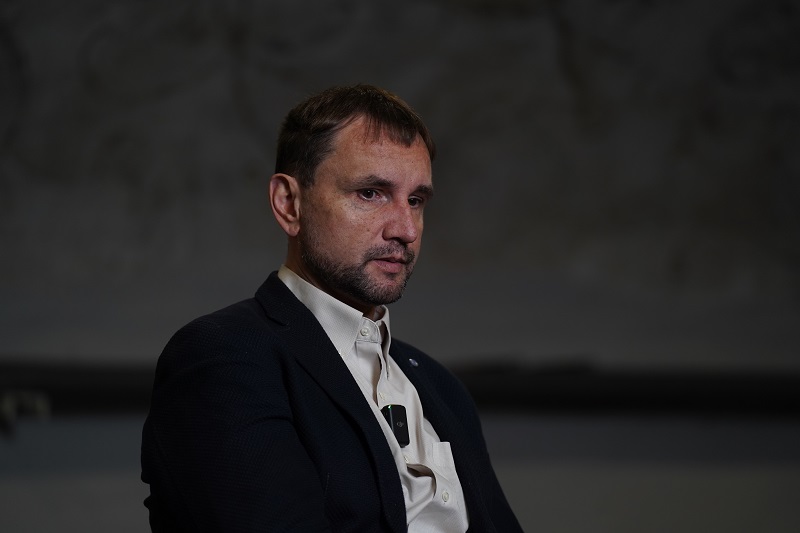
Volodymyr Viatrovych. PHOTO: Intent / Natalia Dovbysh
The cardboard rallies were not so long ago, and the Ukrainian authorities are constantly riding on these pitchforks, underestimating Ukrainian society and the weight of its pressure.
The peculiarity of the current government is that it is mostly represented by people who have not had any previous social and political experience. Therefore, these topics of protests and the ability of Ukrainian society to organize are quite distant to them. Therefore, it is a novelty for them. I remember very well the situation when we were talking about the likelihood of passing this law abolishing the independence of NABU and SAPO. There were very clear signals from our European partners: don't do this, it's a stupid thing to do, and you will have to repent for it later. On the other hand, there was a similar signal from Ukrainian society as soon as the discussion began: don't do it. But there was such overconfidence, which was based on a lack of understanding of what Ukraine is, what Ukrainian society is. And on the one hand, it gives hope that if we are ready to continue to fight, we will be able to stop this kind of institution. On the other hand, it's a bit frightening because we are living in a situation of war, when it is incredibly important that the government understands the need to protect Ukraine from the outside and is sensitive to the issues that are important to Ukrainians from the inside.
I am well aware that any protests in Ukraine can be used by Russia. Even when there was this Cardboard Maidan, I went there, and on the one hand, I was very happy that there is a potential of Ukrainian society, which has shown itself well. On the other hand, I was afraid, because if, God forbid, the Ukrainian authorities made a crazy move - an attempt to disperse, to repeat, what happened on November 30 - it would become a source of enormous destabilization. And, unfortunately, this threat that the authorities, because of their lack of sensitivity and understanding of Ukrainian society, may make some mistakes that will contribute to the destabilization of Ukraine from within, does not disappear. Now, as we speak, as this scandal is growing around some incredibly corrupt things related to Energoatom, I think we are witnessing the continuation of this trend, the lack of understanding of how Ukrainian society can react to this. For a whole day, the government thought it would keep silent, and the next day it finally said that it was probably necessary to talk about the resignation of two ministers. That is, again, there are no sensors to feel how Ukrainian society is actually reacting. I mean, it seems to me that Ukrainians' indignation at this topic is much deeper than they realize on Bankova Street.
How can society stay united and focused on the fight when corruption scandals like the Mindich case arise?
In fact, the situation is very difficult. We must understand what the highest value is for us. And the highest value is the state. We must understand that any government is not completely identical to the state. It is important to influence the government, to force the government to abide by the law, and to bring to justice those people who weaken the country, who take some corrupt steps that border on, or maybe even go beyond, treason. It is important for us that the state stand up. And here we are in a very shitty situation where Ukrainian corruption is a double win for Russia. On the one hand, if corruption works, then resources flow out of the country, someone gets richer, and obviously Ukraine seems weaker. On the other hand, when corruption is exposed, it delegitimizes the Ukrainian government. That is, it gives Russia the opportunity to launch a message: who are you protecting? Look what kind of scoundrels they are. So, we have to understand that even scoundrels in power are not a reason to say that we will not defend this country. These are dangerous narratives. There is a certain indignation, fatigue in Ukrainian society, and some people just don't think, or are just ready to support this kind of thing on emotion. I've seen absolutely harmful posts from real people saying that they're stopping collecting donations because they're fed up: a person is collecting a penny, and here billions are being taken out of the country, stolen. Obviously, we need to hit the hands that are stealing from Ukraine, we need to replace those people, but in no case should we say: let them do it themselves. Even if we don't appeal to patriotic feelings, we need to understand that the state is a mechanism for protecting ourselves. If the state falls, then obviously we ourselves will be at risk, because we will be destroyed. I am not equating any government - good or bad - with the state. We must direct our efforts to protect the state. And putting pressure on the authorities to ensure that they do not violate the law and bring to justice people who commit treason or corruption is also aimed at protecting the state.