Меню
Соціальні мережі
Розділи
Nov. 10, 2025, 7:58 p.m.
"Libraries are places where people communicate," Yuliana Amelchenko
This article also available in English28

Yuliana Amelchenko. PHOTO: Intent / Natalia Dovbysh
The library in the modern world has changed its status, but it has not lost its relevance. It can become a meeting place. Yuliana Amelchenko is the director of the Hrushevsky Odesa Regional Universal Library, and has been working there for over 60 years, and she repeatedly notes how much she loves it. Watch the full interview and read the shortened version on Intent about memories, warmth, the desire to be involved, and past lives.
Watch the full video on Intent's YouTube channel
Ms. Yuliana, you came to the library when you were 19. Tell us what you were like then, what the library was like? Remember this period a little bit.
The library was for people. And many, many people came then. But I worked in the book depository. When I was transferred to the reading room as an assistant librarian, I rushed there, losing my shoes. I was so eager to go there.
I loved to read, first of all. And secondly, my mother did not want me to work at the Londonskaya Hotel. Because I was a very pretty girl. And my mother wanted me to come to a decent environment.
I understand that the world has changed during this period, and the role of the library has changed, in fact. And I know the Hrushevsky Library as this hall where events take place. What were the days like before? What was the main request in the library?
I worked in the reading room, and the regional library's subscriptiondesk. There were seven departments there, because a lot of people wanted to take books home, and the book was in one copy. They wanted to read it on the spot. Now the Internet has replaced this work, but the book smells different. It doesn't smell like an online book. It is very good. I wish everyone would open and read the book.
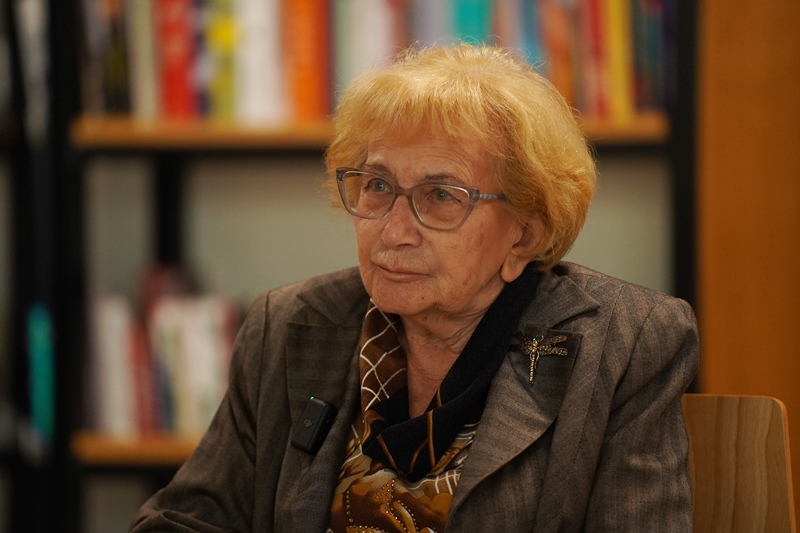
Yuliana Amelchenko. PHOTO: Intent/Natalia Dovbysh
Tell me how you got the idea to change the library. Because now the library is quite modern, it looks like, you know, for example, European libraries, even if it's just a simple renovation. When did you start making such active changes?
I worked during many changes, as you know. But the bright changes began in the 90s, when our state became independent. At the same time, I became the director of the institution. People started working with information, with the Internet. The view of the library changed, it became different. We made it modern. We open our doors to everyone who comes, we are happy to see every reader. And we are happy that all events can be held here. And the halls... we opened a museum of Ukrainian books. I just love it. The library should be a meeting place. I've always loved the library, and I was happy when I started to change my view of it. I was happy to become the director. I was elected! It was probably the first election of a library director. I have always worked here. But when the State Security Committee was in charge, I was translating Brezhnev once, and I was reprimanded. I was summoned to the KGB and told that it was impossible to do so. And yet I stayed here. I was reprimanded by a woman whom I considered my friend... I will remember the very beginning of my work, when it was difficult, when I had no money. And yet I still told my subordinates that the main thing was that people talked about us.
Weren't you afraid to become a director when this competition was held?
No, I wanted to become a director because it was a different time. I wanted to redo the place the way it needed to be at that time. I have always loved the library. Just always. Even when it was bad, and when there was no money for books. I loved it all the time anyway. My favorite books are old books. I have five thousand old books from the 17th century and the 16th century. We have one and a half million books. Every time I worry that there will be more and more of them, that we will be given money. The heyday is now.
Tell us about Odesa. You grew up here. What is it like for you?
Odesa is my favorite city. Despite the fact that I was born when my mother was on tour in the Kharkiv region, I have always lived in Odesa. I used to live near Mechnikov Square, on Staroportofrankivska Street.
Is there any cooperation between librarians in Odesa?
We are curators of libraries for the entire Odesa region. There are about 700 of them now. They are working. They are very modern and are shelters for people who come just to talk. They are the implementers of the "How are you?" and "Barrier-Free" projects. We communicate with them all the time and see that they are now working under the auspices of local communities. And we are still always directing them to be people's assistants.
Tell us a little bit about the rules of visiting the library. People like me and people a little younger than me, we are not from this active period when we knew how to use the library... So, for example, I can create a library card and take a book home?
You can borrow a book for 30 days, and we calculate the cost as if it were a year, so you can sign up. We have 19 departments, and they serve many users. But we want people to come to our events, to socialize, and not just take a book home. This is what we are working on.