Меню
Соціальні мережі
Розділи
Dec. 28, 2025, 6:56 p.m.
Why Third World Countries Still Exist in the 21st Century
This article also available in English1451

MAP: Wikipedia
The Second World War ended 80 years ago, but its consequences continue to influence the world today. The course and consequences of the great war inevitably formed a certain geopolitical structure and a certain system of relations in the world, where all states were divided into the first, second, and third worlds. Of course, the current geopolitical structure is significantly different from the postwar bipolarity. However, a significant number of countries can still be characterized as the "third world." Let's try to find out how this phenomenon managed to survive into the twenty-first century.
How the Earth was divided into three worlds
TheUSSR, the United States, and Britain were not friends even when they fought together against Hitler's coalition. It is not an exaggeration to say that the Western world perceived Stalin in much the same way as Hitler. And if Hitler had not begun his expansion, Stalin could have been in his place in a few years. During the Cold War, Britain would be the main US ally in Europe, but their relationship was not without geopolitical nuances. The United States wanted to take advantage of the fact that its territory and economy, unlike other world leaders, had not been damaged during World War II. Therefore, the United States could claim a key role in the postwar world, while simultaneously putting pressure on the European empires to get rid of their colonies in the context of the righteous struggle for self-determination of the world's peoples. Moreover, some of the colonies that would soon be abandoned by European powers needed to be placed under American control. Thus, it was in this triangle that the main contours of the future world were formed during World War II. Capitalism and communism simply put aside their quarrels for a while to deal with Hitler, and then started the Cold War. The weakening of the European empires during World War II forced them to gradually give up their colonial possessions.
During the Cold War, the world was effectively divided into three parts: the capitalist countries, the socialist camp, and the rest of the world. The conceptual idea of such a division was proposed by the French scholar Alfred Sauvé in 1952. He started from an eighteenth-century publication where society was divided into the gentry, the clergy, and the third estate. Accordingly, Sauvie speaks of the first, second, and third worlds. The first two terms were hardly used, but the last one became very popular.
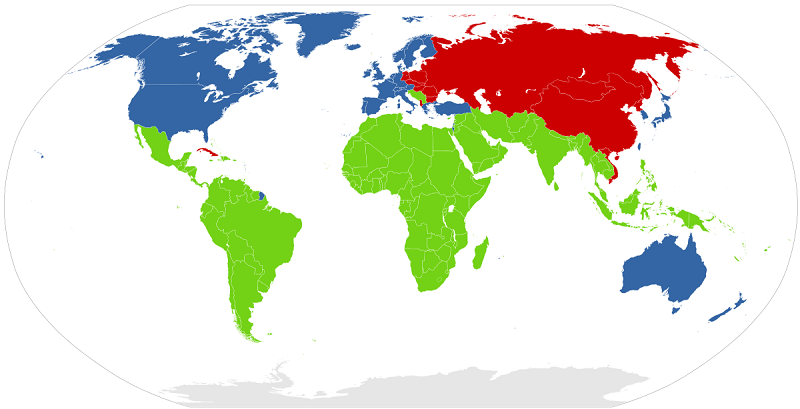
The first, second, and third worlds on the map. MAP: Wikipedia
The term "third world" referred to countries that were unwilling or unable to join either the capitalist bloc or the socialist camp. It should be emphasized that the "third world" was not without reason compared to the third state of society. Therefore, in most cases, the Third World countries were not subjects but objects of geopolitical operations during the Cold War. In our opinion, the key feature of the term is the vulnerability and objectification of the Third World countries for political and economic games of world leaders. Not wanting to start the Third World War, the rivals in the Cold War shifted almost the entire burden of active actions to the Third World.
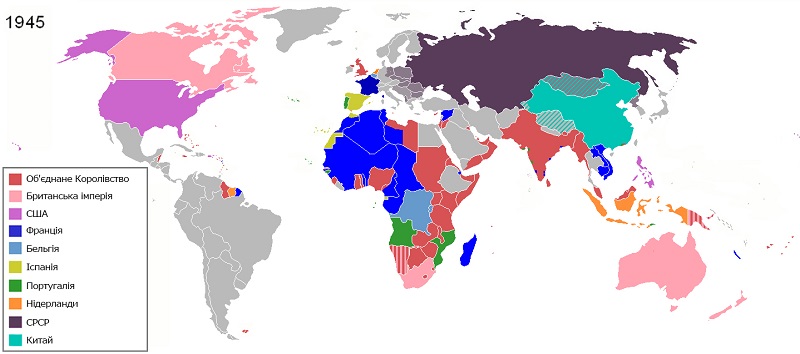
The colonial division of the world in 1945. MAP OF THE WORLD: Wikipedia
The actualization of the term "third world" took place against the backdrop of the process of decolonization that began immediately after World War II and continued until the end of the twentieth century. Many colonies around the world wanted to gain the right to self-determination, and the colonial empires, ravaged by war, were unable to stop this process. Thus, dozens of new countries began to appear on the world map, which could be fully attributed to the "third world." The United States and the Soviet Union were the activators of this process. Formally, both rivals were not colonial empires, but something needs to be clarified here. As early as 1823, the United States announced the Monroe Doctrine, according to which both Americas were part of its zone of control. And control meant the exploitation of economically backward territories. The USSR was a descendant of the Russian Empire, which was actively expanding to the east and south. The only difference between the USSR and the Western European colonial empires was that the USSR annexed new lands directly to the metropolis.
It should be noted that the term "third world" has gradually been replaced by the international community with the allegedly more politically correct "developing countries." However, we will use the old terminology in this article. First, we will be talking about the events of the Cold War. Secondly, many countries of the modern world have the negative features that were laid down in the development of the post-war system and which, in fact, include the term "third world". Thirdly, euphemisms should not conceal the responsibility that the countries of the first and second worlds should bear for the current state of a number of "third world" countries.
The complexities of decolonization
Undoubtedly, decolonization should be considered a progressive process from a historical perspective, as it gives individual peoples the opportunity to fully realize their intellectual and cultural potential. However, history shows that the success of a new state project depends to a large extent on the peculiarities of exploitation of the former colony and the conditions of transfer of power. Even today, some countries continue to suffer from severe or even devastating traumas sustained on the path to statehood during decolonization. Let's try to understand what problems the newly created countries faced during the Cold War.
A classic way to misuse a colony is to siphon off resources without providing funding for its needs. In this case, the colonizer considers the colony to be an asset with a limited usefulness that should be squeezed to the end. Accordingly, he does not care about the infrastructure, is not interested in the development of colonial workers, which in the long run could make the process of resource extraction more efficient. This is exactly the situation in French Equatorial Africa. France leased large areas to European private companies, which began to actively exploit the local population in the collection of rubber, ivory, and cotton. In order to force the local population to work, they were subjected to heavy taxes. Torture was used. The result was famine and significant demographic losses.
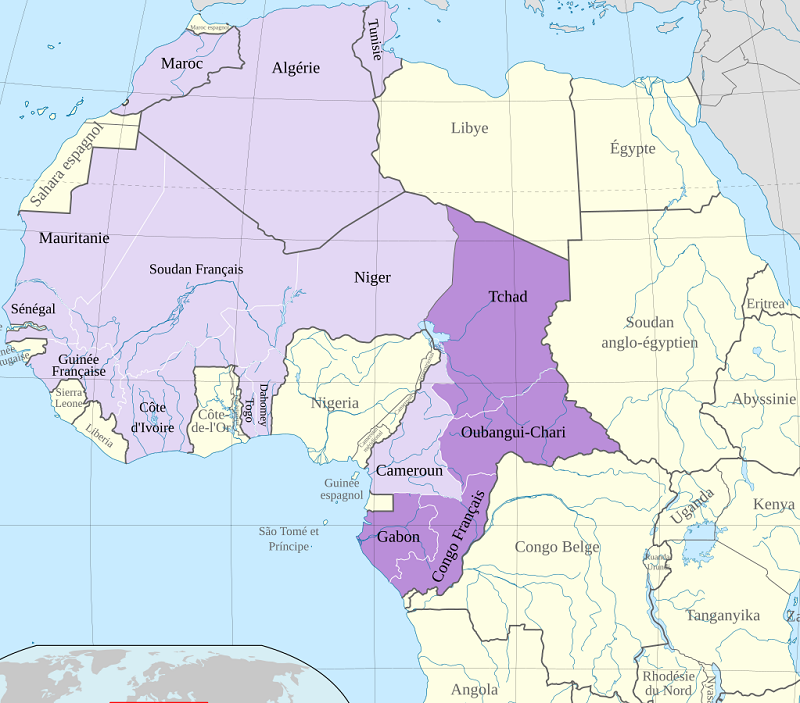
French Equatorial Africa in 1935. MAP OF THE AREA: Wikipedia
Another negative consequence of the above colonial policy was that, with the gradual degradation of the local population, an elite stratum of society was not formed, which would have to lead the country after independence. In the Central African Republic and Chad, which gained experience of French colonization, it has not yet been possible to establish a government that would unite the entire country. In both countries, following the model of the colonizers, authoritarian governments have been established, which are held together by the bayonets of the army. Periodic coups only confirm the fact that the authorities do not enjoy public trust.
Quite typical for the era of decolonization were the cases of the formation of new states without taking into account the ethnic, geographical and religious characteristics of the territories. In 1960, Somalia was formed through the unification of the Italian and British colonies. At the same time, Somalis constituted a fairly significant group in Ethiopia, Kenya, and French Somalia, which after liberation became Djibouti. This fragmentation gave rise to the idea of a Greater Somalia, which led to conflicts with neighboring countries.
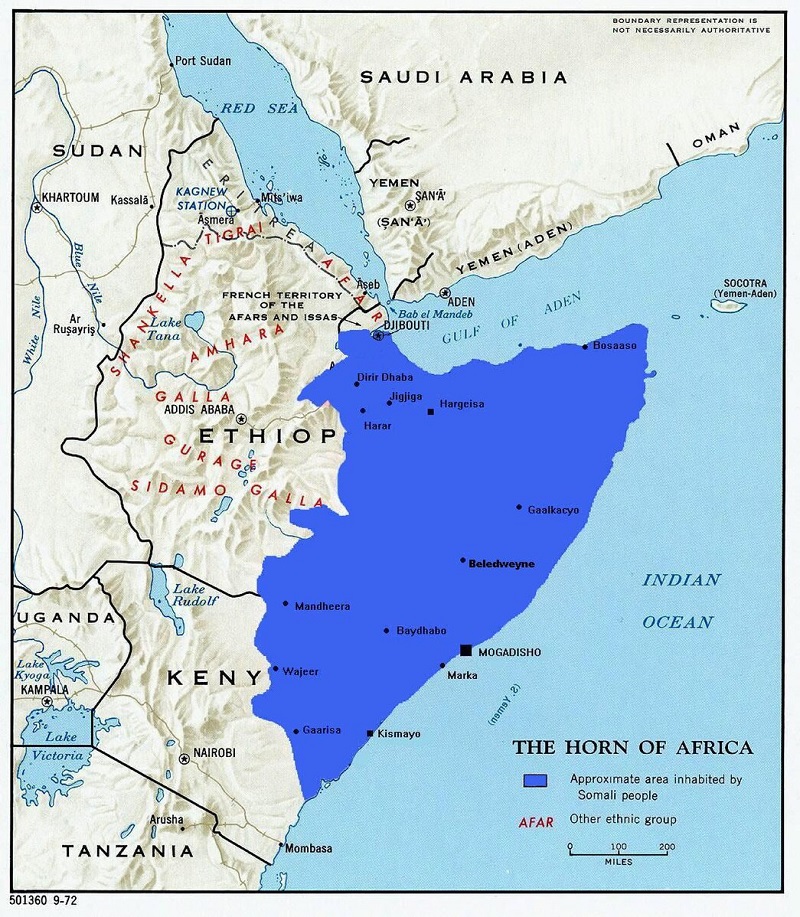 Resettlement of Somalis. MAP OF SOMALIA: Wikipedia
A striking example of the violation of geographical and cultural features was the formation of Pakistan from two territories divided by India. After the war, Britain was in a hurry to decolonize India, so a number of imperfect decisions were made. The idea of a united Pakistan was to create a single large country of Islamic adherents that could be a counterweight to India. In practice, the western and eastern parts turned out to be not entirely homogeneous. First, the Punjabis and Bengalis had different languages and cultural characteristics. Second, political power was concentrated in the western part, which created additional tension. This eventually led to the war of independence and the creation of Bangladesh in 1971. Thus, it can be argued that the wrong decision during decolonization suspended the process of national self-identification of the Bengalis for several decades.
The importance of the religious factor was ignored by the British when they created Sudan and Nigeria. Both countries had an Arab Islamic region in the north and an African Christian region in the south. In both countries, this led to wars and coups. In 2011, South Sudan seceded into a separate state. Nigeria was able to draw the right conclusions from the civil war of 1967-70, but due to mistakes in its creation, the country still has a number of systemic problems.
 A line at the referendum in South Sudan. PHOTO: Wikipedia
A unique social experiment on the territory of modern Rwanda and Burundi was conducted first by the Germans and later by the Belgians. The colonizers singled out the Tutsis from the two leading tribes, who began to hold administrative positions. The other tribe, the Hutus, was considered secondary. The Belgians even introduced ID cards in which the "nationality" column had to indicate the relevant tribe. After the end of World War II, the Hutus came to power in the elections. Belgium supported the new government, as well as the ethnic intolerance it incited. In 1959, the Hutus organized mass pogroms that killed 100,000 people. The Rwandan government launched massive repressions against the Tutsis, forcing them out of the country. Such a policy in the 1990s led to a civil war in Rwanda and one of the most brutal Hutu genocides against the Tutsis in history, which killed between 500,000 and 1,100,000 people. Modern Rwanda is actively developing, but on a global scale it still has rather moderate indicators. Not least of all, it is the consequences of Belgian colonization.
 Rwandan children trying to cross the border. PHOTO: Souspilnoye
Neocolonialism as a way to restore relations with the former
It is sometimes said that neocolonialism began after decolonization. In fact, these processes went on in parallel. The victorious countries in World War II established the rules of the game, one of which was decolonization. However, the rules did not specify that the newly created countries could not be taken under their control or exerted influence on their territory in their own interests. In some cases, recent colonizers immediately returned to continue relations with the former colony.
Shortly after the Democratic Republic of Congo declared its independence, one of its richest provinces, Katanga, which was home to copper, uranium, and cobalt mining, announced its intention to secede from the country. This act of separatism was supported by Belgium, the former owner of these territories and a beneficiary of Katanga's resources. Belgian officers actually led the separatist army and used European mercenaries according to the well-known principle of "we are not there". In this way, the Belgians wanted to regain control over the extraction of Katanga's resources, as well as to stop the nationalist movement of Patrice Lumumba's government.
 Patrice Lumumba was assassinated on the territory of Katanga. PHOTO: Wikipedia
In the second half of the twentieth century, organizing coups was a fairly popular way to influence the politics of the Third World, which the countries of the First and Second Worlds considered wrong. In 1945, the writer Jose Arevalo became president of Guatemala, which was under US control. He showed signs of an independent policy and even established diplomatic relations with the USSR. His descendant as president, Colonel Jacobo Arbenz, went even further: he refused to send troops to Korea and nationalized the lands of the United Fruit Company, a large American corporation that exported tropical fruits from the Third World to the United States and Europe. As a result of the U.S. operation, Arbenz was overthrown. He was replaced by a man loyal to the United States who returned the land to the fruit exporter.
In the second half of the twentieth century, France organized a whole system of external governance of its former colonies, which was even called Francafrica. France entered into bilateral agreements and received the exclusive right to develop the subsoil of the former colonies and access to local markets. To implement the system in the ex-colonies, authoritarian pro-French leaders came to power and bribery was used. The French franc was a circulating currency in some territories. France has repeatedly deployed its military contingent to solve internal problems, which often meant a partial loss of sovereignty. The withdrawal of French troops took place even in the 20s of the XXI century. Obviously, Francafrica greatly complicated the development of former colonies.
 French troops in Zaire. Operation Leopard. PHOTO: Wikipedia
During the Cold War, the Third World countries repeatedly became the scene of hostilities between the USSR and the United States, which fought for control over the regions of the geopolitical chessboard. If one side supported the local authorities, the other immediately took over the opposition forces. Interestingly, after a while, the parties could switch roles. Thus, at first, Somali dictator Siad Barre was supported by the USSR. However, during the war with Ethiopia, the USSR was already on their side, and the United States supported Barre. Of course, every armed conflict halts the development of a state, but the involvement of global players with virtually unlimited funding and weapons stockpiles increased the damage caused several times over.
How to successfully survive decolonization
As the experience of decolonization shows, in order to develop successfully, a newborn state should follow the following tips:
- First, it needs an intellectual elite with a quality education, ready to take over. This elite must look legitimate in the eyes of the entire population.
- Secondly, it is necessary to unite the country and create equal conditions for the balanced development of all regions to avoid the prospect of separatism and civil wars.
- Third, a diversified economy with a domestic market and balanced exports/imports must be created that does not rely solely on the agricultural sector or on the sale of resources.
- Fourth, a system of independent and strong public institutions (courts, tax system, parliament) capable of making independent decisions should be built.
- Fifth, it is necessary to limit the influence of powerful external actors, even if their intervention looks like aid.
- Sixth, it is necessary to create conditions for the democratic development of society.
It is easy to see that the colonizers, in some cases, managed to violate all of these points during decolonization. But were there any states that managed to go through the experience of decolonization without systemic problems? There are few such cases, but they do exist. Let's try to analyze successful decolonization on the example of Singapore. Singapore was a major trading port of the British Empire. In our opinion, the British colonies had some of the most favorable relations for the further national self-realization of the local population. Therefore, the new state inherited from the empire developed social institutions and a competent local elite. The leader of this elite was Lee Kuan Yew. Singapore could not turn into a raw material-dependent economy because it lacked significant resources. At the same time, the status of a successful port contributed to the movement towards trade and services. The country now has an export-oriented economy with foreign capital. Singapore is ethnically diverse, but the chosen course of multiculturalism has generally resolved potential problems in this area. It is important to emphasize that Lee Kuan Yew has built a fairly rigid government in the country that is able to quickly overcome various manifestations of radicalism. At the same time, such a government is accepted by the population because it ensures order, stable economic growth, and minimizes corruption.
Conclusions.
The Eurocentric model of the world obviously implies an assessment of the historical process from a European perspective. The outstanding actions of peoples of non-European origin are perceived as incidental to the triumphant movement of the great European nations. Even today, the mainstream media mainly focus on the life of the world's key countries. If they do mention the Third World, it is mostly in a negative context. Because of this, the general public of European descent has historically been conditioned to believe that Africans, Asians, and Latin Americans are inferior. Of course, the self-esteem of Europeans was greatly enhanced by the Age of Discovery, when colonies were established around the world and natives were turned into slaves. The horrific institution of slavery was justified by the fact that European enslavers were supposedly bringing the light of culture to unintelligent savages. But if in terms of technology Europeans could indeed accelerate the evolution of certain peoples, they made too much effort to destroy them morally and culturally and historically delayed the realization of the right to national self-determination. Then the low level of culture of the impoverished colony was presented as irrefutable proof of the inferiority of the local population. We finally have to recognize the simple fact that the enslaved cannot develop as fast as their enslaver. Ukrainians were enslaved to Russia for centuries and should understand this very well.
The victorious countries of World War II created new rules of the geopolitical game that were supposed to transform life for the better. In fact, even such a progressive phenomenon as decolonization was used by the USSR and the United States to redistribute spheres of influence. The "disadvantaged" former European colonizers tried their best to get involved in the process of redistribution of property through neocolonialism. Of course, the interests of the "third world" countries became a bargaining chip in this process. There are few "third world" countries that have not suffered significant traumas as a result of the decolonization process, which are still felt today.
The term "third world" countries not only indicates the structure of the post-war redistribution of the world, but also contains a negative connotation of objectification and defenselessness of these countries before the geopolitical game of world leaders. Gradually, the term "third world" was shyly replaced by "developing countries." However, many countries of today have the characteristics of the "third world" and are subject to exploitation through neocolonization. As this phenomenon continues to exist, euphemization is inappropriate.
Should colonial empires be responsible for the lives of their former colonies? Of course, such things as morality and humanistic values are empty in geopolitics. So let's look at the issue from a pragmatic point of view. Failure to build an effective state on a certain territory gradually leads to frustration and discontent among its inhabitants. Power struggles, separatism, civil wars, and wars with neighboring countries begin. Banditry grows in the war-torn territory, terrorist groups develop, and epidemic diseases spread due to high mortality. Chaos can spread like a disease to neighboring regions. In the Internet era, such things can affect a global audience that will demand effective intervention from developed countries and international organizations. If we prioritize the logic of global interaction and cooperation, it is better to overcome such problems in the early stages of development. In fact, in geopolitical practice, this logic does not work, because it is every man for himself. And the weakness of a particular country or territory is always seen as a potential opportunity for intervention to increase its influence and control. Once upon a time, the philosopher Thomas Hobbes wrote a phrase in his work that has become a catchphrase: "War of all against all". It seems he knew something about modern geopolitics.