Меню
Соціальні мережі
Розділи
July 16, 2025, 10:01 p.m.
Lessons from the "Winter War": What can the confrontation between Russia and Finland in 1939 bring to modern Ukraine?
This article also available in English255

A group of Finnish skiers. Photo: Wikipedia
As Dobby said, history will repeat itself. Dobby, of course, was not referring to a historical process, but to the events of a well-known saga. However, the study of history is valuable precisely because events repeat themselves. An inquisitive mind can explore patterns and learn from the mistakes of others. If we look closely at the Russian-Finnish war of 1939, we can unexpectedly draw parallels with the Russian-Ukrainian war. In the following article, we will try to understand how the experience of the Russian-Finnish conflict can be useful for us.
Relations between Russia and Finland
Similar to Ukraine, Finland has also been constantly ruled by other states. In 1809, Sweden finally ceded Finland to the Russian Empire. The principality of Finland enjoyed considerable autonomy within the empire. Attempts to integrate and Russify Finland at the end of the nineteenth century met with resistance from the local population.
The October Revolution of 1917 finally finished off the remnants of the Russian Empire, and the Finns decided to take advantage of this by declaring independence. The Bolsheviks had too many problems at the time, so they had to let Finland go. However, the Bolsheviks did not plan to let the Finns go "forever." So when the Finnish civil war broke out in January 1918, the Russian Bolsheviks actively supported their Finnish colleagues. Finland fought off the Bolsheviks and then invaded Eastern Karelia during the civil war in the former Russian Empire. After the signing of the peace agreement, Finland received the Pechenga volost, part of the Rybatsky and Srednyi peninsulas, and a number of islands in the Barents Sea.
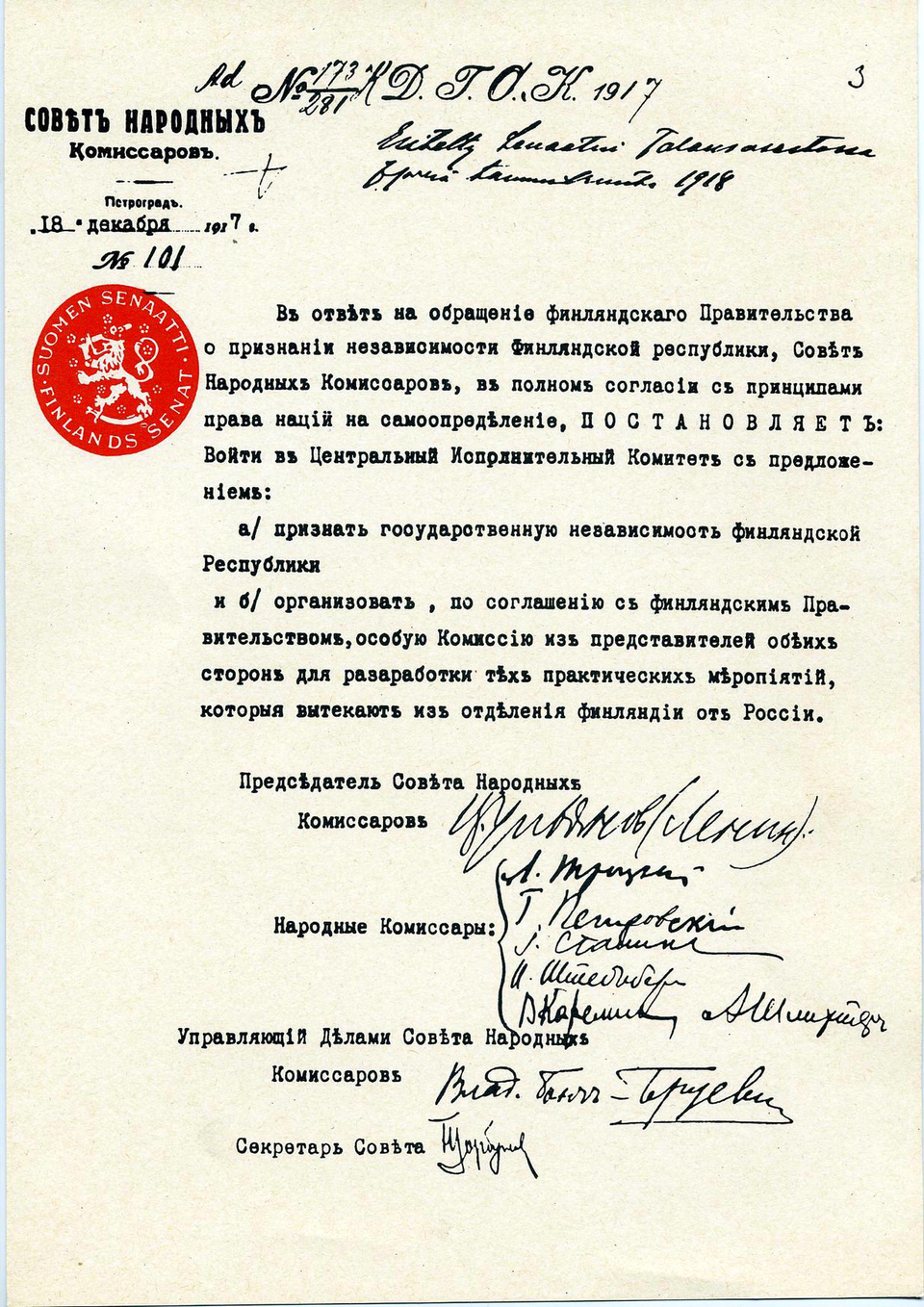
A resolution of the Council of People's Commissars proposing to recognize Finland's independence. Photo: Wikipedia
Later, relations between the USSR and Finland remained tense. It was obvious that the USSR had not forgiven its northern neighbor for the lost territories. In addition, Russia was already used to seeing Finland in its zone of control. Therefore, the Finns had reason to fear that the Bolsheviks would try to take revenge at the right time. The formation of the League of Nations reassured those who feared the return of war for a while. However, in the early 1930s, Japan captured Manchuria, and in the mid-1930s Italy invaded Ethiopia, which showed the helplessness of the League of Nations in resolving international conflicts. As tensions in Europe grew significantly in the 1930s, Finland, Denmark, Sweden, and Norway declared a policy of neutrality. In 1932, the USSR and Finland signed the Treaty of Non-Aggression and Peaceful Settlement of Conflicts, which was later extended until 1945. Finland was supposed to feel safe. But how can we not remember the Budapest Memorandum?
Finland and Russia are negotiating
In 1938-39, the USSR tried to negotiate with Finland. The Soviet Union believed that the distance of 30 kilometers from the strategically important Leningrad to the Soviet-Finnish border was unacceptable. In the second half of the 1930s, the danger of Germany to the USSR was obvious. Therefore, the Bolsheviks feared that the Germans might invade Finland and threaten Leningrad from the north.
In the spring of 1938, the second secretary of the Soviet Embassy in Finland, Boris Yartsev, approached several representatives of the Finnish government with a request to hold secret talks. In fact, Yartsev was not a diplomat, but an NKVD agent who had personal permission from Stalin to communicate with the Finns. Through Yartsev, the USSR expressed concern that Germany might send troops to Finland. To avoid such a danger, the Finns were offered a military assistance agreement. In this case, the USSR would have the right to send its troops into Finnish territory to protect it from the Germans. The Finns refused. First, such an agreement would destroy their neutral status. Second, the USSR could have used this agreement to occupy Finland on "legal" grounds. The next round of negotiations took place in the spring of 1939. The USSR offered to lease Finnish islands in the Baltic Sea, but was again rejected.
The last negotiations between the USSR and Finland took place in the fall of 1939, but a number of important events took place before them. First, the USSR defeated Japan at Halkhin Gol. Secondly, the Bolsheviks managed to sign the Molotov-Ribbentrop Pact with Germany, in which the aggressor states divided spheres of influence in Europe. According to the document, Finland was included in the Soviet zone of control. Third, Germany and the USSR divided Poland. In other words, the USSR formally turned into a powerful expansionist aggressor, although it was still nominally trying to pretend to be a peaceful country. Of course, the outbreak of World War II had a huge impact on all European processes. The fact that Germany, Britain, and France were involved in the war seemed to free the USSR's hands for further expansion.
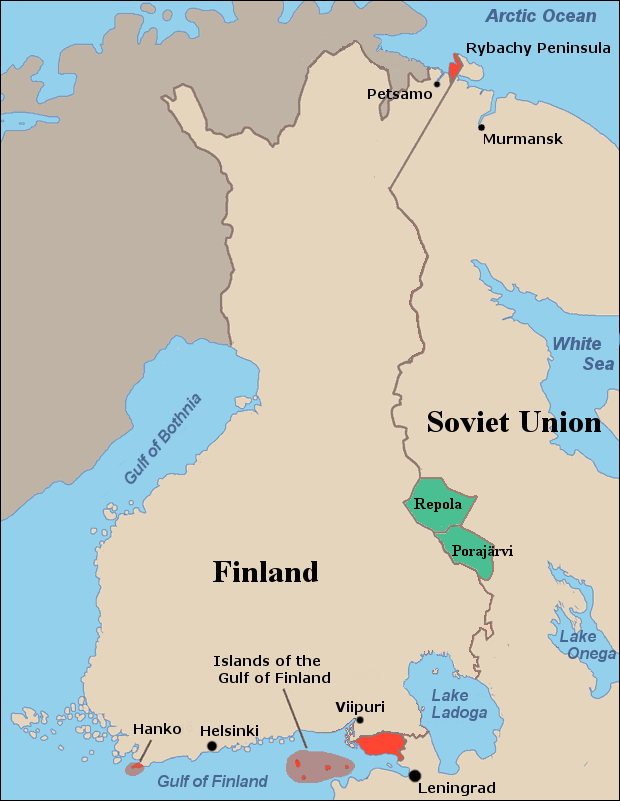
Soviet proposal at the Soviet-Finnish negotiations. Map: Wikipedia
The parties failed to agree on any position. The Finns refused to move the border north of Leningrad because the Karelian Isthmus area was one of the most developed in Finland. Instead, the territories in Eastern Karelia were empty and underdeveloped. The demand for disarmament of the Karelian Isthmus looked like a mockery, because the Finns had been building a series of fortifications there for a long time, which would later become known asthe Mannerheim Line. The Mannerheim Line was Finland's main defense against the Soviet Union. There were those in Finland who actively advocated the need to conclude an agreement with the USSR. Among them was Marshal Carl Gustaf Mannerheim, who was well aware of the danger of war against the Soviet Union. The problem for Finnish diplomats was that the resolution on the transfer of the islands to the USSR had to be adopted by the government and parliamentarians, but it was the Finnish government that had many opponents of the transfer of territories. It is believed that the self-confidence of Finnish politicians was based on the fact that winter was approaching. And it is known to be difficult to fight in winter.
According to Finnish negotiators, Stalin and Molotov were very surprised by the Scandinavians' refusal at the third stage of the discussions. Molotov stated: "We civilians have made no progress. Now the floor will be given to the soldiers." It became clear that the war could not be avoided.
The USSR moves from words to deeds
On November 26, 1939, the so-called "Mainila Incident" took place. According to the Soviet version, the Finns shelled the border village of Mainila that day, killing four Red Army soldiers. It is now known that the provocation on the border was organized by NKVD troops. And even today, historians cannot find evidence that anyone died that day. So we have a typical Soviet-Russian border provocation used as a pretext for war.
The Soviets demanded that Finland withdraw its troops 20-25 kilometers from the border, ostensibly to avoid similar incidents. The Finns offered to investigate the incident and agreed to a mutual withdrawal of troops. The Soviets were allegedly offended by this, and on November 30, Soviet troops crossed the Finnish border along the entire perimeter.
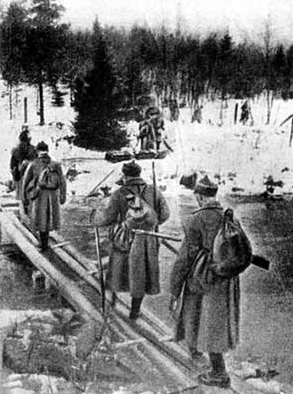
Soviet troops cross the Raijoki River in Karelia. Photo: Wikipedia
Obviously, the USSR had a significant numerical advantage at the beginning of the war. The numbers vary considerably, but they are still quite revealing. The USSR had approximately 450,000 personnel compared to Finland's 250,000. This is a significant difference, but it should be borne in mind that the Red Army troops were stretched across the entire border. More impressive was the technical superiority of the Soviet Union. In particular, the USSR had more than 2000 tanks compared to Finland's 30-60 tanks. In general, it is difficult to find information that Finnish tanks played any role during the fighting. As for airplanes, Finland had up to 270 units, while the USSR had 2,500.
Based on their superiority, Soviet generals discussed the victory over Finland for ten days. This should remind modern Ukrainians of something. Since a quick victory was planned, Soviet soldiers were dressed in ordinary overcoats and boots. They had no idea what a Finnish winter was like.
Anyway, at first the Soviet troops began to advance in all directions. Undoubtedly, one of the key areas of the offensive was the Karelian Isthmus, the territory sandwiched between the Gulf of Finland and Lake Ladoga. Already on December 1, Soviet troops captured the small village of Terijoki in this area, where the government of the puppet Finnish Democratic Republic was formed. This government was headed by Otto Kuusinen, an experienced Bolshevik and member of the Comintern Executive Committee. The USSR immediately began negotiations with the newly created republic, during which it quickly achieved all of its demands.
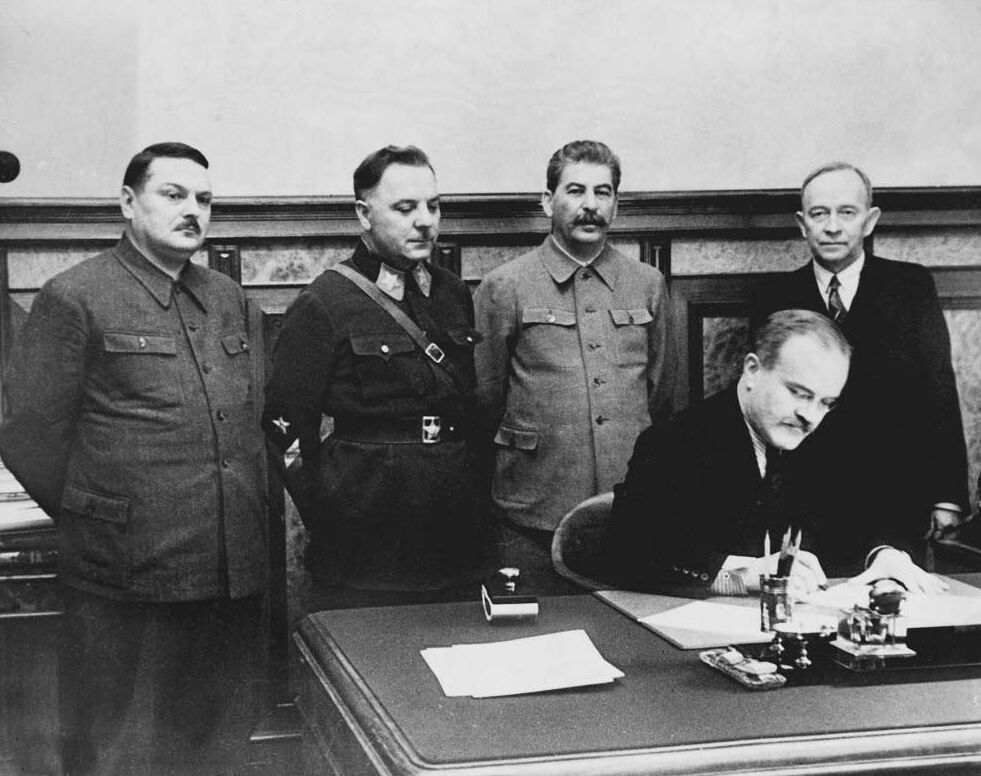
Molotov signs the treaty between the USSR and the Democratic Republic of Finland. Photo: Wikipedia
In the first days of the war, Soviet aviation was actively involved. In addition to military targets, Helsinki was subjected to a devastating bombing raid that destroyed many buildings and caused civilian casualties.
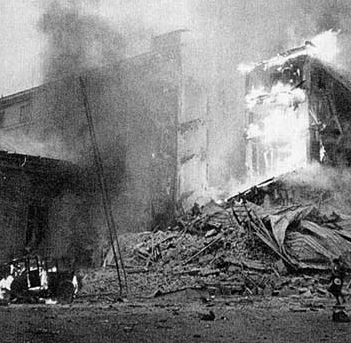
The USSR bombing Helsinki. Photo: Wikipedia
Finland fights back
The main authority on military affairs in Finland was undoubtedly Carl Gustaf Mannerheim. He was a prominent officer in the Russian army and had personal contact with Nicholas II. At the beginning of the war, he was 72 years old, but he was immediately appointed commander-in-chief. Mannerheim's plan was to draw Soviet troops into the snowy forested borderlands of Finland, where they would be subjected to guerrilla warfare. At first, the Finns retreated in all directions. Leaving the villages, the Finns either simply took all the supplies or burned the buildings so that the enemy could not hide from the winter.
As they moved forward, Soviet divisions began to stretch into long caravans. The fact is that snow can fall quite deep in Finland, so it was possible to move with heavy equipment and convoys only by road. Sometimes there was only one road through the forest that was not of very high quality. In such cases, the Finns gained the maximum advantage. Mobile ski groups in white camouflage attacked the stretched column from the flanks and quickly retreated. The Soviet soldiers were so frightened by the Finnish attacks that they even invented Finnish "cuckoo" snipers who were supposedly sitting in the trees. Non-Soviet sources unanimously deny such military know-how, as such a sniper was doomed to die. The Red Army suffered heavy losses from mines that were hidden under a large layer of snow. In the abandoned buildings, a booby trap could be hidden under anything.
On flat terrain, the problem for the Finns was to stop tanks. In addition to mines, artillery, anti-tank weapons, and the so-called "dragon's teeth" were quite effective. In addition, special units were created in the Finnish army to destroy tanks. In addition to grenades, they were armed with Molotov cocktails, bottles of incendiary mixture that were mass-produced by Finnish distilleries. By the way, these cocktails were invented during the Russian-Finnish war.
Gradually, the Finns realized that Soviet divisions stretched out over the terrain could be surrounded and destroyed. To do this, they used the "motti" tactic. First, the Finns blocked the movement of the head of the column and the possibility of retreat in the opposite direction. Then the column was divided into separate "boilers" that were surrounded and gradually destroyed. The encircled experienced additional suffering due to the lack of warm clothing and the inability to deliver supplies. A striking example of the "motti" tactic was the battle near the village of Suomussalmi, where the Soviet 163rd Division was surrounded. The 44th Rifle Division came to its aid, which was surrounded on the march in a narrow area between two lakes. Both divisions were almost completely destroyed. The command of the 44th Division, which managed to escape with the remnants of its fighters, was shot in front of the line.
The key battles took place on the Karelian Isthmus, where the Red Army stopped at the Mannerheim Line, a 136-kilometer strip of pillboxes, bunkers, and artillery firing points. It turned out that the USSR, in its overconfidence, knew nothing about the defenses of the Finnish fortifications. Soviet troops lacked large-caliber artillery to penetrate the armor of the pillboxes. At the end of December, the Soviet leadership decided to stop the offensive and take up defensive positions.
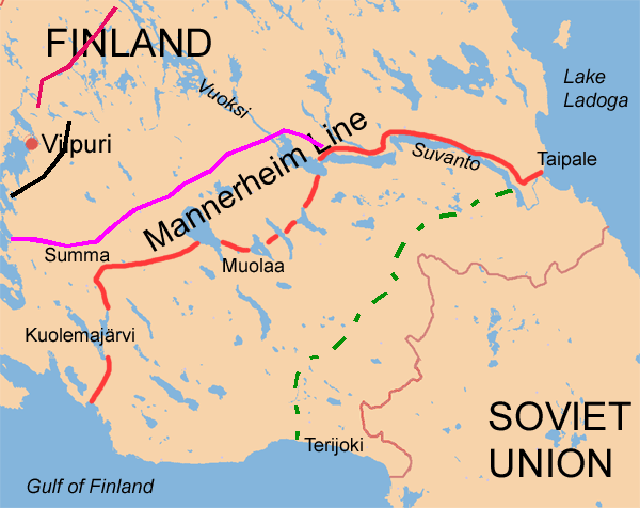
The Mannerheim Line is highlighted in red on the map. Map: Wikipedia
The USSR works on its mistakes and launches a new offensive
The USSR spent January 1940 regrouping its forces. Stalin decided to concentrate the main forces for the attack on the Karelian Isthmus. By breaking through the Mannerheim Line, Soviet troops gained operational space and could move unimpeded to Vyborg, the second most important city in Finland. After Vyborg, Helsinki was next in line.
On January 7, the Northwestern Front was formed to operate on the Karelian Isthmus, with Commander 1st Rank Semen Tymoshenko in charge. This time, the Soviet troops were better equipped. Units of skiers were created. Regular training sessions were held to develop ways to overcome enemy fortifications. For the first time, mine detectors appeared. Heavy artillery and heavy tanks were brought to the front. The number of frontline personnel was brought to 760 thousand.
On February 1, the Red Army launched an offensive on the Karelian Isthmus, but the Finns repelled waves of attacks. On February 11, a general offensive was launched with the support of KV-1 heavy tanks, the Baltic Fleet, and the Ladoga Military Flotilla. After three days of fierce fighting, the first line of defense was broken through. On February 21, the Mannerheim Line was actually overcome. From then on, the Finns could only put up obstacles, but they were unable to stop the offensive.
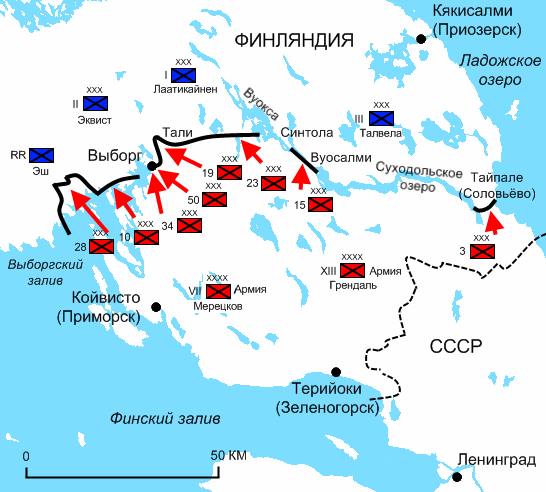
Map of the fighting on the Karelian Isthmus in March 1940. Map: Wikipedia
So Finland began discussing with Moscow, through intermediaries, the option of signing a peace agreement. Interestingly, in March, France and Britain expressed their intention to send some of their troops to Finland. Perhaps the prospect of fighting against the Allies on the side of Germany frightened the USSR.
On March 13, a peace agreement was signed. The USSR gained control of the Karelian Isthmus with the city of Vyborg and a large part of Karelia, several islands in the Gulf of Finland, and part of the Rybatsky and Srednyi peninsulas. The USSR also leased the Hanko Peninsula for 30 years. The border with Finland was moved 150 kilometers away from Leningrad.
Conclusions.
By dividing Poland, and soon afterwards by the war with Finland, the USSR finally demonstrated its expansionist ambitions. Formally, the USSR celebrated victory in the war, as it gained even more territory than it had claimed before the conflict. The Soviet-Finnish border was pushed back a long distance from Leningrad, and Murmansk was covered by new territories in the north. On the other hand, the war brought many negative consequences to the USSR. First, the USSR turned the international community against it. The country was expelled from the League of Nations, and the United States imposed an embargo on trade with the USSR in airplanes and other components of the aircraft industry. Second, many countries concluded that the Soviet armed forces were weak, having once again won due to numerical and technical superiority and significant losses of personnel. In particular, the German military saw the situation in this way, which could have persuaded them to attack the USSR. Third, the war completely destroyed relations between the USSR and Finland. Before the conflict, these relations were simply tense. Now Finland, which had remained neutral, began to finally lean towards Germany, which even promised the Finns to return all the lost territories.
If someone had asked Stalin in 1939 why he had attacked Finland, he would have most likely answered that it was not an act of aggression, but only an attempt to secure his borders. The same rhetoric was used by Putin in 2014 and 2022 when he attacked Ukraine. Moreover, the author of these lines has repeatedly heard this "logic" about the Russian attack from Ukrainians. Of course, such logic is nothing more than the right of the strong, who simply wanted to improve their position or satisfy a need. Thus, a medieval feudal lord has the right to take his subject's bride, while a hoodlum takes money from a schoolboy because he allegedly "needs it for the bus." Obviously, geopolitics is not inherent in morality, and even agreements may not be honored, but when you rob, you at least don't have to put on a virtuous face.
If we evaluate the experience of the 1939 Russian-Finnish war, we can draw many parallels with Putin's activities as president. For example, Putin has repeatedly made provocations to start a war. It is believed that the Second Chechen War began with a provocation by Russian special services on their own territory. Putin provoked Georgia in 2008. He also provoked Ukraine in 2014 and 2022. Interestingly, in both 1939 and 2022, the dictators believed that they would need no more than ten days to seize a neighboring country. The creation of the Democratic Republic of Finland is a direct analog to the creation of the so-called LPR and DPR. Their own unpreparedness for war and ignorance of the enemy's defense resources also characterize both confrontations. It seems that Putin is still learning from the manuals written by Comrade Stalin.