Меню
Соціальні мережі
Розділи
May 1, 2024, 11:16 p.m.
War over a dog that never was
This article also available in English14191

Photo: rua.gr
The Petra Incident or the Stray Dog War was a short armed confrontation between Greece and Bulgaria in 1925 that occurred due to an escalating border clash. As always in such cases, the clash could either be ignored or used as a casus belli. Let's try to understand why the second option was chosen in this case.
Is it possible to blame the dog for everything?
The League of Nations rushes to the rescue
The Balkan powder magazine
For several centuries, the Balkans were dominated by the Ottoman Empire, which managed to enslave many peoples. In the nineteenth century, the empire began to weaken, which was reflected in a series of defeats in military conflicts. Greece gained independence from the Ottomans through the War of Liberation in the 1820s, while other Balkan nations had to wait longer. Part of Bulgaria gained administrative autonomy within the Ottoman Empire after the end of the Russo-Turkish War of 1877-78. The newly created principality of Bulgaria was quite ambitious. Having annexed Eastern Rumelia (an autonomous region within the former Ottoman Empire, in the south of modern Bulgaria; created at the Berlin Congress of 1878 - ed.) shortly after gaining autonomy, the principality initiated the Serbian-Bulgarian War. Bulgaria gained its independence from the Ottoman Empire in 1908, but even before that, it fought with Greece and Serbia for Macedonia. At the beginning of the 20th century, Macedonia still belonged to the Ottoman Empire, which continued to slowly degrade. The Greeks considered the region a historical part of their country, while Bulgarians and Serbs tried to gain access to the Aegean Sea. On the side of Bulgaria, the Internal Macedonian Revolutionary Organization (hereinafter referred to as the VMRO) fought for the liberation of the territory.
It should be noted that tensions between Bulgarians and Greeks began to manifest themselves in the second half of the nineteenth century. In the Ottoman-occupied Balkans, the population was mixed in ethnicity, which led to misunderstandings between national minorities. Additional pressure was created by the religious issue: the Ottomans forced national minorities to belong to the church that dominated a particular region. Priests even forced believers to change their names and surnames from Greek to Slavic and from Slavic to Greek.
In 1912-13, two Balkan wars took place. In the first one, Bulgaria, Greece, Serbia, and Montenegro stood united against the Ottoman Empire to liberate Europe from the Turks. The Allies won, but were not satisfied with the result of the division of Ottoman territories. Interestingly, in the Second Balkan War, the Allied coalition collapsed: the Turks joined Greece, Serbia, Romania, and Montenegro in the fight against the Bulgarians. Since Bulgaria was defeated, it wanted revenge. For this reason, in World War I, the country sided with Austria-Hungary and Germany, but was defeated again and lost a tenth of its territory under the Treaty of Nîmes. As a result of all the conflicts, Bulgaria lost Western Thrace, part of Macedonia, and access to the Aegean Sea. Since a significant part of the population of the lost territories were Bulgarians, Bulgaria continued to make its claims. In particular, the VMRO and the Internal Thracian Revolutionary Organization (IRO), stationed in the country, conducted operations in Greece and Yugoslavia. The VMRO's base was located in the town of Petrich in Bulgarian Macedonia. Since the policy of reconciliation of Bulgarian Prime Minister Aleksandar Stambolski with Yugoslavia did not suit the VMRO, the organization captured and killed the politician. Thus, at the time of the Petrichovo incident, relations between Bulgaria and Greece remained tense.
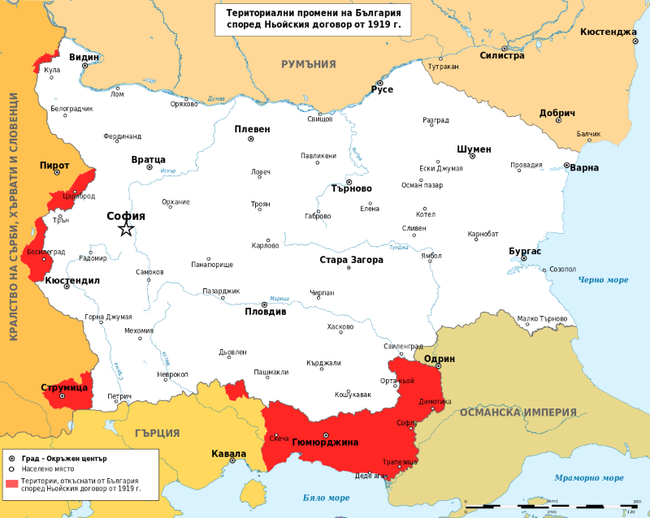
A map of Bulgaria after the signing of the Treaty of Néís in 1919. Map: Wikipedia
Can we blame the dog for everything?
The Petritsa incident began on October 19, 1925, with a border clash. The peculiarity of such clashes is that no one can say exactly what happened and who started first. There is no consensus even on who crossed whose border. The most exotic version claims that a Greek border guard lost his dog, which ran across to the Bulgarian side of the border. Crossing the border in search of the animal, the Greek was shot dead by Bulgarian border guards. For the sake of suspense, some authors point out that the dog was never found. Presumably, the provocateur dog is still running around on the Greek-Bulgarian border... It is thanks to this version that the conflict got its second name, the War of the Stray Dog.
In any case, a Greek captain and a guard were killed during the clash. Bulgaria apologized and offered to set up a commission of Bulgarian and Greek officers to investigate. However, the Greeks were not in the mood for a peaceful resolution of the incident. Greek dictator Theodoros Pangalos decided to use the incident to his advantage. First, on the eve of the elections, he wanted to demonstrate his resolve to the Greeks. Second, the incident "allowed" him to attack the VMRO base in Petrich. The Greek government issued an ultimatum to the Bulgarians, demanding that the perpetrators be punished, that they make an official apology, and that they pay 2 million French francs to the families of the victims. The ultimatum had to be fulfilled within 48 hours, which looked humiliating.
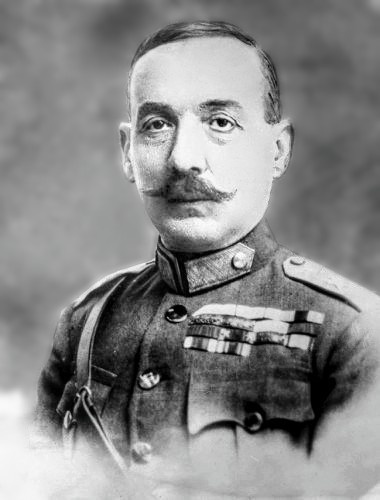
Greek dictator Theodoros Pangalos. Photo: Wikipedia
Meanwhile, on the Greek-Bulgarian border, the area of the clash was restless. Bulgarian border guards were ordered to stop shooting and try to negotiate. However, Greek border guards continued to shoot. On October 20, a Greek aircraft flew low over the border area. Presumably, it was conducting reconnaissance, but the Bulgarians did not attack it. On October 21, it became known that regular Greek troops were stationed near the border. On October 22, the sixth Greek division crossed the Bulgarian border and captured a number of villages. The Greek military then began to move toward Petrich, but were met with resistance from Bulgarian border guards and VMRO soldiers. Bulgarian Defense Minister Ivan Vilkov sent reinforcements to the conflict zone.
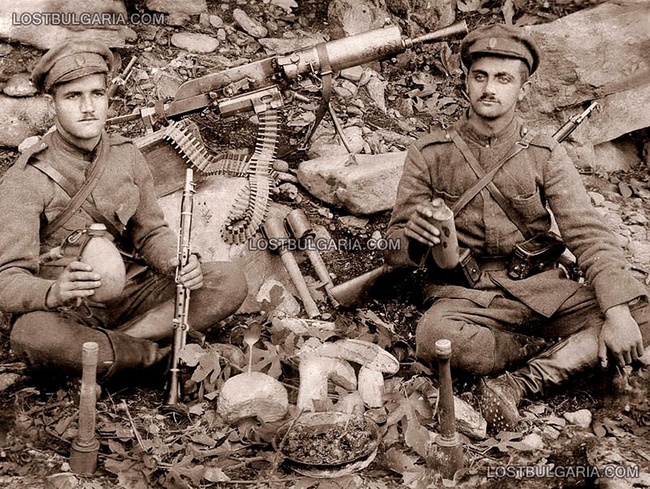
Bulgarian soldiers near the town of Petrich. Photo: rua.gr
The League of Nations is rushing to the rescue
The Bulgarian government decided to resolve the conflict in the diplomatic field. A memorandum was sent to the League of Nations with a request to stop the Greek offensive. The Greeks made it clear that they had no claim to Bulgarian territory, but demanded compensation. However, the situation was resolved in favor of Bulgaria. The League of Nations decided to cease fire, withdraw Greek troops, and ordered Greece, as the aggressor country, to pay compensation to the Bulgarians in the amount of 45,000 pounds. The Greeks fulfilled all the requirements. At the same time, Greece pointed to the double standards for influential and non-influential countries in the work of the League of Nations. In particular, in 1923, during the conflict between Greece and Italy, the League of Nations sided with the latter, which had previously seized the island of Corfu.
Greek troops left the territory of Bulgaria on October 29. Retreating, they took the livestock of local Bulgarian farmers and exported their crops. The losses of the sides vary greatly depending on the nationality of the source of information. For example, Bulgarians talk about 120 dead Greeks. The Greeks themselves limit their losses to five soldiers. Bulgarian losses ranged from 20 to 50 people, including civilians.
The end of the incident hit the authority of the Greek dictator Theodoros Pangalos. In August 1926, a coup took place in Greece, and Pangalos was imprisoned.
Conclusions.
Obviously, the War of the Stray Dog was a completely senseless whim of the Greek dictator. If countries had responded to every provocation on their borders by modern Russia, the world would have been in a state of World War III long ago. Since the war had no real cause, Greece could not count on support from the international community. One might argue that many wars occur without a resolution of the international community. However, in such cases, either the aggressor countries are very reputable and powerful, or the world is not interested in the region where the conflict is taking place. Greece was unlucky with neither. Before that, the young League of Nations had an almost free opportunity to demonstrate its authority at the expense of a weak country. It should be emphasized that this was one of the few times when an international organization managed to do something useful. Failure to have any impact on the outbreak and unfolding of World War II in the future will lead to the natural termination of its activities.
Starting in the last quarter of the nineteenth century, the Balkans became one of the most explosive regions of the world. Many factors contributed to this, including national and religious heterogeneity, which was capriciously combined within territorial boundaries, historical grievances, and resentments that could not be forgotten. The Stray Dog War was not the first or the last conflict in the region. The Second World War and the subsequent Cold War only exacerbated the existing disputes. The Yugoslav wars of the late 20th century culminated in the apogee.
The Stray Dog War has become a good example for future dictators: to start a war, it must be justified in the eyes of the international community. You can provoke the opposite side to take active action, you can intimidate and force them to give up what they want without a fight, you can organize a hybrid conflict based on the principles of "we are not there" and "everything is not so clear," you can even capture a weak country in three days. However, sometimes the manuals fail dictators even in the twenty-first century. And as you know, you always have to pay for mistakes.