Меню
Соціальні мережі
Розділи
Nov. 25, 2025, 7:52 p.m.
How renewable energy projects are displayed in the Dream system
This article also available in English102

PHOTO: https://solar-tech.com.ua/
UAH 30 billion is the cost of a project to build a new CHP plant with a capacity of up to 600 MW in Kyiv. UAH 26 billion for the installation of a modern combined cycle power plant with a capacity of up to 500 MW. UAH 24 billion - design and manufacture of turbine units for Khmelnytskyi NPP Units 3 and 4.
These are the most expensive energy projects in the Dream system. However, none of them has yet been funded.
To be fair, we should add that funding for the next two most expensive energy projects for the construction of thermal power plants in Lviv and Dnipro regions (UAH 15.7 and 13.3 billion, respectively) is available and provided, primarily by international donors.
When the power outages began in October of this year, the question of Ukraine's energy capacity arose. Decentralization and restructuring of the energy system play a key role. And the transition to renewable energy sources (RES) should contribute to this. It is also environmentally friendly, unlike traditional power plants. The latter are also tied to fuel supplies, primarily coal.
Energy initiatives, like other reconstruction projects, are reflected in the Dream system. We decided to find out what the platform says about renewable energy. How many have been implemented? How many remain in development?
What is Dream?
The official name of Dream is "The Unified Digital Integrated Information and Analytical System for the Management of the Reconstruction of Real Estate, Construction and Infrastructure."
Launched in 2023, the system was positioned to record and control every stage of the reconstruction project life cycle. Dream was supposed to collect data from various sources, providing an opportunity to view everything in one place. In addition, the system should create an opportunity for the public to view the status of the restoration and reconstruction processes.
Over the past two years, Dream has grown from a system designed to monitor reconstruction projects into a full-fledged public investment management ecosystem, says Viktor Nestulia, head of the Dream project office. Amendments to the Budget Code of Ukraine and bylaws have been adopted, which require that projects be funded from the state budget exclusively through Dream.
For example, it is through the system that projects are submitted to receive a subvention from the state budget for the arrangement of safe conditions in schools and hospitals, as well as for food service units in schools. Dream is used to form the Unified Project Portfolio of Public Investments of a region (territorial community).
Dream is included in the process of preparing public investment projects and programs (except for projects related to the state's defense capability).
What is currently available in the Dream system?
The data in the system is constantly updated, and projects are added or change status. Therefore, we took data as of November 1, 2025. Projects can have several statuses: "Successfully completed", "In progress", "Initiation", "Unsuccessfully completed", and "Canceled".
For more than 14,500 projects in the system, the total budget is UAH 2 trillion. For comparison, the total revenues of the Ukrainian budget in 2025 amount to UAH 2.3 trillion. But it's not that simple. Available funding covers only 9% of all needs. However, 104 projects have been successfully completed.
One third of the initiatives relate to education (36%), another 15% to healthcare, and 12% to the Water, Sanitation, and Waste Management sector. The energy sector accounts for 4.4% of all projects.
How is the energy sector doing?
The energy sector has 640 initiatives with a total budget of UAH 269 billion and available funding of UAH 37.9 billion (14% of the total). The leaders by number are Mykolaiv (86 initiatives), Dnipro (65), and Kyiv (56) regions.
Only three projects in the energy sector have been successfully completed, and all of them are related to renewable energy sources - solar energy: installation of solar power plants on the roof of the administrative building of the Lyubeshiv village council and on the roof of the building of the Center for the Provision of Administrative Services of the Shatsk Village Council in Volyn Oblast; and solar panels on the building of the Citizens' Activity Center in Solone village, Dnipro Oblast. Their cost ranged from UAH 350 to 800 thousand and was funded by donors.
These projects were registered in the Dream system in 2025, but the contract dates indicated for them are 2023 and 2024. For example, the initiative in Shatsk was created in the system on June 30, 2025, and completed on the same day, although the contract date is May 11, 2023.
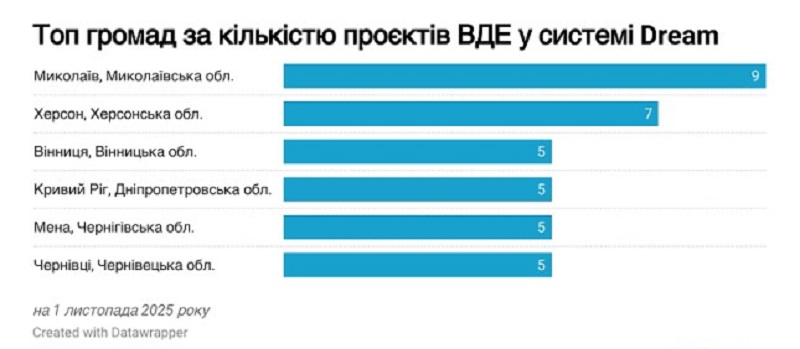 PHOTO: https:// datawrapper.dwcdn.net/yPxvw/1/
Another 68 projects were canceled or unsuccessfully completed. For example, in Kharkiv region, there are 21 projects, 11 of which were initiated by the Izyum district heating company.
The canceled project for the construction of a gas boiler house with a gas metering unit in the Tairovska community of Odesa region even includes a public procurement. However, the procurement took place back in 2021, while the project itself was created in September 2023 and canceled in May 2024.
The example of the same project shows the duplication of initiatives in the system. The Tairovska community has a similar project underway, created in May 2024. No procurement has been conducted here.
What about renewable energy?
The number of renewable energy projects in the Dream system is much smaller, with 168 out of 640 projects. Almost all are in the process of initiation or implementation (165 out of 168), and three have been successfully completed. The largest number of projects was created in 2025 - 105 out of 168.
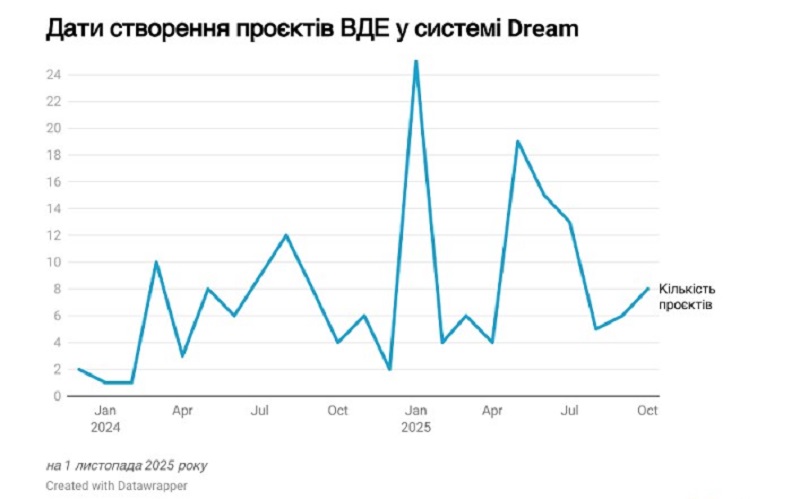 PHOTO: https:// datawrapper.dwcdn.net/nCg9V/1/
The estimated total budget is UAH 42.9 billion with available financial coverage in 23 projects for UAH 70.47 million, which is 0.17% of the total needs.
Out of 168 projects, 133 or 79% are in the solar energy sector. The next most popular areas are biofuels (9.5% of projects) and wind energy (6%).
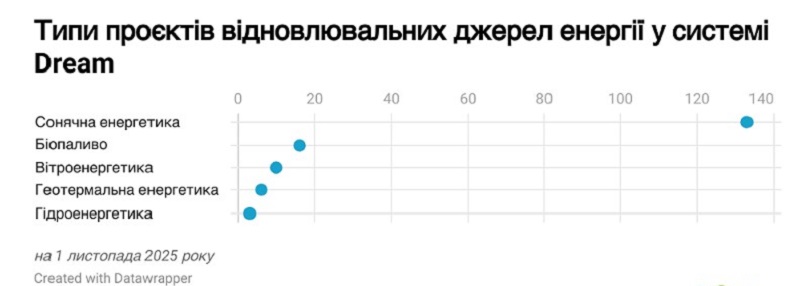 PHOTO: https:// datawrapper.dwcdn.net/2C3GS/1/
Geographically, the leaders are Poltava (19 projects) and Mykolaiv (18 projects) regions. Donetsk, Zaporizhzhia, and Cherkasy regions have only one initiative each. There are no projects in the city of Kyiv or in the occupied Luhansk region.
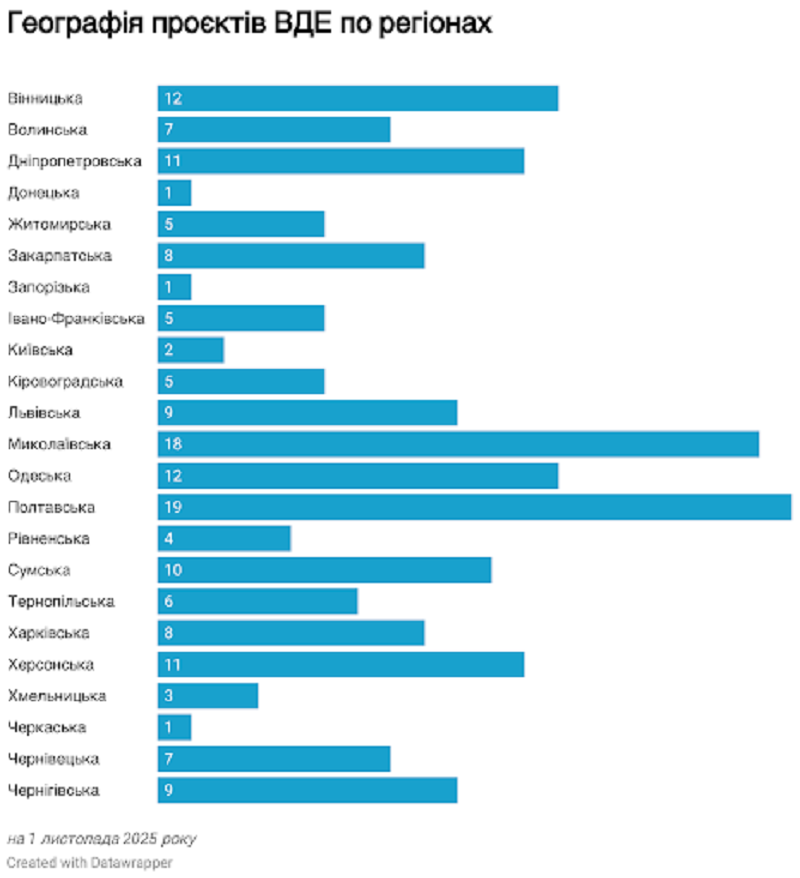 PHOTO: https:// datawrapper.dwcdn.net/z4cD9/1/
The longest project at 112 months is the construction of a CHP plant for the combustion of RDF fuel in the Khmelnytsky community. The cost is over UAH 1.8 billion, but there is no funding yet.
Other "long" projects include: 60 months for biomass power generating complexes for the boiler house of Mykolaivoblteploenergo; 48 months for the construction of a CHP plant running on solid renewable fuels (SRF, RDF) in Chernivtsi; 39 months for the 80 MW ProgressivkaWindFarm in Mykolaiv region.
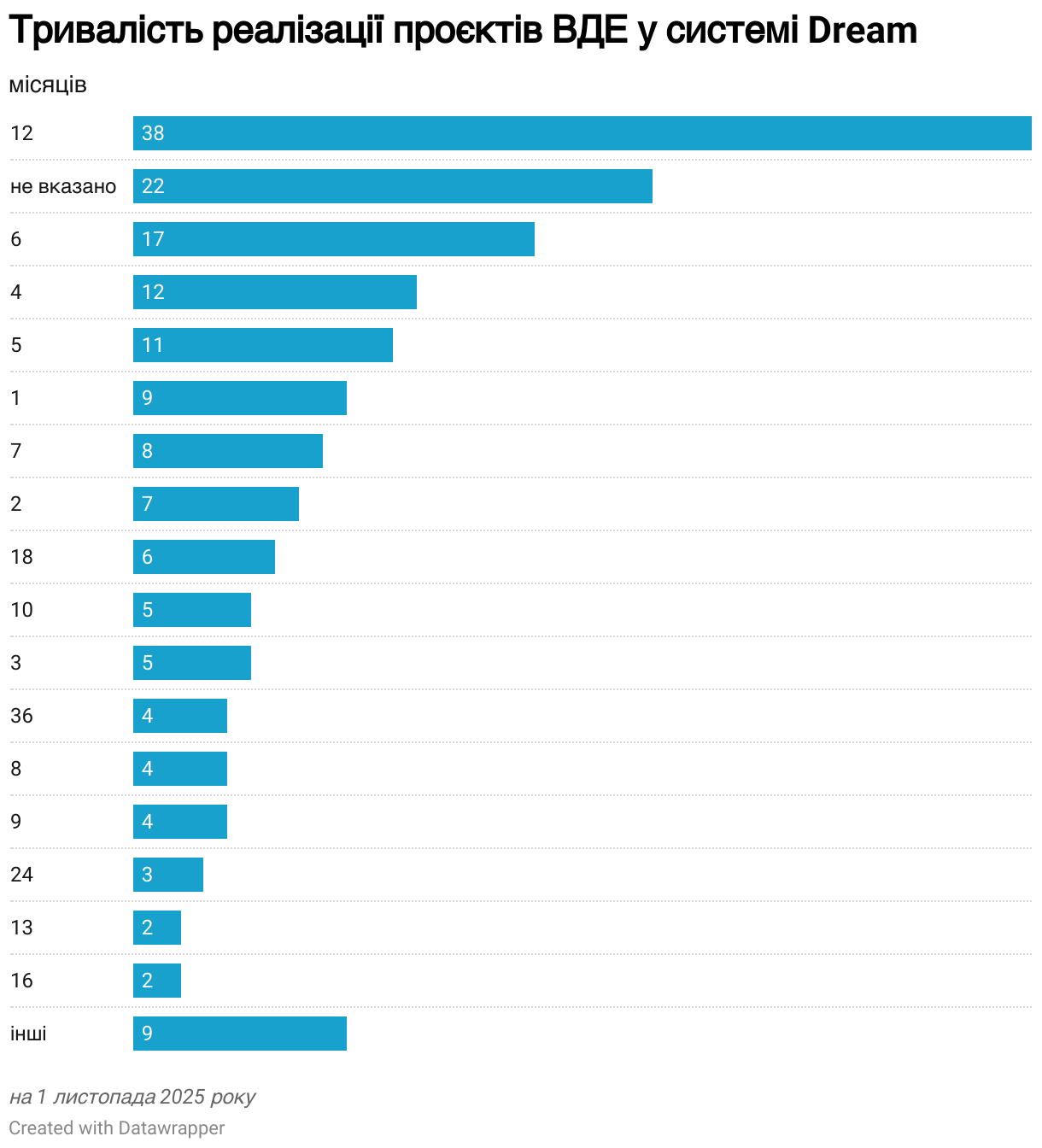 PHOTO: https://datawrapper.dwcdn.net/FNoBt/1/
The most expensive is the construction of a wind farm of up to 100 MW in Poltava region, initiated by the Ministry of Energy, with an estimated budget of UAH 7.2 billion. The construction of a wind farm in Mykolaiv region is estimated at UAH 4.2 billion.
The construction of a mini CHP plant running on solid fuel to generate electricity and heat in Poltava costs UAH 5.7 billion. Zhytomyr also plans to build a CHP plant worth UAH 3 billion.
Catching up with the past
"Yes, we are catching up with the past," says Viktor Nestulia about projects that were created after their implementation. "There are cases when communities inform us about their history of implementing initiatives. It could have been started two years ago, but they come in and voluntarily report on what tenders were held, what they have, and so on. Now the communities have to restart and report on what has already been done, and all new projects will now start from the preparation stage.
Currently, it is difficult to navigate the Dream system data. There are inaccuracies, some projects are not updated, and it is necessary to learn about the actual status of their implementation from other sources. In addition, there are similar projects. There is no supporting documentation for renewable energy.
Now the Dream system is going through big changes, Nestulia says. "Previously, the community could upload anything to the platform, but now projects have to go through stages that are part of mandatory planning. The system was not mandatory, so initiatives were created by communities and not updated. Now, this should change, and without up-to-date project data, it will be impossible to invest public funds in infrastructure.
This article was developed within the framework of the project "Digging More Deeply: Climate Investigations in EaP Countries", supported by Journalismfund Europe and organized by n-ost e.V.
Костянтин Донченко