18 September 2026, 18:45
Igor Gusev: "War turns you into an artist-terminator"
Ця стаття також доступна українською

Igor Gusev. PHOTO: Igor Gusev's Facebook
At first, he painted the war. Then he found himself in the midst of it. At the start of the full-scale invasion, Odesa artist Igor Gusev began creating the series “World War III”—almost in real time, faster than the news feeds could be updated. Today, he speaks about the war from a different perspective: not only as an artist whose works are displayed in gallery halls, but also as a soldier—a member of the “Cultural Assault Force.”
We talked about how a civilian’s perspective differs from that of a soldier, how to address issues of weaponry through contemporary art, and what happens to an artist when, instead of a paint store, he finds himself in the Armed Forces of Ukraine. We also discussed why Gusev says that art today is the only island of freedom he has left.
Background
Igor Gusev is one of the key figures of the New Wave of Ukrainian contemporary art. Born in 1970 in Odesa, he graduated from the M. B. Grekov Odesa Art School. Since the early 1990s, he has been an active participant in landmark art projects, including “Restart,” “Space Odyssey,” “The Independents,” “20 Years of Presence,” and “Double Game”—a special project for the first Kyiv International Biennale ARSENALE 2012—as well as projects for the Odessa Biennale of Contemporary Art. A leader of the Art Raiders art movement, he once founded the underground gallery “Norma.” After the start of the full-scale invasion, the Odessa-based artist began creating a diary titled “World War III.” Gusev uses old Russian books as his canvases, depicting scenes of war on their covers. He regularly shares these drawings with his fans on social media. Gusev’s works have been featured in dozens of exhibitions in Ukraine and abroad. In particular, in late 2024, the exhibition “Drone Over the Empire” opened at the National Museum “Kyiv Art Gallery.” In September 2025, the Odessa Museum of Contemporary Art hosted the “LesyaUA” exhibition, which featured three of the artist’s projects at once: “Card Index”—graphic works about the present and a satire on war; “Drone Over the Empire”—vibrant landscapes set to be destroyed by a drone; and “LesyaUA”—videos, graphics, and installations that reveal new dimensions of Ukraine. In 2024, paintings from the series “High-Precision Love, or World War III” were exhibited in France. In these works, the artist depicted the catastrophe of the Kakhovka Hydroelectric Power Plant’s destruction, with elements generated by artificial intelligence.
You said that everyone has their own war: a soldier has one, a volunteer has another, and an artist has a third. What exactly is your war right now?
Right now, I’m in the military. My path there has been very interesting: from “The Rock” to “Cultural Forces,” where my professional skills are put to optimal use. Right now, for example, we’re working with Ukrainian defense contractors, creating content for mobile containers that will tour Scandinavia. The containers will feature contemporary art, while military equipment will be advertised alongside it. It’s all part of a roadshow. Presenting weapons as an end in themselves is long outdated in today’s world. But through art—it works.
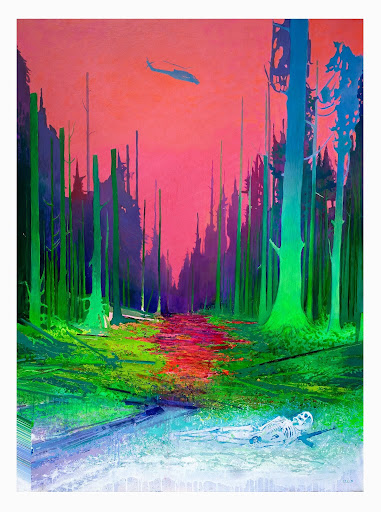
The “New Military Landscape” project, by Igor Gusev. SOURCE: Igor Gusev’s Facebook
You describe your analytical view of reality as your main tool. What do you see today that the average person doesn’t notice?
Ordinary people in civilian life generally don’t want to notice anything at all. They see only the surface: a photo taken through an airplane window or a colleague’s new gadget. The rest of reality simply slips past them. I, on the other hand, try to pause at those moments that others find uninteresting. And in this “uninteresting” stuff, there’s actually a lot that stirs the imagination.
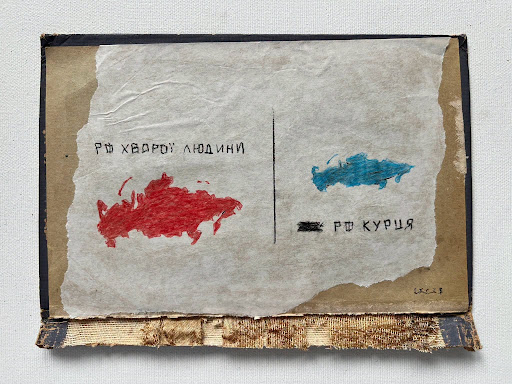
“World War III” series, Igor Gusev. SOURCE: Igor Gusev’s Facebook
How did you end up in the military, and how did that experience change your daily routine?
I ended up in the Ukrainian Armed Forces quite by accident: I went out to buy some paint, was walking toward a store by the sea, and ran into some very “pleasant” people. They were guys from the Tatarbunary Training Center—they’d run out of recruits in the area, so they’d come to Odesa “to go fishing.”
There’s an old truth: you meet people who reflect who you are. Lately, I’ve seen countless versions of my own reflection and am learning to live with it. It’s a kind of “militarized Buddhism.” You ’re constantly in the “here and now.” You have to be ready to react to a command; you don’t have time to daydream or have your head in the clouds. It’s a wonderful diet for the spiritual body.
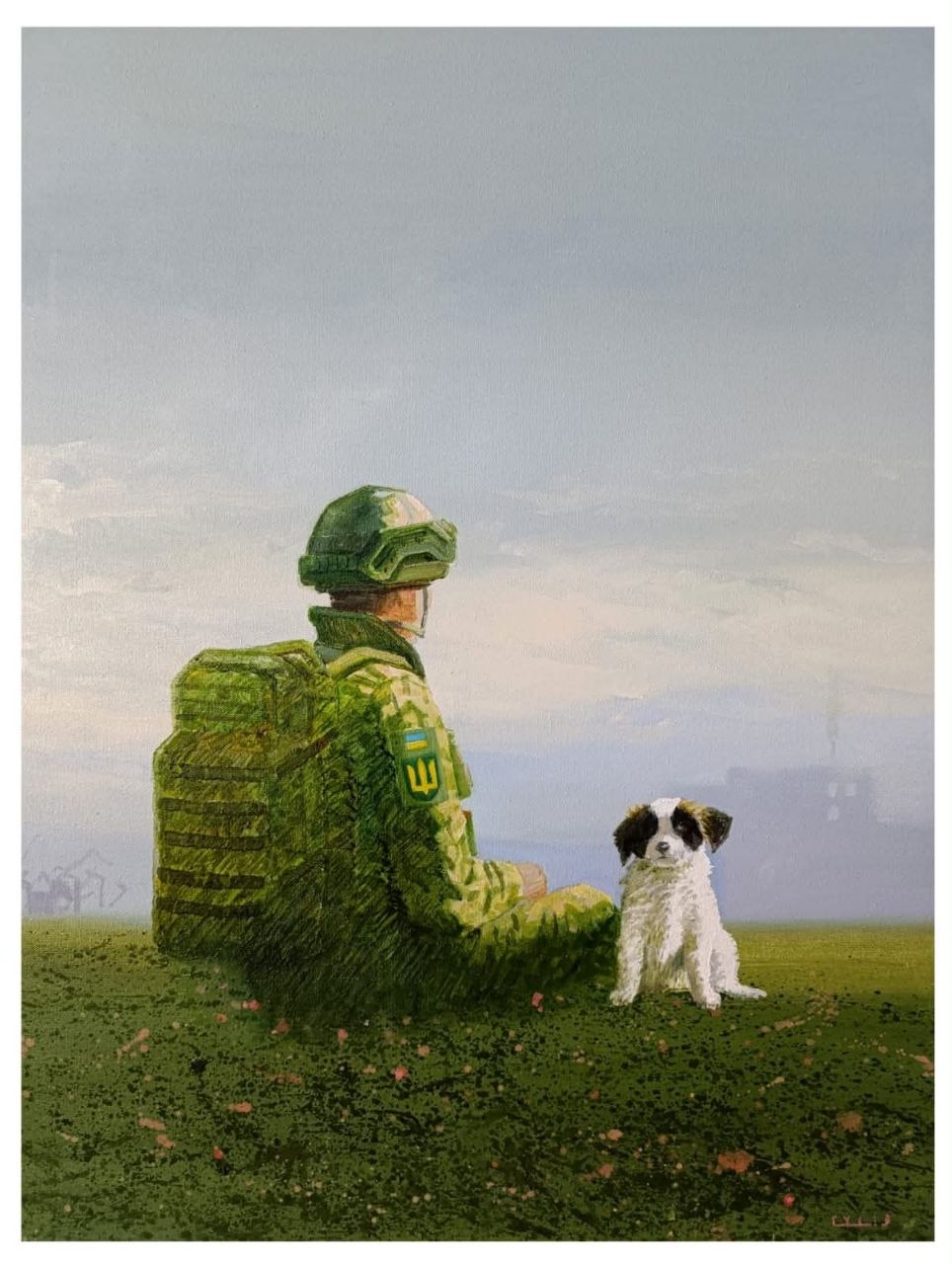
“Brothers in Arms,” Igor Gusev. SOURCE: Igor Gusev’s Facebook
Your current approach is called “the art of rapid response.” Which is more important here—speed or accuracy?
Speed. They say precision has come naturally to me from the start. But if you spend two days fine-tuning and calibrating your work, by then nobody will need it anymore.
Most artists don’t even want to acknowledge the war; they live in their own self-imposed routine. But this situation drives me forward. In the “Third World War” series, you never know what the next piece will be, and that thrill is exhilarating. War transforms you from an academic creator into a “terminator” artist. You have to instantly analyze the situation, calculate your next moves, and at the same time maintain the aesthetic element.
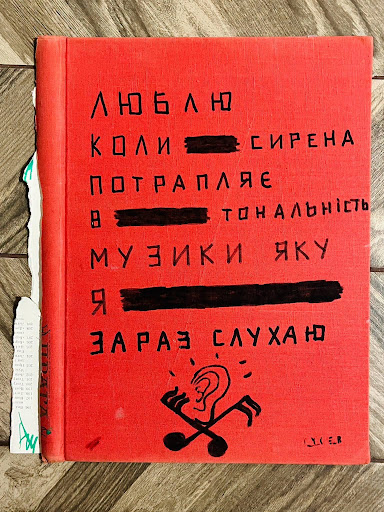
“Third World War” series, Igor Gusev. SOURCE: Igor Gusev’s Facebook
And how should one react to fellow artists who deliberately shut themselves off from the war and live in their own world? With condemnation or with understanding?
Saving those who are drowning is up to the drowning people themselves. If that’s what makes a person comfortable—I’m all for it. The main thing for all of us right now is to survive this situation and stay sane. Some may even slip into a state of detachment for a while, only to come back to their senses later. There are no universal solutions here. I think you have to listen to yourself—all the answers are there. Of course, not all artists are astronauts! Take Serhiy Anufriyev, for example—he’s simply a living dragon.
To what extent is it even possible to maintain an observer’s distance amid sirens and shelling?
I really enjoyed it when I dealt with weapons. I saw someone hang a Kalashnikov assault rifle on a twig—and that inspired me incredibly. I’d never seen an image like that before. It’s like in Remarque’s *All Quiet on the Western Front*: bullets are whizzing by somewhere, and you’re watching how beautifully the shadow from the lace on your combat boot falls. An artist remains an artist even in war.
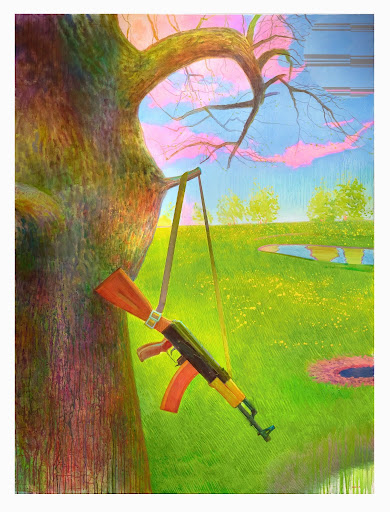
The “New Military Landscape” project, by Igor Gusev. SOURCE: Igor Gusev’s Facebook
What was the most powerful visual impression this war left on you?
The first smoke-filled areas of my city. When, shortly after the war began, I went out to Starokonka Street in Odesa and saw the black sky and the black column of smoke rising above the city. That’s when I finally realized: reality had changed forever.
Is there an image of the war that you saw but consciously chose not to turn into art?
I try to make sure everything is socially acceptable. There are ideas that society might misinterpret right now, so for now they’re tucked away in the far corners of my subconscious.
In one of your interviews, you said that the enemy is rather stupid and comical. Do you still feel that way, or has your opinion changed?
It was a subtle way of engaging with the audience, who were in a state of shock—a kind of sedative. Of course, the Russian army has its share of cold-blooded professionals. They considered themselves a “victorious nation” and bestowed all sorts of epithets upon themselves. But then the discourse had to change, and that needed to be recorded.
Where do you draw the line between dark humor and trivializing tragedy? And is laughter a weapon?
The main thing is not to offend someone who has personally experienced severe stress or grief. And ultimately, dark humor knows no bounds. In this absurd world, laughter is the only way to save yourself and regain your composure.
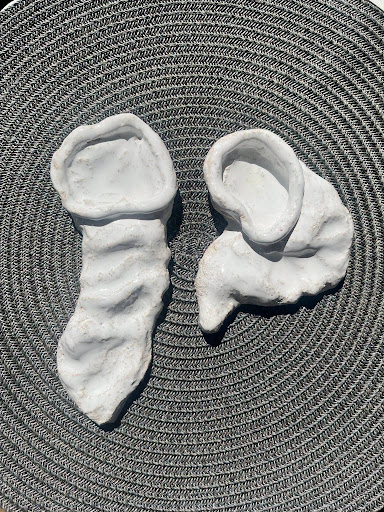
Work by Igor Gusev. SOURCE: Igor Gusev’s Facebook
You take a pretty harshly ironic look at reality in your war diary. Is this a way to attack, defend yourself, or simply engage with your audience?
I work for a specific audience that I’ve imagined. Sometimes, when I watch the news, I open the comments section and already know what the first comment will be. I operate at the intersection of my own thoughts and the collective unconscious of social media users. All you have to do is tap into that space—and suddenly you get the result you need right now.
It’s generally unclear which came first—reality or the artist. Probably the artist, because reality was created by the Creator, and the Creator is the ultimate artist.
You once said that there’s a lot of derivativeness and imitation in Ukrainian art. Has the war changed that?
Our art has long been burdened by a post-Soviet trauma that has taken root in the minds of both collectors and the artists themselves. But now, with the advent of the internet, a lot of cutting-edge aesthetics have emerged.
The downside of being provincial is that we constantly bow to established Western trends. It’s a dead end. But I hope that after the war, when investments come in, something will change. The war is already rebooting the cultural system. It will be 100 percent paradoxical! Right now in Odesa, streets named after writers who made the city famous around the world are being renamed in honor of Ukraine’s fallen defenders—the process is underway.
But what if, tomorrow, a lot of money is poured into Ukrainian art, yet the old system remains in place—will that help?
At one point, a well-known Ukrainian oligarch decided to create a major art center, but ultimately focused on world-renowned artists whose works are worth tens of millions. If even a couple of percent of those investments had been channeled into Ukrainian art, many artists would have had the chance to reach a new level. But things turned out the way they did.
And now everything is being held back by stagnation and the economy: patrons have left, and people are tired of buying art. At the start of the war, something sold every month, but now everything has slowed down.
How do you know when a piece is a success? By the likes, the reposts, or an inner feeling?
Likes and shares—yes. Sometimes I think a piece is a long shot, and then suddenly it gets bought before I even have time to finish it. That’s success for you.
There’s a very dangerous moment for artists: one wrong stroke—and you’re stuck inside the painting for a few more days. You have to know when to stop. Take, for example, Oleksandr Roitburd: he could paint a piece while talking on the phone and never go back to it. But I’m different—I’d wake up in the middle of the night and go check to see how the paint was drying on the spots of the leopard spending the night in a rusty car.
Does the Western art market perceive Ukrainian art differently than we do?
In Ukraine, our work is more accessible. Our art has too much “literary” content and imagery—to understand it, you need to know the context. In the West, however, they appreciate pure visual aesthetics. When my wife, Nata Trandafir, paints her Neo-Geo-style paintings, people in the West are thrilled by them, but in Ukraine, even journalists who write about art don’t understand them.
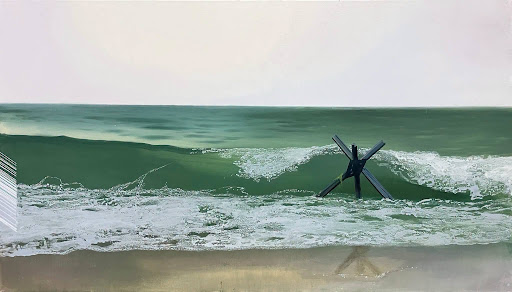
“The Hedgehog and the Sea,” Igor Gusev. SOURCE: Igor Gusev’s Facebook
What is it about a person that technology and artificial intelligence are not yet capable of replacing?
Well, they’re already capable of everything—we just haven’t noticed it yet. We’ve passed the point of no return. Soon it’ll be like this: you buy a bottle of mineral water, and a printer has already printed your portrait and your last phrase right on the label. On the one hand, this is the death of art; on the other, it’s a new chapter.
Can a machine be an artist?
If people absolutely need the “artist’s soul,” they won’t admit it. But I can calmly admit: there are some things a machine already does better than we do, and there’s no need to be ashamed of that.
What are you afraid of today as an artist?
Right now, as we’re talking, drones are flying overhead—I’m actually kind of afraid of drones (laughs). But in general… The worst has already happened to me. Or maybe that was the best part. I’m not afraid of anything in particular.
If we were to remove the war from your life story, what kind of artist would you be today?
I’d be doing the same thing I did before. The only thing is, I’ve realized that I’ve started to perceive color more subtly. I’d just lean more toward color combinations.
One last question: why do you need art at all today?
Right now, art allows me to treat myself as a character whom I at least respect. It’s my last island of freedom. The most important thing I’ve come to understand and appreciate about art during this time is freedom and the will to win—and I have both.