Меню
Соціальні мережі
Розділи
May 21, 2026, 7:11 a.m.
Empire in space: why Yeshkilev's Farengo is a real space opera
This article also available in English0

The first volume of the Fahrenheit series, reprinted in 2026. PHOTO: lyuk.media
Volodymyr Yeshkilev's fantasy epic Farengo, which we have a chance to see in Odesa in June, is defined by the publisher (Georges, 2026) as "the first Ukrainian space opera." For Yeshkilev, a prolific writer from Ivano-Frankivsk, this is not his first large-scale project. He once provided a theoretical framework for the Stanislavsky phenomenon, and his prose is conventionally divided into four main lines in Wikipedia: historical, fiction, art-house, and conspiracy. Moreover, the trilogy was already published by Yaroslaviv Val Publishing House about ten years ago. The first book, The Shadow of the Predecessor, appeared back in 2011.
Of course, one can argue whether Farengo is really the first Ukrainian space opera. For example, Henry Lyon Aldy's Oikoumena series appeared earlier, but was written in Russian and published in Russia. However, another question is more interesting here: what exactly is called space opera today? Where is the line between it and science fiction? After all, the first edition of Farengo explicitly defined the cycle as "science fiction."
In general, I am of the opinion that the presence and popularity of national science fiction (space opera included) is a sign of a healthy society with a healthy vision of the future. It is in this context that the popularity of Kidruk's Colony, as well as the reissue of Fahrenheit, is very inspiring. But first, let's look at the space opera. Yes, there are certain markers that distinguish space opera from science fiction. First of all, it's the ease with which the protagonists travel through space, despite the existing laws of physics and distances of light years. For this purpose, quasi-scientific concepts are used, such as Dark Matter, wormholes, hyperspace, etc. However, such elements alone do not make a work a space opera. For example, Interstellar also actively uses similar ideas, but it is never a space opera.
Another characteristic feature is the presence of mysterious artifacts, traces of ancient civilizations and the so-called Forerunners. Such motifs often appear in the works of Andre Norton, but are almost absent, for example, in Henry Lyon Oldie's Oikoumena, Dune, or Lois McMaster Budgold's large-scale cycle about Miles Forkosigan.
Often space opera also tends to be mystical: parapsychic abilities, prophecies, secret orders. In Dune or Oikoumen, such elements play an important role, while in Budgold they do not. The same applies to other intelligent races: in some cycles they are present, in others the authors limit themselves to various forms of humanity itself - bioconstructions.
An important feature of space opera is its scale: several planets, several worlds, a large number of characters, and movement from planet to planet. At the same time, the scale itself is not a defining criterion. For example, Isaac Asimov's "Foundation" is a large-scale epic, but it is still classified as science fiction.
Of course, space opera cannot do without space wars - in almost all of these texts, someone is at war with someone in space.
Therefore, space opera is a genre with rather fluid boundaries. At the same time, all of these works have two features in common. First, space opera is literally a cosmic scale of events. Secondly, the texts have a large plot that spans many books.
It is significant that in Farengo all these typical features of space opera are present. That is, there are secret societies of the Carriers of Higher Knowledge (something like Ben Gesserit in Dune), there are telepaths, there are remnants of old civilizations (like Andre Norton in Space Sargasso), there is an unfriendly Lizard civilization, there are military space bases, there are evil, voracious creatures from the abyss, there is humanity that has settled in space, there are bioconstructs. Of course, everyone moves from planet to planet in violation of the laws of physics. It is not at all surprising that Yeshkilev, a philosopher by profession and a cultural critic by heart, is well versed in genres. And if he does something, he does it by the rules.
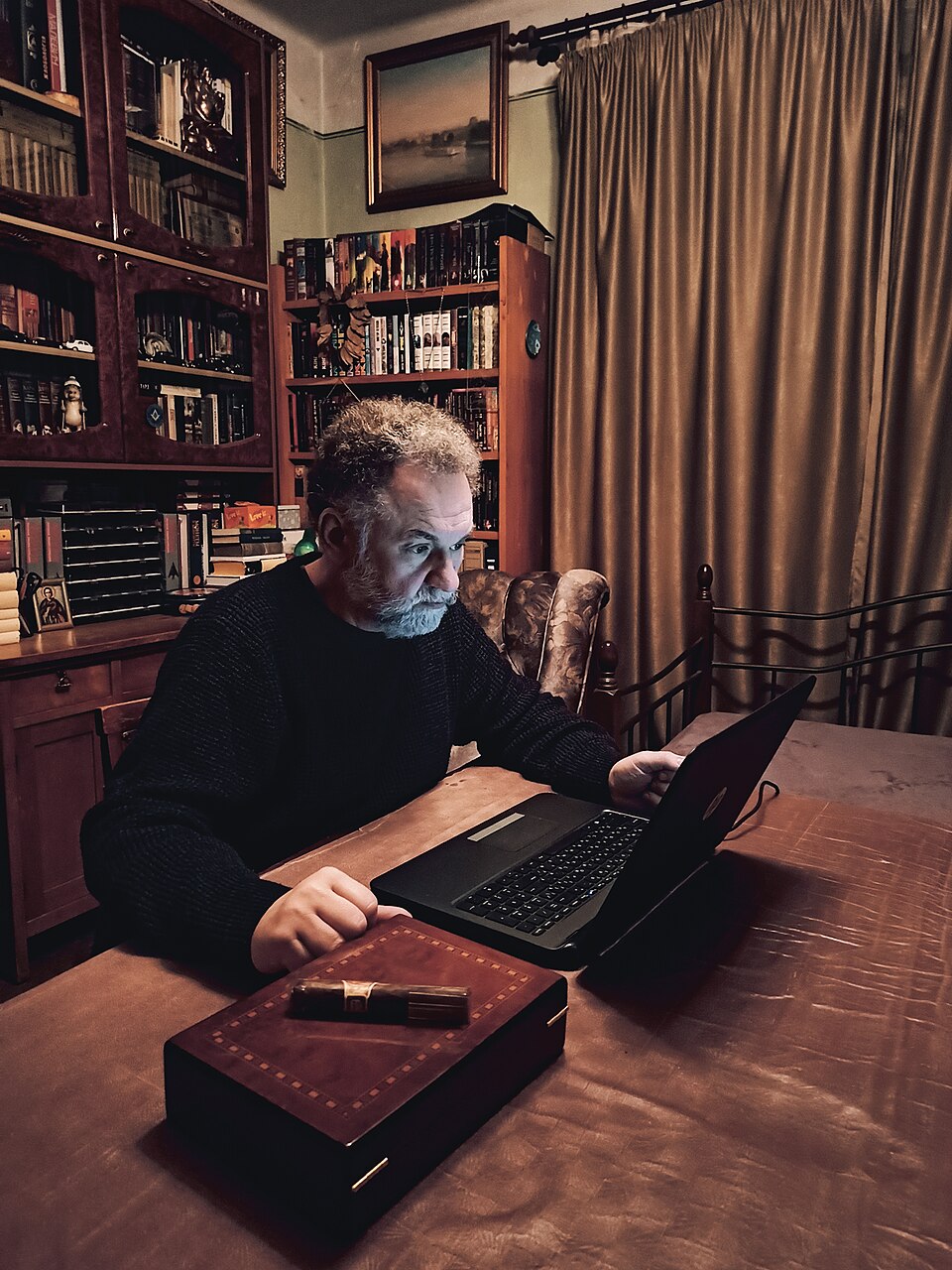
Vladimir Yeshkilev. PHOTO: Nadiia Dutchak
But here I will highlight one more feature typical of space operas: the combination of sophisticated, advanced technologies with archaic social structures. Simply put, space opera is almost always about the Empire. About its rise, its fall (more often about the fall), about rebels, about rebellions, about rebellions against rebellions, about intrigues on a cosmic scale. And empire is always about rigid caste and hierarchy, whether in Dune, the Forkosigan Cycle, or Oikoumen. The world of Fahrenheit is no exception: the lower rung of the hierarchy is occupied by clones, the higher rung by old families, most of which are said to have had traitors, smugglers, bandits, and pirates as their founders.
Yeshkilev himself notes that the rise of empires is as much a necessary element of the historical cycle as the fall. And it is these processes that the author explores in Farengo. Here we must pay tribute to his historical sensitivity, because The Shadow of the Predecessor, the first part of the Fahrenheit cycle, was published in 2011. In the novel, we see a detailed description of the combat work of unmanned military boats and drones (space drones, of course). I even thought that the author had modernized the text a little bit when reissuing it, taking into account modern realities. But when asked, he replied that he had limited himself to only minimal editorial changes. By the way, I had never seen anything like this in space operas before.
Yeshkilev is a good predictor. In an interview with Natalia Dudko on the website of the Lviv City Council's newspaper Ratusha, he said back in 2012 that "...the future will be more rigid, totalitarian, and less humane." This is what we are witnessing now. This is the future the writer builds in Farengo. Of course, if you foresee something, it happens not there, not in that way, and not at that time. But any model teaches us to accept the cruel reality.
And then there's the matter of ours, the actual one. I'm used to space in space operas revolving around a central character or a small number of characters we sympathize with and identify with. Here, Yeshkilev is honest with us. There is no "boy who survived", no hero with physical or mental disabilities who prevails because of his abilities, Destiny, Fate or hypercompensation... The story is driven by the clash of rebellions and intrigues, the confrontation of intentions of different communities, and the counterplay of intelligence. A single person can do little here. Alliances arise and fall apart, everyone wants something, often different things... At least it's honest, and it sets Farengo apart from other space operas. But this brings our interaction with the text to the level of an intellectual game. Because in reality, there is no Count of Monte Cristo, no Odysseus, and even no Harry Potter in the great story. It happens that the fate of humanity is pushed in the right direction by people who are not at all perfect, and sometimes even not very nice.
I want to talk about the downside, which is a continuation of the upside. If everyone has their own truth and lies, if the wheels of history are driven by the interaction of many actors in different parts of the inhabited Cosmos, if it is impossible to single out the main protagonist (in fact, it is in space operas that good and evil are clearly separated), then we risk losing part of what makes us turn the pages with anxiety and hope in anticipation of further events. By the way (although I may be too picky), I was a little surprised at the beginning by the "earthly" animal metaphors and associations - salmon-colored light, a character waving his hand as if to drive away a fly, thoughts that jump like squirrels, etc. Given that some of the characters did not grow up on Earth, such a passion for terrestrial fauna is a bit surprising.
Finally, I would like to mention the very nice, aesthetic design of the new edition. As for me, the only chance for a paper book to survive as a phenomenon is to turn into an art object. Such an edition, with its stylish cover, colorful borders, and pleasant to the touch paper, can decorate any bookcase.
Марія Галіна