20 July 2026, 18:44
Half a Billion Down the Drain: Who Paid for the Water Main for Odessa's High-Rises?
Ця стаття також доступна українською

ILLUSTRATION: CPR/Intent/AI
In Odesa, construction is nearing completion on the “Bagritsky–Frantsuzsky Boulevard” main water pipeline, costing approximately 500 million hryvnias, which was first planned 15 years ago. This project is intended to ensure a reliable water supply to the Primorsky District—a resort area and one of the most densely populated parts of the city, where the existing network has been unable to handle the load for years. Funding for the construction came from the Fund for Eliminating the Consequences of Armed Aggression and the city budget, although the war has nothing to do with it: the water main is needed so that the network can handle the new apartment buildings, the construction of which the city council has been approving for years along French Boulevard and deeper into the Primorsky District.
Intent, together with the Center for Public Investigations, uncovered how the Odesa City Hall managed to turn a business project into a project to address the consequences of armed aggression.
How This Project Came About
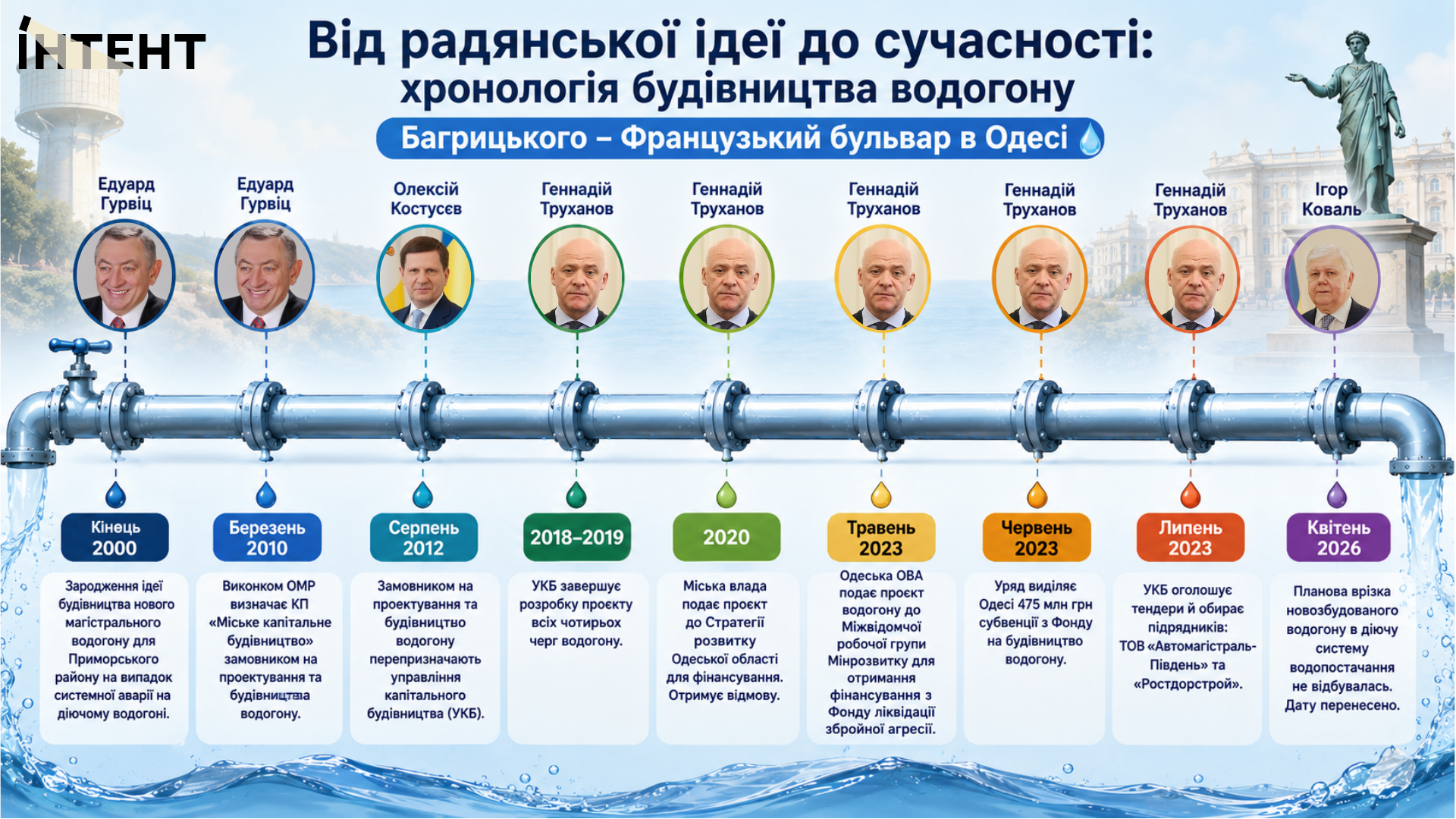
According to First Deputy Mayor Oleksandr Filatov, the idea for this water pipeline dates back to the early days of Ukraine’s independence in the late 2000s. At that time, Filatov says, “the issue was to have a backup water supply for the Primorsky District, primarily along the coastline, because any serious systemic failure on the existing water pipeline would result in a disruption of service for a large number of customers.”
However, nearly two decades passed between the initial concept and the first official steps. During Eduard Gurvitz’s tenure, the Executive Committee of the Odesa City Council designated the municipal enterprise “City Capital Construction” as the contracting authority for the design and construction of main water supply networks from Bagritsky Street to Frantsuzsky Boulevard due to rising water consumption in the Primorsky District. Two years later, in 2012, these functions were transferred to the Capital Construction Department.
In 2018–2019, the design of all four phases of the water main was completed, with three phases calling for the use of 800-mm-diameter pipes and the fourth phase using 600-mm-diameter pipes. According to calculations, the capacity of this network was designed to supply water to 200,000 consumers. Half of them are residents of buildings along French Boulevard. This is a significantly larger number than even the current population there. It appears that the water main was designed from the outset with new construction in mind.
INFOGRAPHIC: Intent/AI
But funding for it was lacking for a long time. And while the city was searching for money for the new water main with one hand, with the other it was allowing development in the Primorsky District. As a result, over the past 15 years, dozens of new high-rises have sprung up along French Boulevard, built by three or four key companies.
The largest of these is the Kadorr Group, founded by the late Adnan Kivan: the “Perlyny” series, the “Korolivski Sady” residential complex at 60 Frantsuzsky Boulevard, the Kadorr business center, and now the large-scale KADORR City near the 4th station of Velykyi Fontan. In total, there are over 60 buildings in Odesa.
The second is the municipal enterprise “Budova,” known for the “Four Seasons” residential complex (four 25-story buildings at 19 Lesya Ukrainka Avenue). The official beneficiary of “Budova” isDmytro Dimarskyi —a name Odessa knows for another reason: Dimarsky is implicated in the NABU and SAPO case involving Volodymyr Galanternyk’s criminal organization, which, according to the investigation, caused over 558 million hryvnias in damages to Odesa between 2016 and 2019 through illegal construction.
The third is “Gefest” LLC, owned by Panteleimon Bumburas, the Honorary Consul of Greece in Kherson: a series of Greek-themed residential complexes; the company is currently completing the “Acropolis” residential complex at 25 Fontanska Road.
This is not an exhaustive list. But these three companies are the largest developers in Odesa’s Primorsky District. It was the residents of their buildings who began experiencing water problems when the existing network gradually became unable to cope with the increased load.
What’s wrong with the water supply in the district
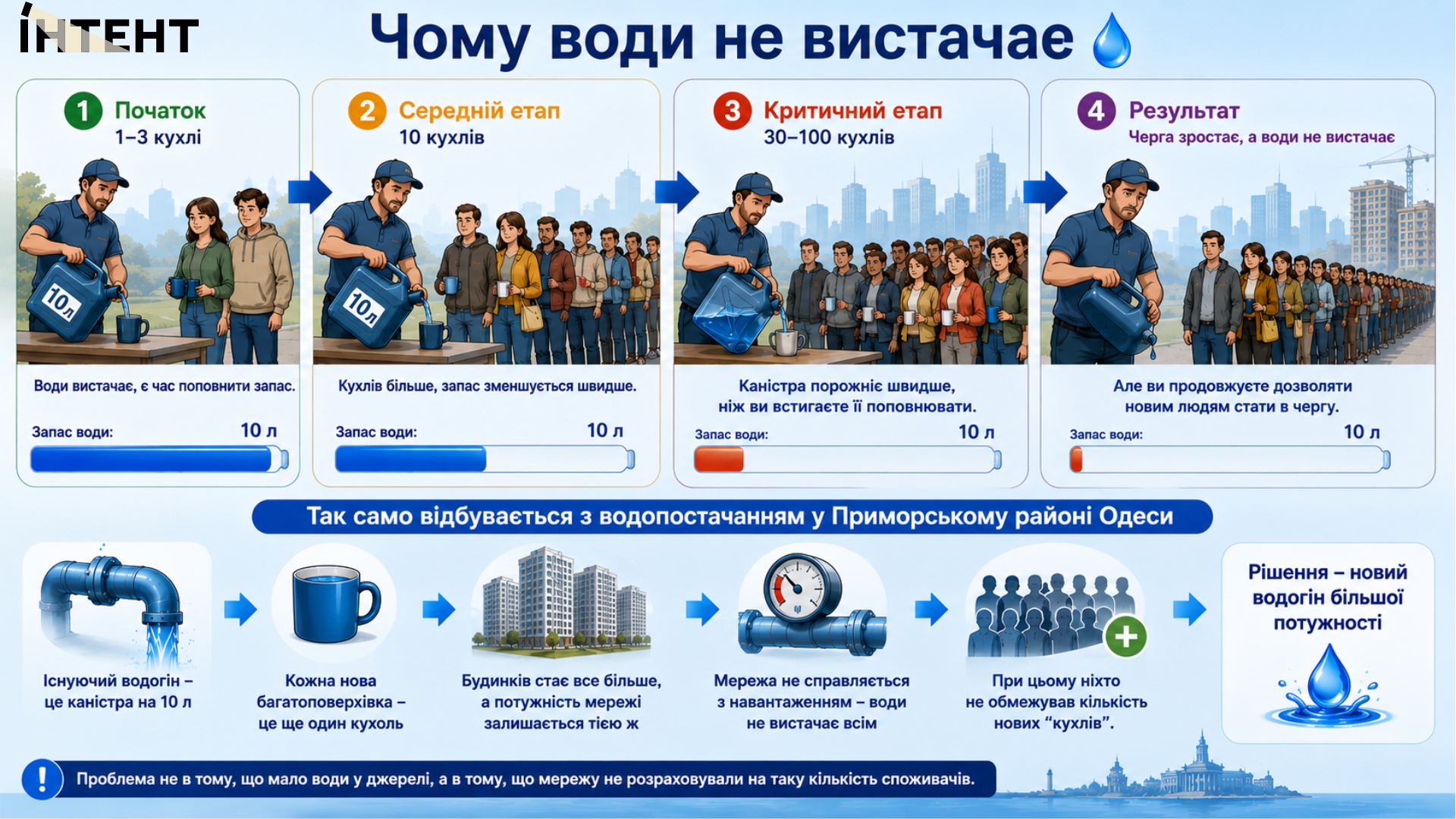
Imagine you’re handing out water from a 10-liter canister. One mug of water, then a second, then a third—everything’s fine; there’s enough water, and you have time to refill the canister. But then the number of mugs grows to 10, 30, 100, and at some point, the canister empties faster than you can refill it. Yet you keep letting new people join the line with their mugs.
This is a pretty accurate analogy for what happened with the water supplyin Odesa’s Primorsky District: every new high-rise building connected to the existing main water line was like another mug. And no one limited the number of them.
INFOGRAPHIC: Intent/AI
As early as 2020, the Committee for the Development of the Odesa Region’s Development Strategy noted the water supply problem in the Primorsky District anddirectly linked it to the active development of the area. The minutes of the meeting held on February 11, 2020, state:
“The aforementioned construction [of a new water main—ed.] is necessitated by the rapid increase in the number of apartment buildings along the route of the proposed main water supply network. The construction of these apartment buildings was approved by the Odesa City Council even in violation of the requirements of the General Plan and the Zoning Plan. At the same time, such construction of apartment buildings became possible because ‘Infox’ provided construction companies with the initial conditions, confirming the capacity of the existing main water pipeline to handle the load…”
After analyzing this document, two conclusions can be drawn immediately. First: the private company“Infox,” which has been operating Odessa’s entire centralized water supply system under a lease agreement since 2003, issued technical specifications to developers for connecting to the water main without actually verifying its capacity. Second: the Odesa City Council approved this development without taking into account the requirementsof the master plan andzoning plans.
How to Paint a Project in Military Colors
Thus, the water supply problem grew, while the project for a new water main remained on paper until 2023. It was then that a loophole appeared in the rules governing the use of funds from the Fund for the Elimination of the Consequences of Armed Aggression—which was established after the full-scale invasion in 2022—allowing Odesa authorities to draw funds from it for the new water pipeline.
Initially, the law allowed the Fund’s resources to be spent only on the reconstruction or major repairs of infrastructure facilities. But as early as April 2023, parliamentadded the option to finance “new construction” of water supply facilities. It was this amendment that opened the loophole exploited by Odesa.
Subsequently, the Accounting Chamber did indeed report on the non-transparent allocation of the Fund’s resources. Consequently, the rules for using the Fund’s resources were changed. Now they can be used for“the restoration of infrastructure facilities related to the provision of water supply and wastewater disposal services…”
However, Odesa officials managed to take advantage of this temporary opportunity, and as early as June 2023, the government,by itsdecree, allocated 475 million hryvnias in subsidies to the city, the lion’s share of which was earmarked specifically for the construction of four sections of this water main. A telling detail: according to the Ministry of Infrastructure, out of the 15 projects that Odesa submitted for funding from the Fund, funds were allocated for only 6. Four of these six were phases of the“Bagritsky–French Boulevard” water pipeline. The remaining nine applications were rejected—largely due to non-compliance with safety requirements for civil defense structures.
In a conversation with Intent, Oleksandr Filatov explained the logic behind the decision as follows: “There was a relevant government program. We couldn’t pass up the opportunity to receive about 400 million hryvnias to build this water main.” In other words, the city administration’s official position is: we took the money because it was offered. The question of whether the construction of water supply networks in the Primorsky District constitutes “remedying the consequences of armed aggression” did not even arise within this line of reasoning.
At the same time, in the DREAM State System, this project is describedwithout any mention of the war:
“Due to the growth in residential construction, which is provided for in accordance with planning decisions in the Primorsky District of the city of Odesa, the issue of ensuring an uninterrupted supply of domestic and drinking water to residents and consumers in this district has become acute…”
In other words, the submissions to the working group cite one rationale (citywide scale), while the technical descriptions in the DREAM system cite a completely different one (the consequences of new development). All within the same project.
Odessa’s population has halved on paper
In the list of projects submitted by the Odesa Regional Military Administration for consideration by the Interagency Working Group of the Ministry of Community and Territorial Development on May 12, 2023, the following is stated for each of the four phases of the water main:
“Number of people who will use the service—1,010,537 people—the population of the city of Odesa as of January 1, 2023. Every resident of the city of Odesa will benefit from the project’s implementation.”
Eight months later, in the documents for the working group meeting on February 9, 2024—where continued funding was discussed—the “number of users” column already listed 503,000 people. That is, half as many.
Meanwhile, the project itself had not changed—the same four phases, the same pipes, the same route. The change in the number of future users in the documents was not accompanied by any technical justification.
“I think that at first you simply included the entire population of the city, and then you counted these districts—Kyivskyi, Khadzhibeiskyi, and Primorskyi. And that’s why this figure was adjusted, because it certainly doesn’t apply to the Peresypskyi district. When it comes to this water supply system, it really does serve 500,000 residents,” Filatov explained.
In other words, city hall effectively acknowledged that in 2023, they “initially recorded the entire city’s population”—without any actual reference to the real number of future users. This confirms the assumption that, in order to secure funding from the Fund, the 2023 application used a “citywide scale.” When it came time to simply extend funding into 2024, the figure was adjusted to a realistic value.
“Savings” of 45 million
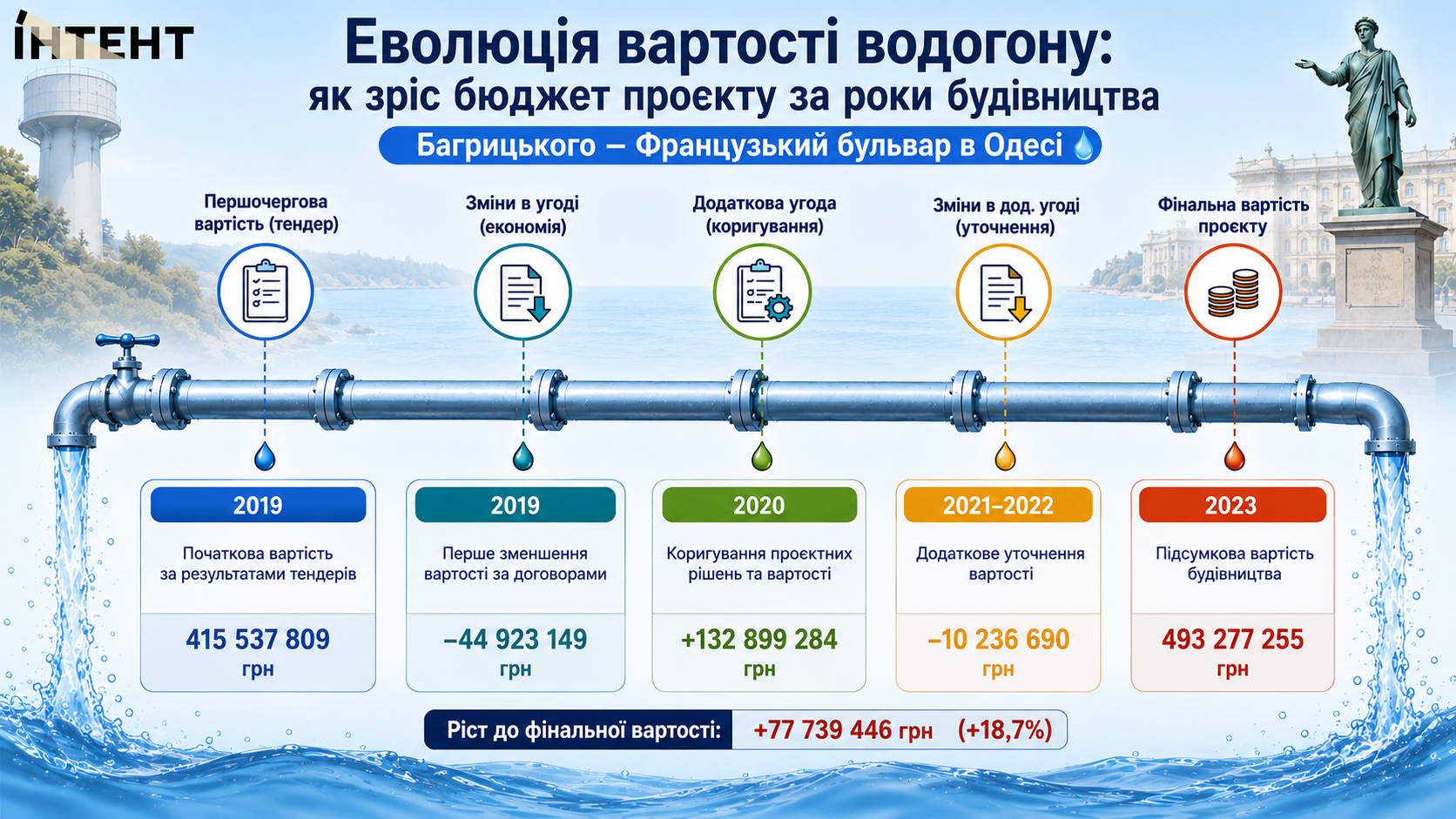
As early as July 27, 2023, the Capital Construction Department of the Odesa City Council announced four tenders—one for each phase of the water main project. The first and second phases went to Avtomagistral-Pivden LLC, whilethe third andfourth went to Rostdorstroy LLC. Both contractors are part of a well-known pool of Odesa road and construction companies that regularly divide large local tenders among themselves.
INFOGRAPHIC: Intent/AI
Our colleagues at “Nashi Hroshi” alsowrote about the lack of transparency in these tenders: during the bidding process for 416 million hryvnias, the OMR Construction Management Unit did not publish the final resource breakdown, and the most expensive component of the project—the price of pipes—remained hidden.
In addition, the actual cost of the work increased after the bidding due to “price adjustments.” In other words, the winners used an old scheme: a bidder quotes a lower price during the auction, beats out competitors, and then, through “adjustments,” brings the cost back up to the estimated amount.
Who Was Supposed to Pay for the Pipes
However, perhaps the most important question is whether it is truly appropriate to spend funds from the State Fund for the Elimination of the Consequences of Armed Aggression on the construction of a municipal water supply system—a system that city officials have been saying is necessary for 15 years.
As a reminder, until January 1, 2020, Ukraine had a system requiring developers to contribute to the development of a settlement’s infrastructure. Construction clients were required to pay a contribution to the community budget of up to 10% of the project’s estimated cost (4% for non-residential projects). The community could allocate these funds to the development of engineering and transportation infrastructure—in particular, to new main water supply, sewer, and power supply networks.
In 2019, parliament abolished the cost-sharing requirement. They argued that the system was corrupt and opaque, and that the amount of the contribution was set arbitrarily by local councils. At the same time, they did not propose any alternative. In other words, Ukraine has not introduced any mandatory mechanism that would require developers of new multi-unit residential projects to share the financial burden of developing city-wide engineering infrastructure with the community.
When asked by Intent whether the situation should be reviewed at the local level to find a way to involve developers in investing in such projects, Filatov replied that they would consider it:
“We would gladly [ involve developers in investing in such projects] do so, but this is a matter for the legislature, which first abolished the 10% housing quota for the city and then also abolished the 4% financial contribution to the city budget specifically for infrastructure development.”
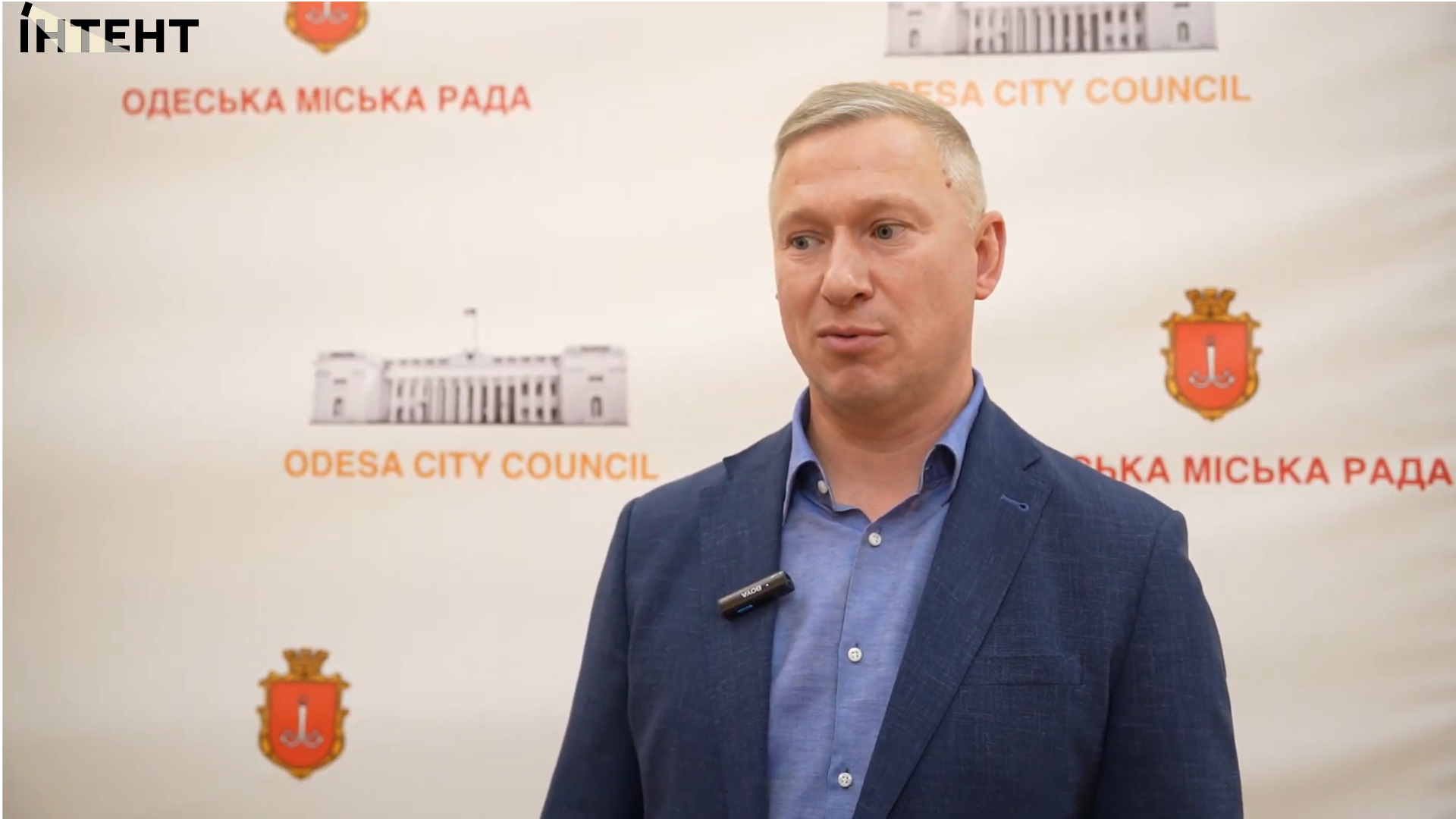
Oleksandr Filatov. PHOTO: Intent
At the same time, mechanisms such as mandatory co-financing agreements for the development of utility networks—which the city can enter into with developers on its own—have not even been considered yet by the Odesa City Council:
“It’s an interesting proposal; we’ll just work on it. I’ll ask my colleagues to develop it further, and we’ll look at other experiences. Because it’s one thing to be working on something, and another to see results.”
It was in this gap that the Odesa story unfolded. Developers were building multi-unit residential complexes in the Primorsky District, bearing almost no costs for the development of the main utility networks required by their projects. The network operator—the private company “Infox”—issued technical specifications to them. And when the load exceeded all permissible limits, all Odessa residents began paying for the new main utility line.
A 26-Year Trap
The question of who will maintain the water main after the work is completed remains open, since the city government does not have its own municipal water utility. On December 17, 2003, members of the Odesa City Councilleased the entire property complex of the municipal utility “Odesvodokanal” to Infox LLC for a term of 49 years—until 2052. The water supply and sewer systems throughout Odesa as a whole remain municipal property, but they are operated by a private company. At the same time, the agreement itself contained contradictory provisions: on the one hand, the lessee was required to carry out the construction and reconstruction of the networks at its own expense; on the other hand, the city reserved the right to finance these same works independently. It is precisely this clause that has become the “backdoor” through which millions in budget funds now flow into networks that legally belong to the community but generate profits for the private lessee.
Previously, the ultimate beneficiary of “Infox” was Mykola Zlochevsky, a former ecology minister under Yanukovych, owner of the gas production company Burisma, and a defendant in a high-profile NABU case involving bribery of investigators; The company’s current owners are his daughters, Karina and Anna Zlochevskyi.
In April 2007, members of the Odesa City Counciladded a clause to the lease agreement stipulating that Infox LLC pays one hryvnia per year for the additionally accepted properties.
The key phrase here is “additionally accepted properties.” This does not mean that the entire property complex of “Odesvodokanal” is leased for one hryvnia (other, significantly higher rates apply to it). But if the newly constructed “Bagritsky–French Boulevard” main water pipeline, costing 493 million hryvnias, is included in the leased property, the rent for it will be one hryvnia per year—until 2052. The city and the state will spend half a billion, while the private company will pay just one hryvnia for it.
For example, in 2007, the Odesa City Council received a loan from the International Bank for Reconstruction and Development, backed by state guarantees, for over $45 million—the funds were used to repair the “Odesvodokanal” water main. The facility was put into operation in October 2015. The city paid off the loan, while “Infox” was already receiving profits from water supply and wastewater services. According to estimates by the State Audit Service, the budget spent over 370 million hryvnias to repay the loan and incurred losses of at least 338 million hryvnias due to the loss of a profitable business. In other words, the community took out a loan, repaid it itself—and used that money to repair the networks that a private company has been using for free for 26 years.
However, the situation regarding the transfer of utility networks built with budget funds to “Infox” is not as straightforward as it is with the repair of existing ones. According to Oleksandr Filatov, since 2020, the transfer of such facilities for lease has effectively been blocked due to changes in the Law “On the Lease of State and Municipal Property”:
“This is the southern sewerage basin, for which the city council took out a fairly large loan. We paid it off and closed the loan. And in fact, ‘Infox’ is operating it, but it’s operating in limbo because it cannot legally lease it and use it under normal circumstances. The same applies to this water main,” says the deputy mayor.
In other words, if the moratorium on the transfer remains in place, the water pipeline will simply be “left hanging in limbo”—“Infox” will operate the network, which was paid for entirely by the community’s budget, but without a formal lease agreement. That is, without any rent at all. If, however, the moratorium is lifted, the 2007 provision regarding one hryvnia will take effect, and Odesa will be stuck for a decade in a situation where those same networks generate profit for a private company, while the community foots the bill.
According to Filatov, members of the Odesa City Council, together with the Department of Municipal Services, have been developing an initiative for lawmakers—aimed at at least “unlocking” the mechanism for transferring the networks to companies that are already tenants. Through a member of the Verkhovna Rada, these proposals were submitted to parliament. In other words, the Odessa City Council factions are drafting a bill themselves that will ultimately allow this water pipeline to be transferred to “Infox”—even if it is based on an appraisal rather than for one hryvnia. But this “unblocking” will result in profit for the lessee.
On July 14, 2026, during an extraordinary session of the Odesa City Council, Deputy Andriy Vagapovwas one of the firstto raise this very issue—to whom and under what conditions the new water pipeline would be transferred:
“Half a billion hryvnias were spent on new equipment and laying new pipes, yet Infox refuses to lease them.”

Andriy Vagapov / PHOTO: Andriy Vagapov / Instagram
On April 30, 2026, the Odessa City Council’s Capital Construction Department (OCCD) planned to finally connect the newly built main water pipeline to Odessa’s existing water supply system. However,the plannedconnection did not take place due to the security situation:
“We’ve already postponed this several times. First and foremost, this is due to constant shelling. If we’re going to make this connection, we need to find the perfect technical moment when we won’t be bombed—whether by artillery or drones,” Filatov explained, adding that sooner or later they will complete this work and then move forward.
***
This story isn’t about private developers who built high-rises. Nor is it even about “Infox.” This story is about the rules of the game—which, in reality, don’t exist.
A developer sells an apartment in a 25-story high-rise at market price and keeps the profit. The utility provider collects connection fees but does not take on the responsibility of developing the main utility lines, as it is not obligated to do so under the lease agreement. The city, however, is the only party in this model that has neither a commercial interest nor available resources. But common sense dictates that it is the city’s responsibility to “sort things out” when the existing infrastructure falls short. And it does sort things out—at the community’s expense.
Half a billion hryvnias for the “Bagritsky–French Boulevard” project amounts to about 500 hryvnias out of the pocket of every Odessa resident. All so that private developers could line their own pockets. For the fact that the city council approved the development for 15 years without considering the consequences. Because no one at the national level offered an alternative to the abolished equity participation program. And because local authorities didn’t even bother to think about how to fill this gap themselves for five years—even though they have the tools to do so.
And this story will repeat itself. With the sewer system, with the power grid, with heating. In another district. In another city. Because the loophole in the rules of the game is nationwide, and until it’s closed, those who have no choice will be the ones to pay. That is, you and me.

Produced with the support of the “Stronger Together: Media and Democracy” program, implemented by the World Association of News Publishers (WAN-IFRA) in partnership with the Association of Independent Regional Publishers of Ukraine (ANRVU) and the Norwegian Media Business Association (MBL), with support from Norway. The authors’ views do not necessarily reflect the official position of the program’s partners.