02 October 2026, 22:59
Why Are Cars from the U.S. Cheaper?Advertisement
Ця стаття також доступна українською

This is a familiar situation for anyone who has ever looked for a car in Poland. You browse listings on a local marketplace, then—wanting to compare prices and offers—you open an American auction site and see the exact same model, from the same model year, with similar mileage, but for a price that at first seems like a mistake. Don’t look for the reason in the difference between the dollar and zloty exchange rates or anything else. Prices on the U.S. market are determined by the rules and characteristics of the American market itself, and also depend on the car’s history before it goes up for auction.
You need to understand this before you place your first bid on a lot. Don’t forget that a low bid is just the starting point for your total cost of a used car.
A market where supply always exceeds demand
Americans rarely keep a single car for more than five years. The standard cycle is three to five years, after which the car is traded in or returned to the dealer upon the expiration of the lease. Other sources add to this: corporate fleets, rental companies, and cars returned under buyback programs. All these vehicles enter the used car market every month, where supply consistently exceeds demand; therefore, prices are determined not by the seller’s wishes but by competition among thousands of identical lots.
The European market works differently: cars are kept longer, owners change less frequently, and as a result, desirable vehicles sell very quickly. It is precisely this imbalance that makes cars from the U.S. cheaper even before auctions come into play.
Add to this the culture of bargaining that is common in America. The seller doesn’t wait months for “the right buyer”; instead, they put the car up for auction and accept whatever price the market offers today.
What Insurance Companies Do and Where Cheap Lots Come From
The second reason for the price difference is how insurance companies operate. In the American system, the decision regarding the fate of a damaged car is not made by the owner, but based on economic calculations. If the cost of repairs approaches a certain percentage of the car’s market value, it’s more profitable for the insurance company to pay the owner compensation and take the car for itself than to pay for the repair work.
The car, now with a new status on its paperwork, is then sent to Copart or IAAI lots, where it is put up for auction. For the insurance company, this is a way to recoup part of the payout; for the buyer, it’s an opportunity to purchase a damaged car at a price that’s simply unattainable anywhere else on the European market.
It’s important to understand that “salvage” in the American sense does not mean “destroyed.” The “salvage” designation applies equally to a car that has sustained a serious impact to its structural components, a crossover with a crumpled fender and two deployed airbags, and a car that simply sat in a flooded area. The legal status is similar in all three cases, but the actual condition and restoration costs differ significantly. Hence the main rule: risk assessment should be based not on photos of the lot, but on data from official documents.
Transparency Instead of a Pig in a Poke
Here, the American market offers something the European used-car market cannot. Every car in the U.S. has a documented history: registrations in various states, odometer readings at each official transaction, service visits, recorded accidents, use as a rental or taxi, and title transfers.
This changes the very logic of the purchase. You don’t rely on the seller’s word, and you don’t try to guess what’s hidden beneath a fresh coat of paint. You read the car’s history.
Before making an offer, it’s worth running a check on the vehicle using its VIN. On the website checkcar.vin , you can check a car from the U.S. by its VIN and get a report detailing the mileage at various stages of the car’s life, a list of recorded damages, title status, and other information that the seller at the auction is not required to disclose. A few minutes spent analyzing the report will allow you to draw clear conclusions about the prospects of bidding on this lot.
What Makes Up the Final Turnkey Price
The most common mistake made by first-time online auction participants is to base their calculations solely on the price they see in the bid. The actual total cost of purchasing a car at auction consists of the following components:
- Auction bid. The amount for which you won the car at auction. This is usually about half of the total amount, sometimes less.
- Platform commission. Auction fees, payment processing fees, and brokerage fees on the U.S. side. This depends on the amount you paid to win the lot.
- Towing to the port. The car must be picked up from the auction site and transported to the coast. Domestic logistics in the U.S. cost more the farther the state is from the ocean.
- Container space and freight. Ocean shipping to Europe, most often to the port of Gdańsk. The price depends on the season, the route’s capacity, and the mode of transport.
- Broker’s services. Document processing, customs clearance assistance, and communication with the port.
That is precisely why there is no single answer to the question “how much does it cost to ship?” When working with an auction, you need to follow a consistent calculation method: Take the winning bid, add the auction house fees, domestic shipping within the U.S., freight, and brokerage services—and only then does it make sense to compare the total price with those on the local market. Any calculator provides a rough estimate, but the final “turnkey” price is determined separately for each lot, depending on the lot’s location in the U.S.
What You’ll Have to Pay When Importing to Poland
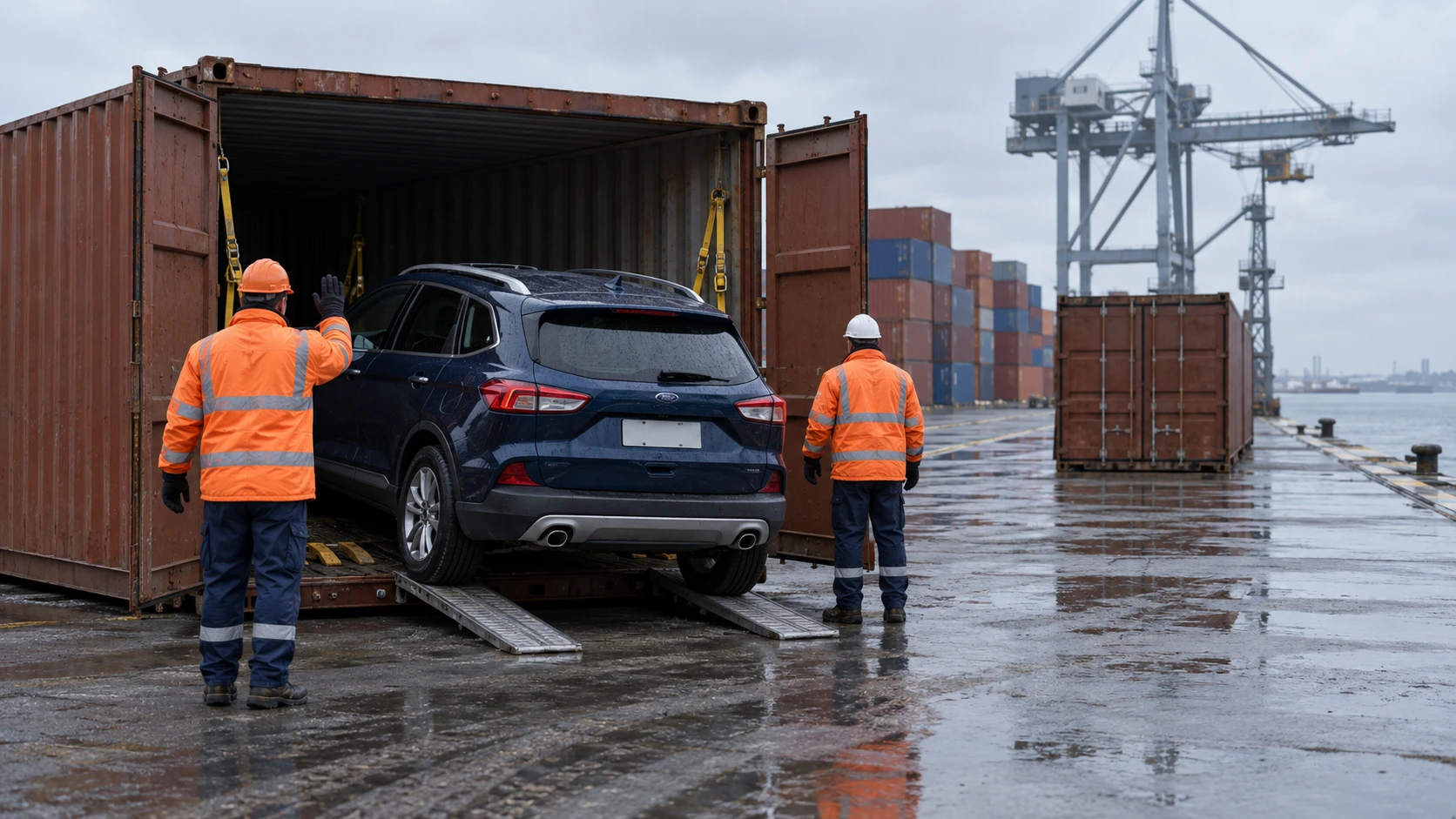
When the car arrives at the port, other expenses—such as legalization fees—are added to the costs already incurred. For a car from outside the European Union, the cost breakdown is as follows.
The buyer must pay a duty based on the car’s customs value, including shipping. The amount of the excise tax, which is paid at the next stage, depends on the engine displacement. An engine with a displacement of more than 2 liters places the car in a higher-priced category, and in this case, the difference can be quite significant. After that comes VAT, which is calculated on the total amount including customs duties and excise tax—in other words, a tax is levied on top of another tax.
Next comes a technical inspection, translation of documents, and registration with the Polish authorities, which issues license plates. If you plan to import a car not into Poland but into Ukraine, different rates for customs duties, excise taxes, and VAT will apply to you; a different calculation formula will be used, along with different rules regarding the vehicle’s age and environmental class.
When Is the Deal Truly Profitable?
Two lots may be sold at auction for the same price, but the total cost will differ. There are typically three reasons for this:
- The nature of the damage. The cost of repairing a dented fender and a deformed car frame will differ. This is due to both the cost of replacement parts and the cost of the labor itself. Even airbags that have deployed require not only the replacement of the modules themselves but also the replacement of the pyrotechnic charges, belts, and control unit, as well as diagnostic testing.
- Engine displacement. Two cars in identical condition but with different engine displacements will be classified into different vehicle categories for excise tax purposes.
- Availability of spare parts. American trim levels differ from European ones in terms of headlights, bumpers, and electronic control units. Therefore, delivery of spare parts may take several weeks, and the car will be out of service for the entire time.
That is precisely why an accurate calculation must include all cost items, including shipping, customs clearance, and repairs. And it is this total price that should be compared to the price of a comparable vehicle in Poland. If the difference remains significant after all calculations—importing a car from abroad really does make sense.
Repairs: What to Assess in Advance
Before making a decision, it’s worth analyzing photos of the vehicle to identify signs of hidden damage—gaps between body panels, misaligned headlights, or signs of work in the engine compartment. Check whether the airbags have deployed, as this is almost always a significant expense. Check whether the vehicle’s structural frame has been damaged, as this would turn cosmetic repairs into major bodywork repairs.
Who This Approach Is Suitable For—and Who It Isn’t
Buying a car at U.S. auctions is an option for those who are willing to invest time, budget their funds, and understand the details of the process. If you know how to read a VIN report, have already chosen a service center, and understand that the car will arrive in a few months, the price difference will work in your favor.
However, if you need a car that you can start driving as early as next week—without repairs or waiting—then the savings from an auction are most likely not worth the stress and time involved. In that case, it’s better to buy a car on the local market and not look for a bargain where it requires your personal involvement at every stage.