13 April 2026, 23:19
Typical mistakes in the placement of sockets that are regretted after repair - VENCONAdvertisement
Ця стаття також доступна українською

Proper placement of outlets ensures comfortable use of electricity and various household appliances. It also affects the room's interior and safety. The difficulty is that once you have marked a socket in the wall during the renovation, you cannot move it in the future. This can only be done at the repair stage. We turned to electrical specialists from the Wenkon store to get some recommendations from them. They provide advice to their customers and help them choose the right electrical goods in the vencon.ua online store.
Error 1: There are too few sockets
If too few sockets are provided, the consequences will be as follows:
- you will have to use an extension cord, which is inconvenient, spoils the interior, and obstructs the passage;
- one outlet will be constantly overloaded with appliances, and if the load is exceeded, automatic machines may be triggered.
You need to think in advance about which devices and in which places in the room you will use and provide the right number of sockets there. In some cases, it is advisable to use double or triple sockets.
Mistake 2. Placing sockets behind furniture
If a socket remains covered by large furniture that is difficult to move, it becomes either useless or dangerous. If you can't reach in and plug in the appliance, the outlet is useless. You will have to use another outlet or pull out the extension cord again. If you still manage to turn it on, but with difficulty, then the question of safety arises - in the event of a critical situation (for example, in case of a malfunction in the appliance), it will not be possible to quickly turn it off by pulling the cord.
To prevent this from happening, it is recommended that you immediately consider where heavy furniture that is usually never rearranged - cabinets, beds - will be placed. And plan the placement of sockets so that they are not fenced off.
Mistake 3. Sockets without protection in hazardous areas
Wenkon warns that when placing sockets in a humid environment and in a children's room, you need to remember that in such areas they can become a source of danger. The following will be mistakes:
- Place sockets with a moisture protection class of less than IP44 in the bathroom, near the sink and other water sources. In this case, moisture can get on them, causing injury or a short circuit.
- Do not place sockets in the children's room without protective mechanisms, such as curtains. Children can stick objects into the sockets. In the best case scenario, the result will be blocked sockets and inoperable outlets. But this can lead to injury.
Mistake 4. No outlet at the bedside
Didn't provide an outlet by the bed? You've doomed yourself to quests with an extension cord. After all, you need at least two outlets near your bedside table. One for charging your mobile gadget, the other for local lighting. If the bed is double, then you need a couple of outlets on each side.
Mistake 5. Wenkon warns against placing sockets at the wrong height
The recommended height of the socket in a living room is 25-30 cm from the floor. In the kitchen - 100-110 cm from the floor. If the socket is placed above the desktop tabletop, it is required about 10-15 cm from its surface. The height of the TV socket depends on the height of its installation - it should be located directly behind it.
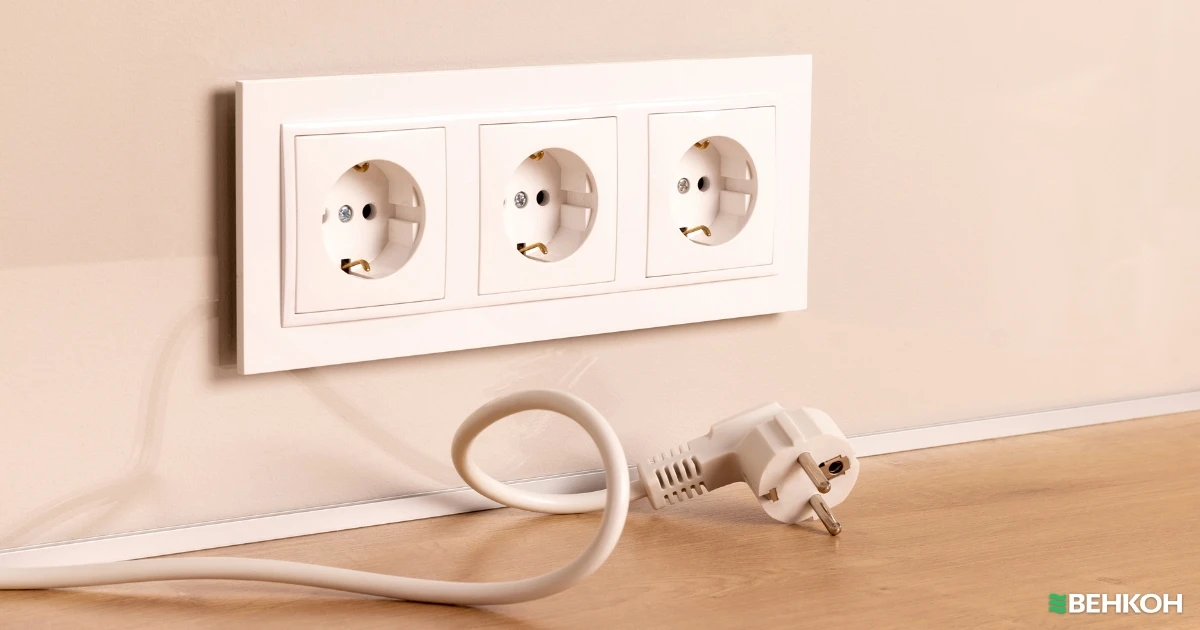
If the socket is installed at a different height, it will be inconvenient to use it. The cords of the devices will stretch along the walls and spoil the interior. Or it will be difficult to turn on the plug.
Questions and answers
What class of waterproof sockets is needed for the bathroom?
The minimum class is IP44. But if the socket is placed close to a water source, you need even more protection.
Can I install sockets near my bed?
Sockets near the bed are not only possible, but necessary. They are needed for local lighting and for charging mobile gadgets.
How to plan the placement of outlets before renovation?
When planning outlets, consider the placement of large furniture and stationary equipment. All sockets should be easily accessible and should be sufficient for each consumer without the use of extension cords.