18 May 2026, 16:00
Executive Committee urgently convened in Odesa because of shelter
Ця стаття також доступна українською

PHOTO: Olesya Lantsman/CPR
The Executive Committee of the Odesa City Council has been urgently convened for an extraordinary meeting on May 18.
According to the press service of the Odesa municipality, there is only one item on the agenda.
It concerns amendments to the decision of the Executive Committee of the Odesa City Council of June 19, 2025 "On Determining the Need of the Territorial Community of Odesa in the Fund of Civil Defense Facilities".
The amended decision stipulated that the need for civil protection structures and dual-purpose structures, as well as for the simplest shelters during the special period (the total need for the population of Odesa) is 70 class A-IV shelters that can withstand the excessive pressure of an air shock wave and provide a radiation attenuation factor. And 3,626 anti-radiation shelters. The city also needs 124 mobile shelters.
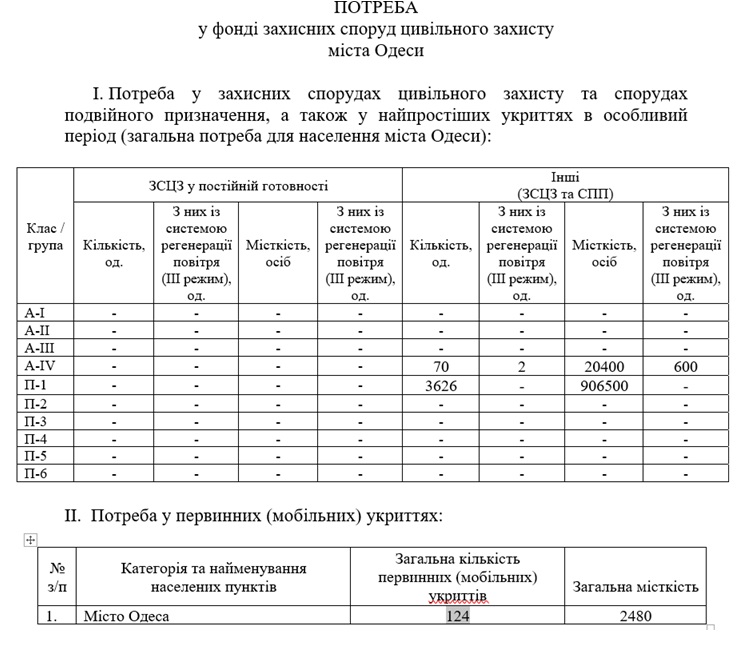
PHOTO: Appendix to the decision of the executive committee 19.06.2025
Earlier, the Center for Public Investigations found out how the situation with shelters in Odesa really is, who should determine their need, and why, even in the fourth year of the war, the city does not have a clear system. It turned out that out of the 3,696 necessary shelters and 124 mobile shelters available in the city, only 1,189 have not been solved during almost four years of full-scale invasion.
In March 2026, acting Deputy Mayor Volodymyr Krylenko reported that the number of shelters in Odesa did not meet the regulatory requirements, with a total coverage rate of 62.9%. At the time, he said that work to expand the fund of protective structures was ongoing and that 35 basements and 12 civil defense structures had already been inspected in March. Of these, seven basements were considered as possible for further activation. In March, two facilities were put into operation - two simple shelters on the Arkadiyske Plateau5 (for 50 and 100 people). Two state-owned basements and 11 communal basements were in operation.