Меню
Соціальні мережі
Розділи
Sept. 26, 2025, 1:44 p.m.
Kherson region communities in occupied territories have lost tax base and depend on state subsidies: study
This article also available in English105

IMAGE: Budgets in exile 2.0
For the communities of Kherson region, which formally retained the status of legal entities under public law after the occupation in 2022, the main challenge was the loss of tax revenues. In 2025, subsidies from the state budget will remain the main source of their funding.
This is stated in the study of the project "Budgets in Exile 2.0" implemented by the Public Partnership"For Transparent Local Budgets!" and the NGO "Siverskyi Donets Crisis Media Center ".
According to the study, in 2024, almost half of the expenditures of the temporarily occupied communities in Kherson Oblast were directed to education (45%). A significant share of funds was spent on general government functions (29%), including transfers to support military units. Social protection accounted for about 14%, while healthcare, housing and communal services, and culture together accounted for less than 15%.
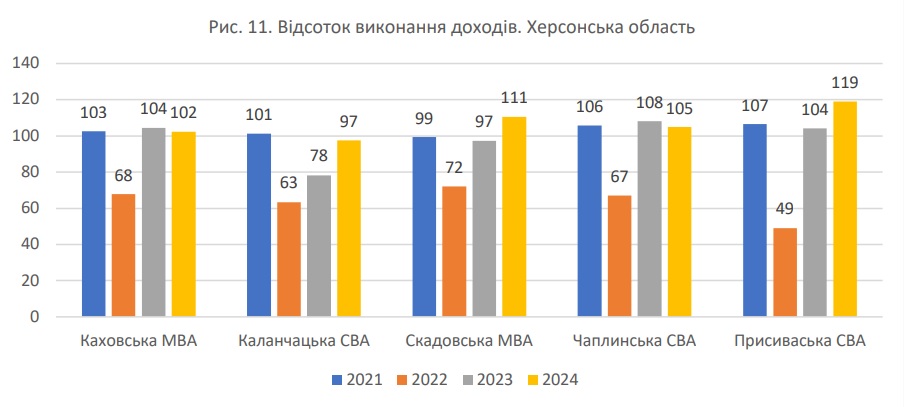
INFOGRAPHICS: Budget in exile 2.0
The tax base has virtually disappeared. While in 2021, communities received 4-5.7 thousand hryvnias per person, in 2024 this figure fell below 800 hryvnias. The worst situation is in the Prysyvaska community, where revenues amounted to only UAH 274 per person. "Grants and subventions have become a key source of livelihood, but this creates a dangerous dependence on the decisions of the central government and deprives communities of the opportunity to plan for the future," said Olena Nizhelska, lead project expert.
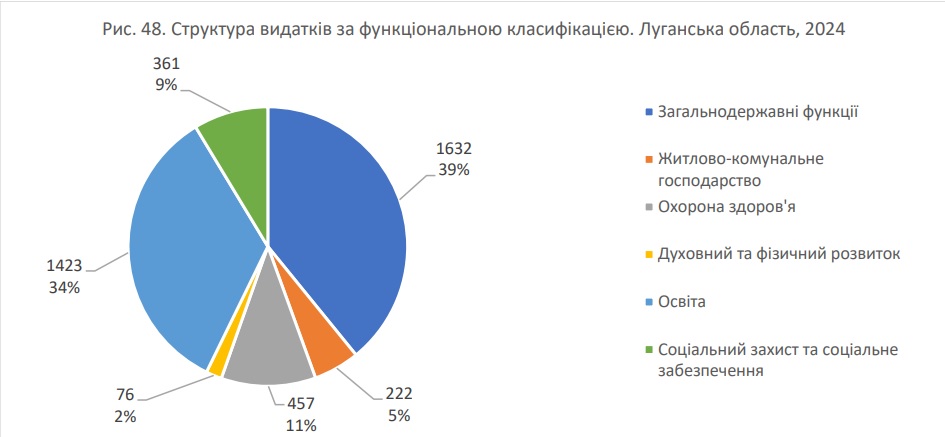
INFOGRAPHICS: Budget in exile 2.0
Another challenge, experts say, is the loss of effectiveness of traditional mechanisms of interaction with residents. In the context of relocation, communities should make more active use of remote channels, such as online reception centers, digital platforms, and information campaigns.
Despite the difficulties, education, healthcare, and culture remain the "pillars" for communities in exile. Schools provide support for children and parents, hospitals - thanks to the principle of "money follows the patient" - serve not only IDPs but also local residents in host communities. Culture has become a tool for psychological resilience and identity preservation. "Even small cultural initiatives help keep communities together and become the foundation for future recovery," the authors of the study note.
"We have a unique practice of managing communities without actual access to the territories. This complicates the processes. In addition, we do not have a single list of occupied communities. In fact, there is a survival budget in these territories," Olena Nizhelska said during the presentation.
The project studied the budgets of 20 communities in Luhansk, Donetsk, Zaporizhzhia, and Kherson oblasts that are under temporary occupation in the period from 2022 to 2024.









