Меню
Соціальні мережі
Розділи
Oct. 27, 2025, 10:07 a.m.
War-damaged forest strips restored in de-occupied community of Mykolaiv region
This article also available in English183

Forest belts. PHOTO: Suspilne Mykolaiv.
The Snihuriv community in Mykolaiv region has begun active work to restore forest belts that have been severely damaged by hostilities and the fires they caused.
This was reported by Suspilne Mykolaiv with reference to an ecologist from The HALO Trust and an expert from WWF-Ukraine.
As of October 25, two forest strips have already been planted in the community by specialized organizations. Their total area of restoration is 7,800 square meters. This work is a step towards the environmental restoration of the areas affected by Russian aggression.
Sergiy Shcherbak, an environmental expert at the international organization HALO Trust, said that the work is focused on the area where a Russian artillery unit with a field ammunition depot was located. This depot was hit by Ukrainian artillery, and the explosion scattered the ammunition across the territory.
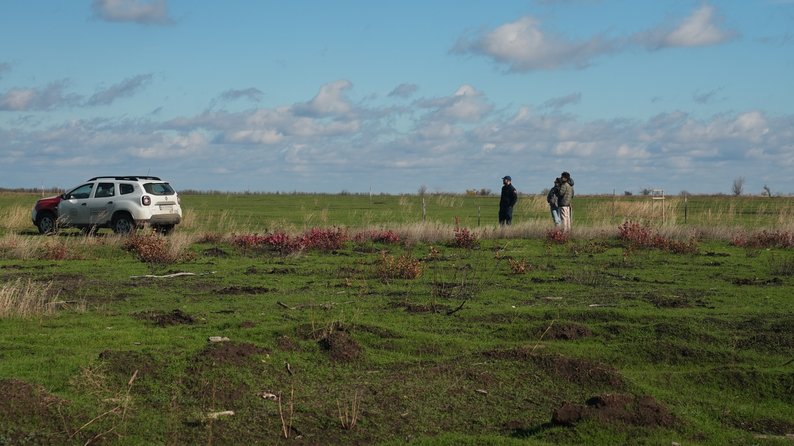
Restoration of forest belts. PHOTO: Suspilne Mykolaiv.
After the de-occupation of Snihurivka, Ukrainian sappers collected more than 300 artillery shells and more than 50 fuses. After an additional non-technical survey conducted by HALO Trust, several dozen more explosive items were found. Only after the site was completely cleared could HALO Trust, together with local authorities and the World Wildlife Fund-Ukraine, begin to develop a restoration project.
Shcherbak emphasizes that forest belts are important both in terms of preserving soil fertility and maintaining biodiversity. Oleksandr Sovakov, WWF-Ukraine's expert on forest belt restoration, said that the crops most typical for the area were chosen for planting: common oak, which was harvested with acorns and planted, as well as fruit species for the outer rows - almonds and apricots. The saplings were planted in the spring of 2025, and now local residents are helping to take care of the plants.
Oleksandr Sovakov drew the attention of Mykolaiv farmers to the significant economic importance of restoring these plantations. He noted that shelterbelts in the southern steppe region are the most effective compared to other regions. This is because the strip retains moisture, which is a critical factor for the south. Sovakov summarized that shelterbelts provide an average increase of 4 centners per hectare, and in Mykolaiv region this increase will be the most significant.