Меню
Соціальні мережі
Розділи
Feb. 21, 2026, 3:01 p.m.
Ministry of Culture removes Alexander's Column in Odesa from the register of monuments
This article also available in English11

A rally demanding the demolition of the monument in 2022. PHOTOS: Intent
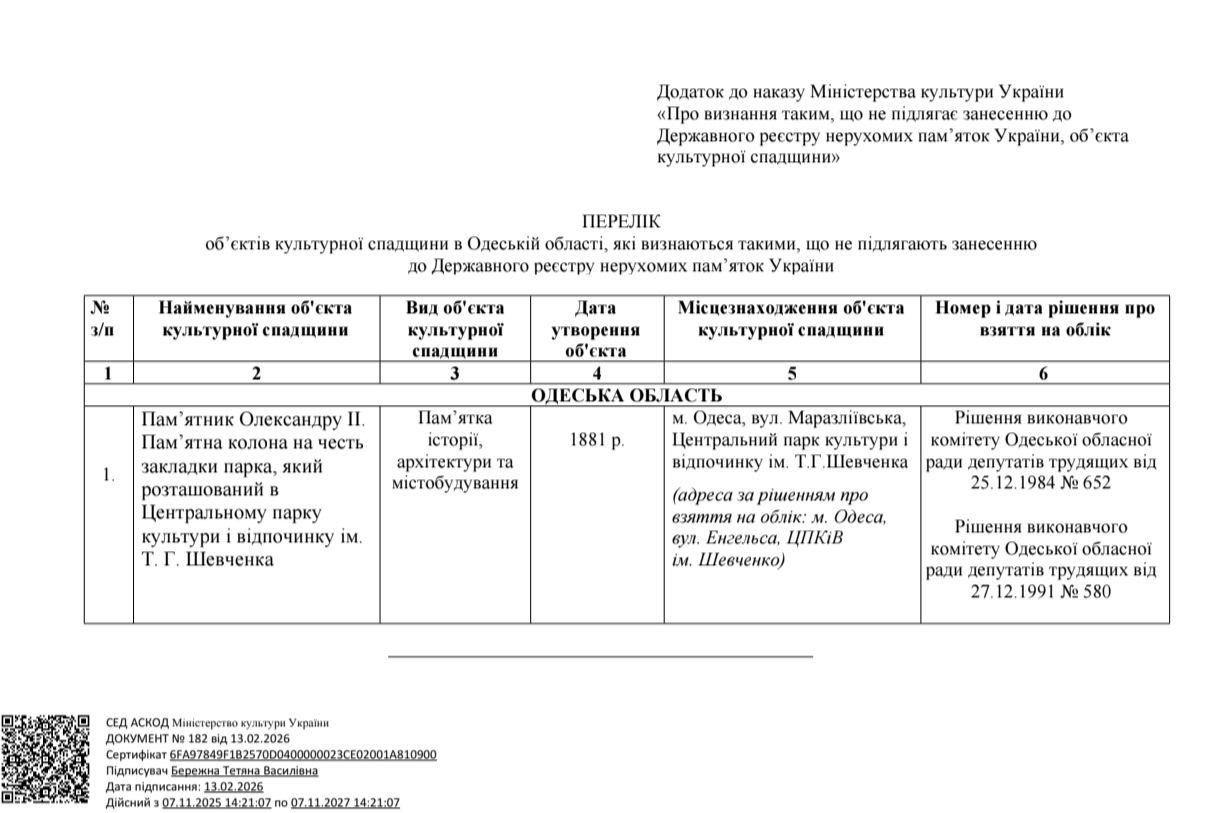
The Ministry of Culture of Ukraine has included the monument to Alexander II in Odesa in the list of cultural heritage sites that are not subject to entry in the State Register of Immovable Monuments of Ukraine.
This was reported by the NGO Decolonization. Ukraine.
The Alexander Column in Odesa is a monument erected in May 1891 at the same place where the city authorities received Emperor Alexander II in 1875, for which the Tsarist Pavilion was built, where the monarch gave permission to establish a park in his name and planted the first tree.
Themonument is built on the remains of St. Andrew's Bastion (an earthen rampart) of the border fortress of Hadjibey, which was built on this site in 1793-1794 and was abolished in 1811 "as it was recognized as incapable of defense" as the border of the Empire moved further to the southeast. In order to allow the imperial carriage to drive to the top of the rampart, it was supplemented with a ramp built specifically for this purpose, which has been preserved to this day.
After the Bolsheviks came to power, the monument was repeatedly remodeled. Monomakh's hat was removed, along with the symbols of autocracy and pre-Bolshevik Russia - a two-headed eagle, a crown, a sword, a scepter, a rod, and dedicatory inscriptions, including the name of the project's author, sculptor M. I. Barinov. The column was draped with red cloth, and a red flag was raised on a flagpole installed nearby. The monument was declared dedicated to the Third International, as the inscription and the bas-relief of Karl Marx installed on the monument indicated. The grand opening took place on June 18, 1920.
In 2012, reconstruction began to restore the monument to its original appearance. Thanks to the efforts of the city's residents and patrons, the reconstruction of the monument was completed in 2012 and timed to coincide with the City Day, which is celebrated in Odesa on September 2.