31 August 2026, 12:35
Military officials called for the date of Odessa's founding in 1794 to be abandoned
Ця стаття також доступна українською

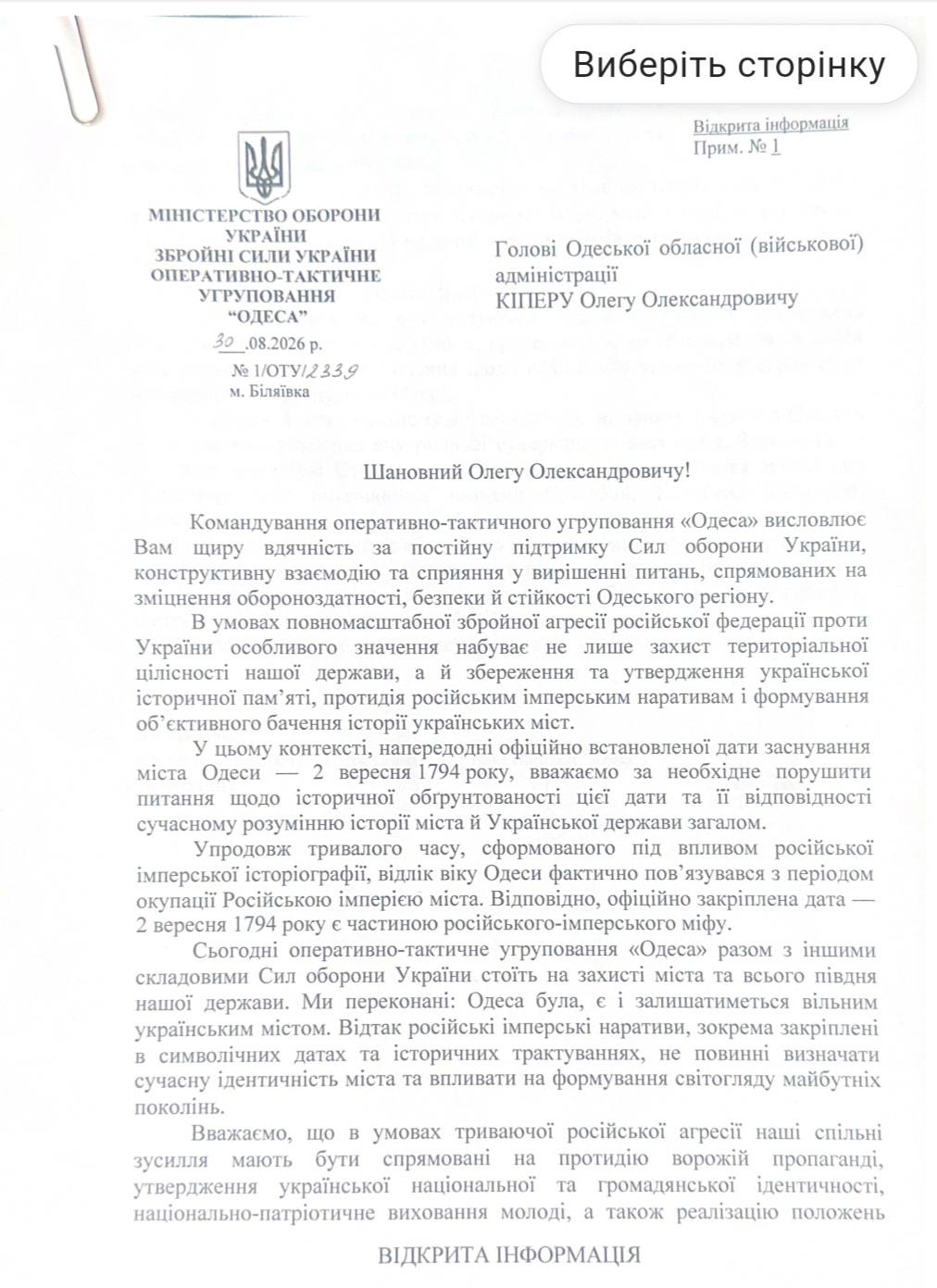
The command of the "Odessa" Operational-Tactical Group has proposed revising the officially recognized date of Odessa's founding—September 2, 1794. Colonel Denis Nosikov, commander of the “Odessa” Operational-Tactical Group, sent a letter to this effect to Serhiy Lysak, head of the Odessa City Military Administration.
This is evidenced by a document dated August 30, 2026, which Intent has obtained.
The military also addressed Oleg Kipper , head of the Odessa Regional Military Administration, and Igor Koval, acting mayor of Odessa.
In the letter, the command notes that in the context of a full-scale war, it is crucial not only to defend Ukraine’s territorial integrity but also to preserve historical memory and counter Russian imperial narratives.
The command emphasizes that the officially designated date—September 2, 1794—effectively ties the history of Odesa to the period when it was under the rule of the Russian Empire.
“Accordingly, the officially established date—September 2, 1794—is part of the Russian imperial myth,” the document states.
The authors of the letter point out that the preamble to the Odessa Charter already contains a reference to the port city under its historical names— Kochibiy, Kachibey, and Khadzhibey—dated May 19, 1415. In the command’s view, retaining both this reference and the date of 1794 in the Charter creates an internal contradiction.
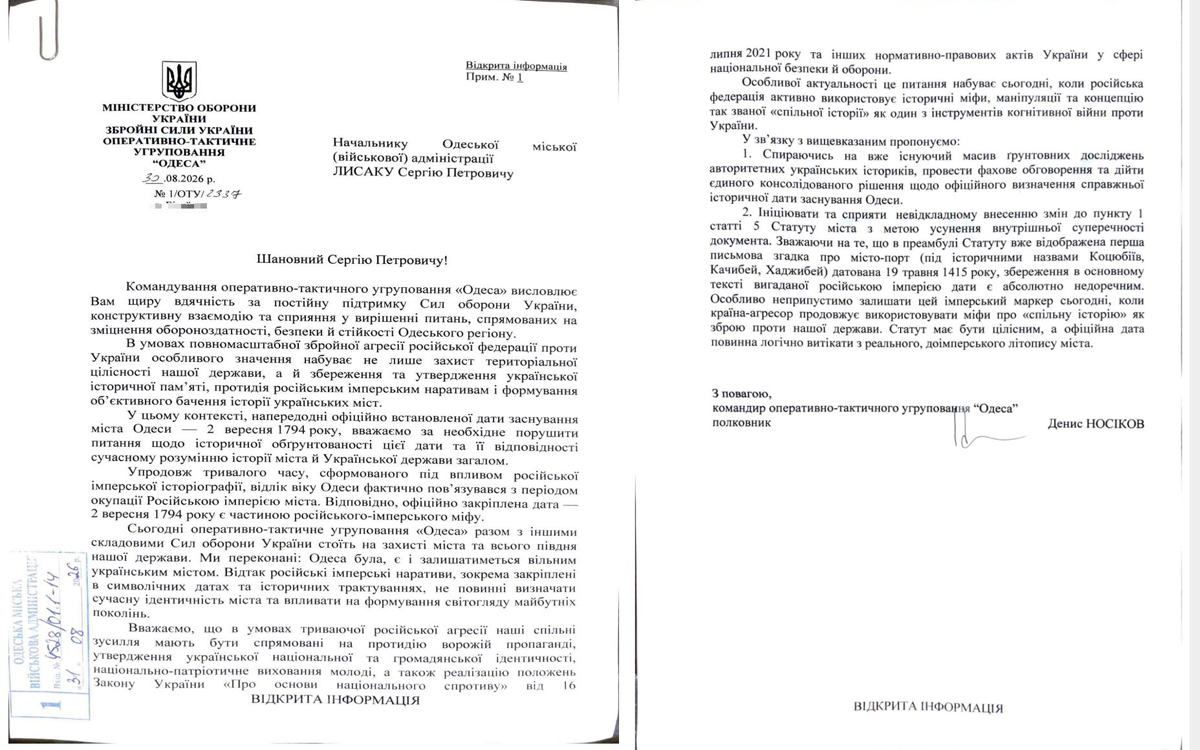
In this regard, the Odessa City Administration proposes holding an expert discussion with the participation of authoritative Ukrainian historians and, based on that discussion, adopting a consolidated decision regarding the true historical date of Odessa’s founding.
The city administration also proposes to immediately amend paragraph 1 of Article 5 of the City Charter to resolve the aforementioned contradiction.
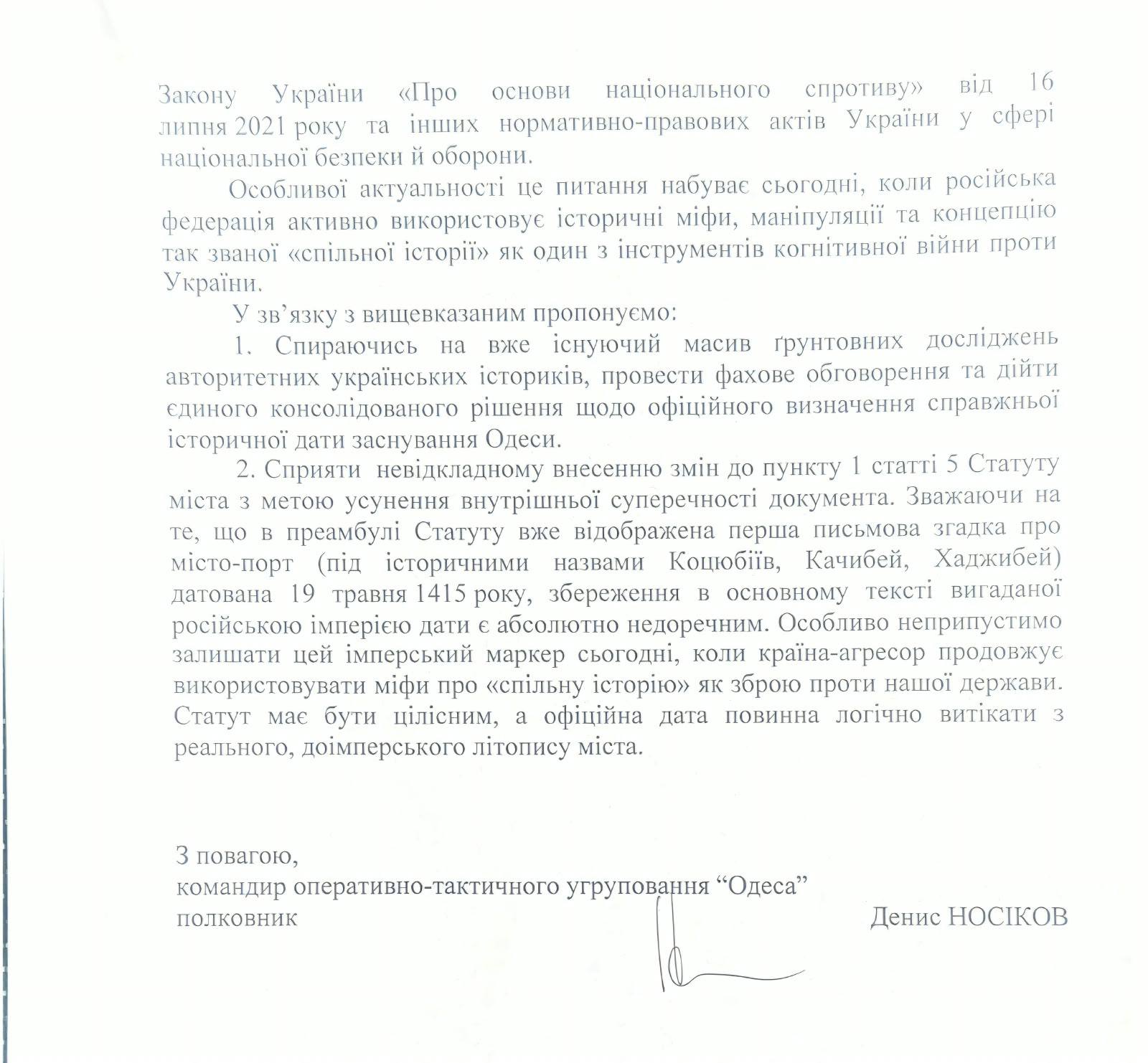
The document emphasizes that Russia uses historical myths, manipulation, and the concept of so-called “shared history” as a tool of cognitive warfare against Ukraine.
The “Odesa” Command believes that joint efforts should be directed toward countering Russian propaganda, affirming Ukrainian national and civic identity, and fostering patriotism among young people.
The letter also notes that the “Odesa” Operational-Tactical Group, together with other components of the Ukrainian Defense Forces, stands guard over Odesa and the entire southern region of Ukraine.
Earlier, an archaeologist presented evidence of Odesa’s existence prior to Catherine II. Earlier settlements existed within the city’s territory, serving various functions and linked to trade and transportation routes.
According to the archaeologist, it has long been accepted in academic circles to refer to the ancient Greek port of Istrian, the medieval city of Dzhinestra, and the Ottoman settlement of Khadzhibey as the historical predecessors of modern Odesa.