Меню
Соціальні мережі
Розділи
Sept. 16, 2025, 9:24 a.m.
YouTube blocks a writer's video about Odesa because of footage from "Liquidation"
This article also available in English155

Footage from the series that caused the video to be blocked. PHOTO: Valeriy Puzik
YouTube has blocked a podcast created by the Sixth Studio team and writer Valeriy Puzik, in which he explains how the myth of gangster Odesa was built in Soviet times with the help of cinema.
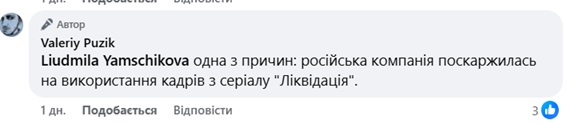
As Valeriy Puzik wrote on Facebook, one of the reasons for the blocking was a complaint from the rights holders about the use of footage from the TV series Liquidation.
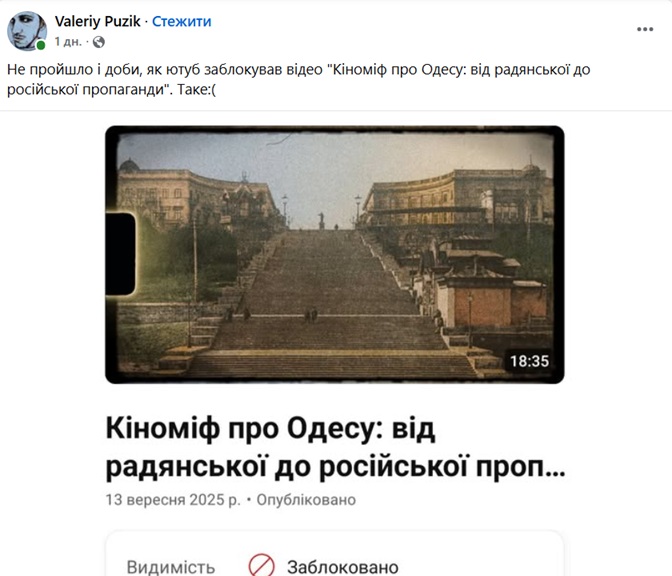
In his podcast, Valeriy Puzik focused on this film project because it was created in Soviet narratives, as a story about Odesa as an exclusively Russian city.
"For the Russian audience, it was an ideal story about a city where there was always pro-Russian fun, where there was no Ukrainian subtext, and where history was written from the point of view of the winners. The phenomenon of Liquidation was that it not only consolidated old Soviet clichés, but also modernized them, making them attractive to a modern audience: stylish pictures, charismatic actors, a post-war noir atmosphere. All this created the feeling that we were watching great art. But this aesthetic hid the main thing: the ideological reproduction of the myth of Russian Odesa," the writer emphasized.
Subsequently, Valeriy Puzyk duplicated the podcast on his channel, slightly changing the faces of the "Liquidation" actors in the footage with retouching to avoid copyright claims and a new blocking.
VIDEO: Valeriy Puzik/YouTube
In the podcast, Valeriy Puzik notes that throughout the twentieth century, Russian propaganda - first Soviet and later post-Soviet - used Odesa as a screen on which to project any narrative they wanted.
According to the writer, the film projects that pushed these narratives were created to deprive Odesa of voices that did not fit the narratives of the Soviet government.
"The myth created by Soviet cinema and literature emphasized the multinationality of Odesa, but only in a decorative sense. Thus, the myth was formed in the Soviet and post-Soviet space that Odesa was a city of laughter and crime where neither Ukrainian memory, nor Ukrainian history, nor Ukrainian culture existed. The city seems to be colorful, but devoid of its own voice, and this was the victory of imperial policy," said Valeriy Puzik.
Valeriy Puzik also believes that Mykhailo Zhvanetsky was another creator of the Odesa myth.