01 July 2026, 19:33
Odessa received the lowest integrity rating among regional capitals
Ця стаття також доступна українською

ILLUSTRATION: transparentcities.in.ua
Anti-corruption mechanisms in Ukrainian communities remain the exception rather than the rule, and so far only a few cities have demonstrated compliance with European standards. Against this backdrop, Odesa ranked last among all regional capitals.
This is evidenced by the results of a study by Transparency International Ukraine.
Transparency International Ukraine’s “Transparent Cities” program has released the results of a study on the development of integrity ecosystems and anti-corruption efforts in Ukrainian cities. Analysts assessed the extent to which local self-government meets European standards of good governance and requirements that are important for Ukraine’s European integration.
The sample included Kyiv and ten regional centers: Dnipro, Zaporizhzhia, Kropyvnytskyi, Lutsk, Lviv, Odesa, Poltava, Kharkiv, Khmelnytskyi, and Chernihiv. The assessment was based on 40 criteria, with a maximum score of 100.
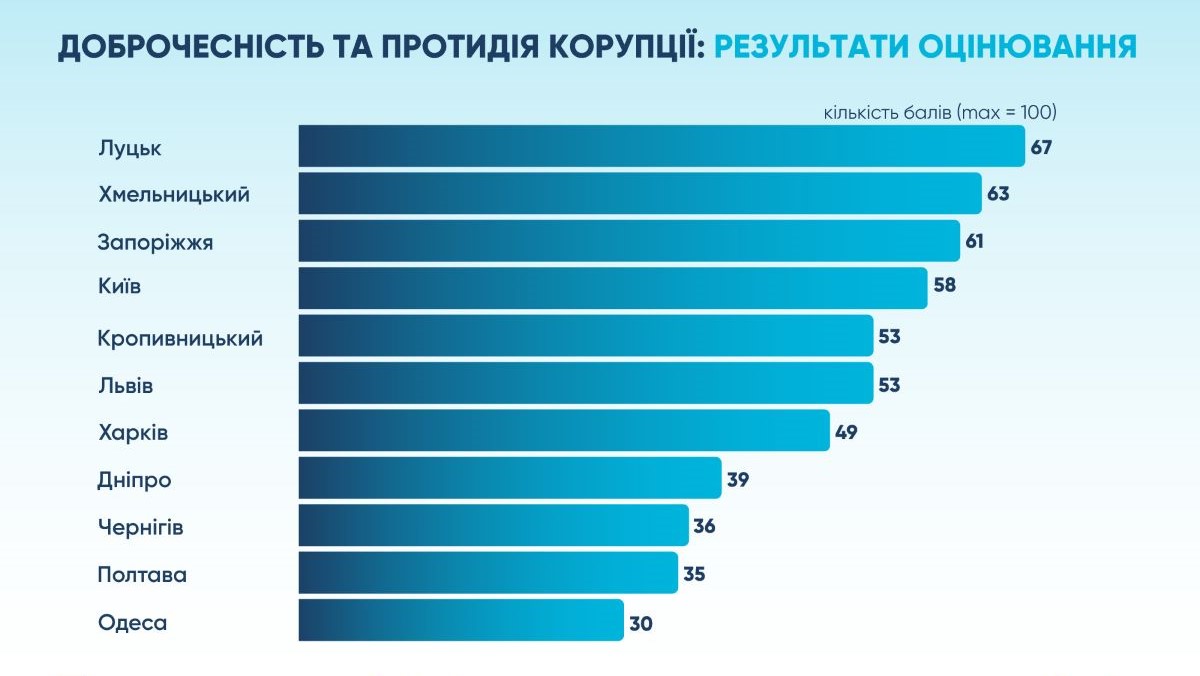
The average score for meeting the criteria among the cities studied was only 49.5%. Lutsk achieved the best result, scoring 67 points. It was followed by Khmelnytskyi with 63 points and Zaporizhzhia with 61.
Odesa, Poltava, and Chernihiv received the lowest scores. Odesa ranked last, scoring only 30 out of a possible 100 points.
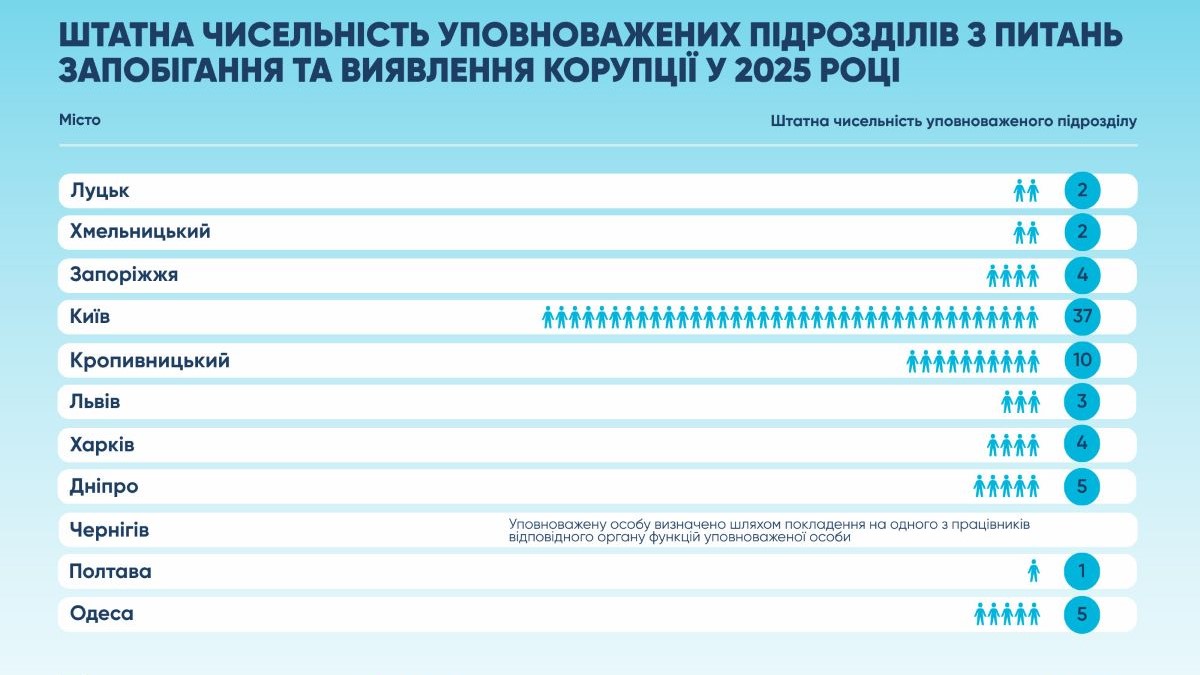
During the study, experts examined whether city councils had anti-corruption programs, specially authorized officials, codes of ethics, mechanisms for working with whistleblowers, and whether they used tools provided by the National Agency for Corruption Prevention, in particular the Unified Whistleblower Reporting Portal.
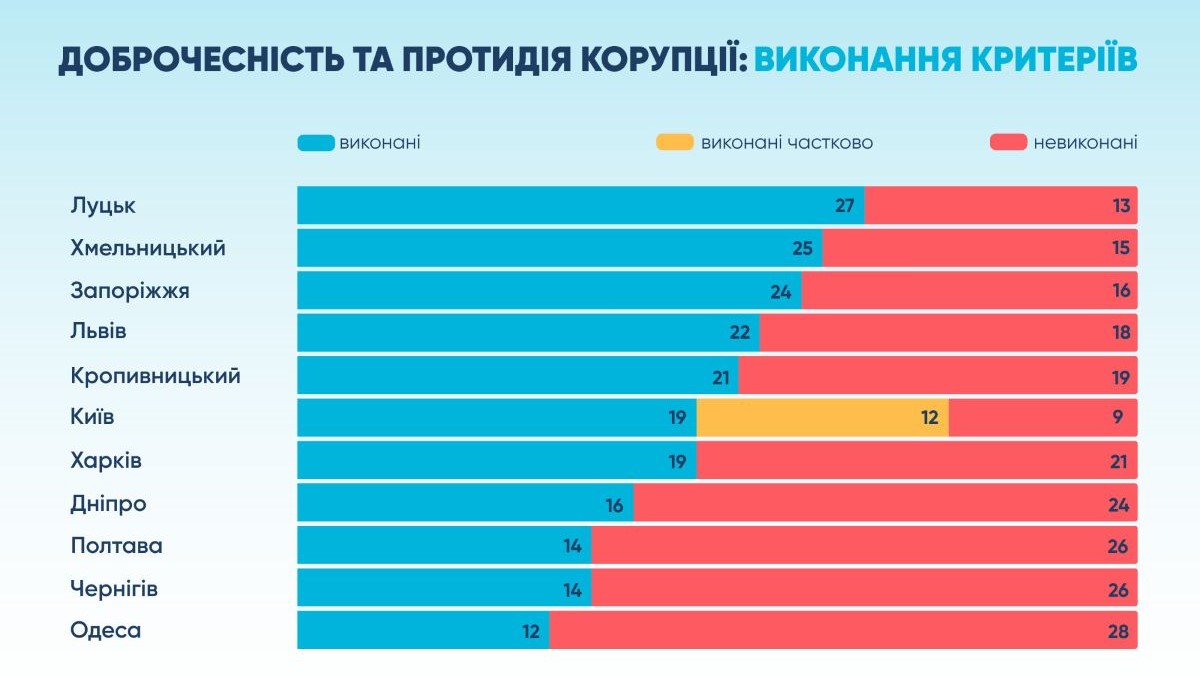
Special attention was paid to information transparency. Analysts determined whether local governments publish the results of corruption risk monitoring, information on conflicts of interest, violations of asset declaration laws, and cases where officials were held accountable.
The results showed that most city councils do not publish such data. In 2025, only Kyiv partially published the results of integrity monitoring, even though this is precisely the kind of information needed to assess the effectiveness of anti-corruption policies.
Only three cities had both active anti-corruption programs and published registers of corruption risks. Six city councils approved codes of ethics for officials, while only three did so for council members. Khmelnytskyi was the only city where all these tools were in place simultaneously.
The situation was even worse when it came to supporting whistlebl owers. Only Kropyvnytskyi and Kharkiv established comprehensive mechanisms for handling reports of corruption, approved procedures for reviewing them, and ensured that municipal enterprises and institutions were connected to the Unified Whistleblower Reporting Portal.
Olesya Koval , director of the “Transparent Cities” program, emphasized that European integration must already be implemented at the local level, since that is where citizens interact with the government on a daily basis. According to her, transparency, accountability, ethical conduct by officials, and effective management of corruption risks are no longer mere recommendations but mandatory standards against which Ukraine’s readiness for European Union membership will be assessed.
Based on the study’s findings, experts recommend that city councils go beyond merely adopting formal documents and instead establish comprehensive integrity systems. Specifically, this involves maintaining registries of corruption risks, developing anti-corruption programs, adopting codes of ethics, connecting municipal institutions to the NACP’s tools, and regularly publishing monitoring results.
Last year, Mykolaiv ranked 7th in the Transparency Ranking of Cities During Wars, while Odesa did not make it into the top ten. The study showed that transparency depends not on a city’s size or budget, but on political will and systematic efforts.